All recordingsPrices shown exclude VAT. (UK tax is not payable for deliveries to United States.) See Terms & Conditions for p&p rates. | |  | Tchaikovsky - Romances
Tchaikovsky: | Sred' shumnogo bala (Amid the din of the ball), Op. 38 No. 3 None but the lonely heart, Op. 6 No. 6 I never spoke to her, Op. 25, No. 5 Moy geni, moy angel, moy drug (My genius, my angel, my friend) Lullaby, Op. 16 No. 1 Primiren'ye (Reconciliation), Op. 25 No. 1 Zakatilos solntse (The sun has set), Op. 73 No. 4 Strashnaya minuta (The Fearful Moment), Op. 28 No. 6 The mild stars shone for us, Op. 60 No. 12 If only I had known, Op.47, No.1 The lights were being dimmed, Op. 63, No. 5 Ni slova, o drug moy (Not a word, O my friend), Op. 6 No. 2 Otchevo? (Why?), Op. 6 No. 5 Was I not a blade of grass?, Op. 47 No. 7 The gypsy song, Op. 60, No. 7 Do not believe, my friend Op. 6 No. 1 To bilo ranneyu vesnoy (It happened in the early spring), Op. 38 No. 2 The Cuckoo, Op. 54 No. 8 Den' li tsarit? (Does the day reign?), Op. 47 No. 6 Solitude ('Again, as before, alone'), Op. 73 No. 6 |
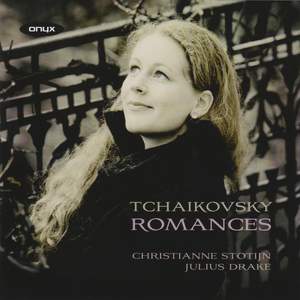
Third release on ONYX from young Dutch mezzo and rising star Christianne Stotijn Beautiful collection of 20 Tchaikovsky songs representing the whole range of his creative life from his first performed composition “My Genius, My angel, my friend,” written when we was 16, through to the last published song from the year of his death “Again, as before, alone”. Includes favourites such as “None but the Lonely Heart” and “Why?” but also rarely heard songs such as “Mild Stars Looked down”, “The Cuckoo” and “The Gypsy Song” Christianne learnt Russian especially for this recording and toured it widely before recording it with her superb pianist Julius Drake. This recording should do much to re-evaluate Tchaikovsky as one of the greatest composers of song and not just a writer of pretty tunes. “The two best-known songs open proceedings: "At the Ball", with its reminiscence of unrequited passion to the lilt of a sad waltz, and then "None but the lonely heart". Everyone conceivable from Rosa Ponselle to Frank Sinatra has recorded this, but Stotijn loses nothing in comparison with ghosts from the past. Her voice is a full-blooded mezzo but steady and true, without a hint of that vibrato that can often disturb the line in Slavonic singers... The piano parts are superbly done: in every sense these songs are duets. Tchaikovsky's songs are not nearly well enough known and this superb recital should encourage more interest in them.” Gramophone Magazine, March 2009 “…Christianne Stotijn is that artist in a thousand whose personality shines through everything she does. Her Russian characterisations and folk inflections seem spot-on in the vivid narratives of 'Had I known', 'The Bride's Lament' and 'The Cuckoo'. Here, too, as in their often wonderful Mahler recital together, Julius Drake's focused narratives make us want to hear even more from him... But Stotijn's charisma and her beautifully recorded altoish depth of tone is enough to hold me spellbound.” BBC Music Magazine, March 2009 ***** “For the most part these are angst-ridden stories of death and lost love. The two best-known songs open proceedings: 'At the Ball', with its reminiscence of unrequited passion to the lilt of a sad waltz, and then 'None but the lonely heart'. Everyone conceivable from Rosa Ponselle to Frank Sinatra has recorded this, but Stotijn loses nothing in comparison with ghosts from the past. Her voice is a full-blooded mezzo but steady and true, without a hint of that vibrato that can often disturb the line in Slavonic singers (Stotijn is from The Netherlands). The emotional climax of the selection comes with 'The Bride's Lament'. This outpouring of grief can seem over melodramatic but Stotijn and Drake find exactly the right mood. The piano parts are superbly done: in every sense these songs are duets. There are a couple of other light moments – 'Cuckoo', one of 16 children's songs composed in the 1880s, and a 'Gypsy Song' from around the same time. Tchaikovsky's songs are not nearly well enough known and this superb recital should encourage more interest in them. Highly recommended.” Gramophone Classical Music Guide, 2010 | | | In stock - usually despatched within 1 working day. |
|
|
| |  | Gerald Finley & Julius Drake
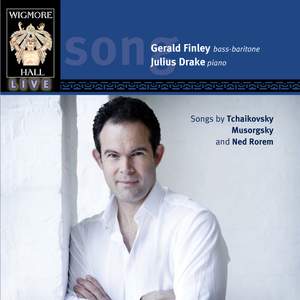
Gerald Finley writes: “It is with great sense of pride that this disc becomes the 25th release of the Wigmore Live series, in a musical partnership I have enjoyed for many years with Julius Drake. Performing at the Wigmore is always a highlight of any career. The others in the series are distinguished performers I have admired for years and the performances are wonderful. The audiences at the Wigmore are always welcoming and knowledgeable, and this atmosphere is captured perfectly. Already a fine catalogue, I hope the Wigmore Live series continues its honour roll” Critically praised for his performances both on stage and in concert, this recital of American and Russian song by Gerald Finley offers listeners the rare opportunity to hear one of today’s most in-demand baritones within the beautiful, intimate setting of the Wigmore Hall. After a recital at Carnegie Hall in March, 2007, Finley was praised by New York Times critic Bernard Holland as having a "bass-baritone of easy luxury" and that his "sensibilities begin with the pre-eminence of words." His recording of Stanford's Songs of the Sea and Songs of the Fleet with Richard Hickox and the BBC NOW for Chandos received the Editor's Choice Award at the 2006 Classic FM Gramophone Awards. Press acclaim for Gerald Finley & Julius Drake at Wigmore Hall “Gerald Finley is one of the few baritones before the public today with whom it's virtually impossible to find fault” Music OMH “No other baritone can touch him for declamatory expressiveness” The Independent “Finley and Drake paced them all tactfully, precisely mediating between relaxed storytelling and rapt introspection. Here was very fine singing of truly great songs” The Guardian “For my money this inspired pianist is now the best in the business” New York Magazine “…a really superb recital by this accomplished Canadian bass-baritone and his celebrated accompanist, Julius Drake. In recent years Gerald Finley's voice has developed more character and cutting power, and a fine dramatic edge which suits this emphatic, sometimes shocking programme very well indeed.” BBC Music Magazine, December 2008 ***** “Gerald Finley can do no wrong at present, and this Wigmore Hall Live offering makes a cherishable keepsake of what was evidently a memorable event. …Finley lavishes wonderfully rounded treatment upon the sequence of seven Tchaikovsky songs… Not only do his top notes ring out with thrilling projection... he exhibits grace, sensitivity and intelligence that ensure that the music never topples into rampant self-pity.” Gramophone Magazine, February 2009 “Aided by scrupulous support from Julius Drake, Gerald Finley lavishes wonderfully rounded treatment upon the sequence of seven Tchaikovsky songs that open proceedings. Be it in the ardent swagger of 'Don Juan's Serenade', wistful glow of 'At the ball' or meltingly lovely 'The mild stars shone for us', Finley is not found wanting. Not only do his top notes ring out with thrilling projection (yet without a hint of hardness), he exhibits a grace, sensitivity and intelligence that ensure that the music never topples into rampant self-pity. There's a comparable authority and integrity about these artists' interpretation of Mussorgsky's Songs and Dances of Death. Finley is in complete command of his very considerable resources, distilling every ounce of pathos from the mother's desperate pleadings in the opening 'Lullaby' and conveying in full the grim implacability of 'The Field-Marshal' . Ned Rorem's similarly declamatory War Scenes is also performed with total understanding, while the last of the three encores, Wolseley Charles's wickedly amusing TheGreen-Eyed Dragon (written in 1926 for Stanley Holloway), predictably brings the house down. A genuine treat, this, and not to be missed.” Gramophone Classical Music Guide, 2010 | | | In stock - usually despatched within 1 working day. |
|
|
| |  | Tchaikovsky: Romances
Tchaikovsky: | Sred' shumnogo bala (Amid the din of the ball), Op. 38 No. 3 The mild stars shone for us, Op. 60 No. 12 Merknet slaby svet svechi, Op. 73 No. 2 My mischief, Op. 27, No. 6 Strashnaya minuta (The Fearful Moment), Op. 28 No. 6 Serenada Don-Zhuana (Don Juan's Serenade), Op. 38 No. 1 Les Larmes, Op. 65 No. 5 Wait, Op. 16 No. 2 None but the lonely heart, Op. 6 No. 6 Had my mother borne me, Op. 27, No. 5 Déception, Op. 65 No. 2 Podvig (The Heroic Deed), Op. 60 No. 11 Zakatilos solntse (The sun has set), Op. 73 No. 4 Lullaby in a storm, Op. 54 No. 10 Sérénade, Op. 65 No. 1 The Nightingale Op. 60 No. 4 The gypsy song, Op. 60, No. 7 Skazhi, o chom v teni vetvey (Tell me, what in the shade of the branches), Op. 57 No. 1 We sat with you, Op. 73 No. 1 To bilo ranneyu vesnoy (It happened in the early spring), Op. 38 No. 2 Blagoslavlyayu vas, lesa (I Bless you, Forests), Op. 47 No. 5 Charmer, Op. 65 No. 6 Na nivi zhyoltiye (On the golden cornfields), Op. 57 No.2 So bald vergessen, Op. 28, No. 4 The lights were being dimmed, Op. 63, No. 5 Rastvoril ya okno (I opened the window), Op. 63 No. 2 Sred mrachnïkh dnei, Op. 73, No. 5 Zabït tak skoro (So soon forgotten) Sleep, my poor friend, Op.47, No. 4 Qu'importe que l'hiver, Op. 65 No. 4 Solitude ('Again, as before, alone'), Op. 73 No. 6 Was I not a blade of grass?, Op. 47 No. 7 A tear trembles, Op. 6 No. 4 Khotel bi v edinoye slovo (I should like in a single word) Sérénade: J'aime dans le rayon de la limpide aurore, Op. 65 No. 3 Why did I dream of you?, Op. 28 No. 3 Primiren'ye (Reconciliation), Op. 25 No. 1 Hear at least once, Op. 16, No. 3 Den' li tsarit? (Does the day reign?), Op. 47 No. 6 |
Tchaikovsky wrote over 100 romances, settings of short poems, which are touching and sincere. The melodies are diverse and original and the accompaniment is rich and often very independent. These compositions are performed here by some outstanding Russian vocalists. As well as those listed above, the recording includes performances by the tenor Lemshev. | | | Usually despatched in 2 - 3 working days. |
|
|
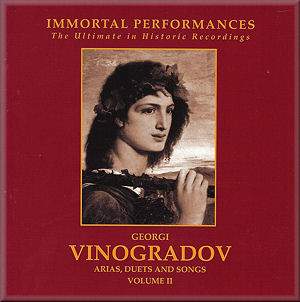
| |  | Georgi Vinogradov: Arias, Duets and Songs Vol. 2
Abaza: | Foggy Morning | Alexandrovich: | It was only a dream | Baron-Timofeeva: | The Weeping Willows Slumber | Blanter: | In the Forest by the Front Line | Bogoslovsky: | Dark Night | Bulakhov: | Burn, My Star, Burn Naduty gubki dlia ugrozy (A dainty mouth pursed in anger) On parting she spoke Do Not Awaken Memories | Dargomïzhsky: | Vanka-tanka | Dubuque: | Do kiss me, my darling Do not repeat those words | Glinka: | O say why did you come? Tell me why! How sweet it is for me to be with you I am here, Inezilla Oh, do not say that your heart aches The Poor Singer You will never come again | Gounod: | De grâce demeurez… Ange adorable (Roméo et Juliette) | Gubkin: | When you look at him | Gurilyov, A: | The Lovely Bird Has Flown | Ippolitov-Ivanov: | In the Wonderful Night (from Ole the Norseman) | Ludyanovic: | Elegy | Millöcker: | Ich knüpfte manche zarte Bande (from Der Bettelstudent) | Mussorgsky: | Why my sad heart? (from Sorochinsky Fair) | Nisnevich: | My guitar | Novikov: | Roads | Prigozhin: | Darling | Rachmaninov: | Night is sorrowful, Op. 26 No.12 Let us leave, my sweet, Op. 26 No. 5 | Rimsky Korsakov: | Beauty, Op. 51 No. 4 | Rossini: | Ecco, ridente in cielo (from Il Barbiere di Siviglia) Se il mio nome (from Il Barbiere di Siviglia) | Rubinstein: | Azra, Op. 32 No. 6 Volkslied, Op. 48 No. 12 ('The Sun is Shining') On desirés soft fleeting wing (from The Demon) | Schubert: | Die schöne Müllerin, D795 | Schumann: | Meine Rose, Op. 90 No. 2 Der Nussbaum, Op. 25 No. 3 Mit Myrten und Rosen (No. 9 from Liederkreis, Op. 24) | Shiryaiev: | Moonlit night | Shishkin: | Always and everywhere I follow you | Sokolov, V T: | The sea and my heart | Solovyov-Sedoy: | Golden Lights | Taneyev: | How you caress, silvery night, Op. 18 No. 1 | Tchaikovsky: | Kuda, Kuda 'Lensky's Aria' (from Eugene Onegin) The mild stars shone for us, Op. 60 No. 12 Lullaby in a storm, Op. 54 No. 10 Spring, Op 54 No. 9 Spring Song, Op. 54 No. 13 My little garden, Op. 54 No. 4 The grass grows green, Op. 54 No. 3 | Thomas, Ambroise: | Mignon - Excerpts | Titov, A: | I knew her as a child | trad.: | The Grass in the Meadow By the River in the Meadow The Steppe All Around The Grass Withers on the Steppe Black Eyes You never loved me Look at me The Black-eyed girl | Varlamov: | O Do Not Kiss Me Grass | Vasilenko: | Armenian Serenade Malayan Serenade | Voloshin: | A twig of lilac |
Georgi Vinogradov (tenor) | | | Usually despatched in 8 - 10 working days. |
|
|
| |
|