Prices shown exclude VAT. (UK tax is not payable for deliveries to United States.) See Terms & Conditions for p&p rates. | |  | Bach - Cantatas
Agnes Giebel, Sheila Armstrong, Rotraus Hansmann (sopranos), Julia Falk, Helen Watts (altos), Bert van t’Hoff, Kurt Equiluz (tenors) & Jacques Villisech, Max van Egmond (basses) Monteverdi Choir Hamburg, Jürgen Jürgens “Patches of engaging music-making here, though giving more insight into 1960s Hamburg than 1720s Leipzig. Choruses are often woolly, soloists vary from off-the-voice big voices to insecure, boyish sounds.” BBC Music Magazine, March 2009 *** | | | In stock - usually despatched within 1 working day. |
|
|
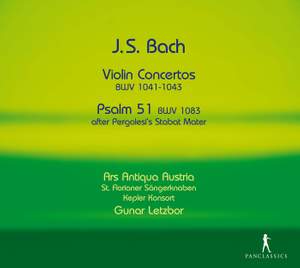
| |  | JS Bach: Violin Concertos BWV1041-1043
Gunar Letzbor, Daniel Sepec (violins) St. Florianer Sängerknaben, Kepler Konsort & Ars Antiqua Austria The ensemble Ars Antiqua Austria under the direction of the violinist Gunar Letzbor devote this double CD to Bach's instrumental and vocal works with reissued recordings originating from 1995 and 1996. CD 1 features the two Violin Concertos BWV1041 and 1042, with Letzbor as soloist, and the Double Violin concerto, in which Daniel Sepec takes on the equal role of second soloist. These works are augmented by Brandenburg Concerto No. 4, in which the concertino group includes not only solo violin but also two recorders, performed with great virtuosity and sinuous tone by Kees Boeke and Michael Oman. Bach’s arrangement of the Pergolesi 'Stabat Mater' known as Psalm 51 is seldom performed. Bach replaced Pergolesi’s text of the 'Stabat Mater' with the Lutheran translation of Psalm 51 and undertook a number of alterations to both vocal and instrumental parts. Bach attached great importance to the exact musical illustration of individual words of the text, producing an orchestral score with greater complexity and more heightened contrasts than the original Pergolesi. The special feature of this recording is the assignment of the St. Florianer Sängerknaben boys’ choir from which the excellent soloists have also been recruited. The CD also includes 'Himmelskönig, sei willkommen' in which the male vocal parts are sung by the Kepler Consort. | | | (also available to download from $21.00) | Usually despatched in 3 - 4 working days. (Available now to download.) |
|
|
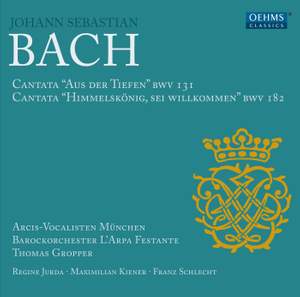
| |  | JS Bach: Cantatas BWV131 & BWV182
Regine Jurda (alto), Maximilian Kiener (tenor), Franz Schlecht (bass) L'Arpa Festante & Arcis-Vocalisten Munchen, Thomas Gropper The 50 members of Arcis-Vocalisten München are all professionally trained and the choir is complemented by students from the Academy of Theatre and Music in Munich. Here they bring their experience to two early cantatas by Bach. | | | (also available to download from $10.50) | Usually despatched in 2 - 3 working days. (Available now to download.) |
|
|
| |  | JS Bach: Three Weimar Cantatas
| | | (also available to download from $10.50) | Usually despatched in 2 - 3 working days. (Available now to download.) |
|
|
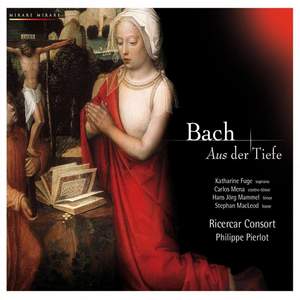
| |  | Bach - Aus der Tieffen
The Ricercar Consort have already been awarded a Radio 3 disc of the Week and a Gramophone Editor's Choice for their Bach recordings for Mirare. Here they present three sacred cantatas, among the earliest written by the young Johann Sebastian in his first posts as Kapellmeister in Mühlausen and Weimar, for Easter. They display the heritage and influence of the old master Buxtehude, but also the force, the modernity, and the genius of the future Kantor. “Pierlot's instrumentalists are pleasingly attuned to each other's declamatory needs, resulting in a well-balanced and lucidly coloured ensemble. He favours the one-voice-to-a-part approach which works well in the generally lighter textures of Bach's earliest cantatas. His four soloists, ever aware of Bach's imaginative work painting, are excellent in their declamatory fervour both in a solo capacity and in ensemble.” BBC Music Magazine, September 2009 ***** | | | Usually despatched in 3 - 4 working days. |
|
|
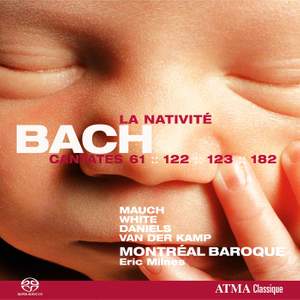
| |  | Bach - Cantatas Volume 4Cantatas for the Nativity
This is the fourth release in ATMA’s ambitious project to record all the sacred cantatas of JS Bach in conjunction with the annual Montréal Baroque Festival. This cycle is unique in two significant ways: in keeping with the latest scholarship on Bach’s own performances, the choral sections are sung by the four soloists, one to a part; it is also the first-ever Bach cantata cycle to be recorded in surround sound. | | | (also available to download from $10.50) | Usually despatched in 2 - 3 working days. (Available now to download.) |
|
|
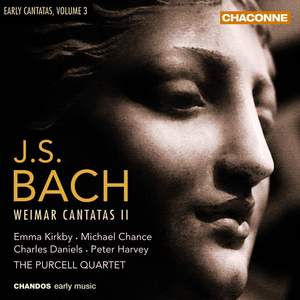
| | .jpg) | Bach - Early Cantatas Volume 3Weimer Cantatas II
This 2-CD set with The Purcell Quartet and a distinguished group of soloists is the third in a series devoted to Bach’s early cantatas and the second focussing on the Weimar period. On an earlier release, International Record Review wrote, ‘The Purcell Quartet and guests are most welcome: even the most distinguished of period performers with larger ensembles can’t achieve the intimacy that the forces here have at their disposal’. Uniquely, but following historical precedent, The Purcell Quartet employs single voices, rather than a choir. The stance is still controversial, but recreates the works as they would have been performed originally, and therefore stands out from the more conventional approach, the product of subsequent developments of massed choral singing. Accompanied by The Purcell Quartet and their guest instrumentalists are the vocal soloists Emma Kirkby, Michael Chance, Charles Daniels and Peter Harvey. Individual vocal and instrumental lines are allowed to be heard to their full effect, which greatly enhances the impact and meaning of the cantata texts. This programme contains three cantatas dating from 1714, the year in which Bach was promoted to the post of Konzertmeister at the ducal court in Weimar. His responsibilities now included the composition of concerted sacred vocal music, including the writing of cantatas at regular intervals for Sundays and feast days of the liturgical year. Bach performed all three works collected on this pair of discs several times. They are presented here as they would have been heard in Weimar at their 1714 performances. The first two works, Erschallet, ihr Lieder, BWV 172 and Himmelskönig, sei willkommen, BWV 182, have much in common in tone and atmosphere: both are essentially jubilant at the prospect of the heavenly eternity awaiting the good Christian at the end of his life, and the images of the Trinity led Bach to employ three trumpets in BWV 172. In BWV 182 there is, instead of trumpets and drums, an intimate conversation principally between violin and recorder. The jubilant mood of these two cantatas is juxtaposed with that of Ich hatte viel Bekümmernis, BWV 21, which exudes a feeling of despair, only for Bach to bring in trumpets and drums at the end as hope gradually begins to dawn. The Weimar cantatas of J.S. Bach form an exceptional body of work and it is thrilling to hear them performed in a way that Bach would have recognised, and by artists respected in the early music field. We offer this set at the price of two CDs for one. “Out to impress, Bach's instrumental imagination soared in these works. …the playing is consistently rewarding, more so than the singing which at its most persuasive is ravishing, but (excepting Peter Harvey) is not without the odd hint of strain. Still there are marvellous things from all, and this version of BWV 21 sustains greater presence than Masaaki.” BBC Music Magazine, November 2008 **** | | | (also available to download from $21.00) | Usually despatched in 2 - 3 working days. (Available now to download.) |
|
|
| |  | J S Bach - Easter CantatasA reproduction - with the exception of the Passion - of the musical programme Bach offered in 1724, his first year as Thomaskantor in Leipzig, to cover the period from 24th March (the Annunciation) to 11th April (the third day of Easter).
Barbara Schlick, Sibylla Rubens, Caroline Stam (soprano), Kai Wessel, Bernhard Landauer, Michael Chance (alto), Guy de Mey, Christoph Pregardien, Paul Agnew (tenor), Klaus Mertens (bass) The Amsterdam Baroque Orchestra & Choir, Ton Koopman | | | Usually despatched in 4 - 5 working days. |
|
|
| |  | Bach Cantatas Volume 21Cantatas for Quinquagesima, Annunciation, Palm Sunday, Oculi
Ruth Holton, Claudia Schubert, James Oxley, Peter Harvey, Malin Hartelius, Nathalie Stutzmann, James Gilchrist The Monteverdi Choir, The English Baroque Soloists, The Choirs of Clare and Trinity Colleges, Cambridge, John Eliot Gardiner “Perhaps most appealing in Gardiner's direction is the unfailing delight he takes in refreshing Bach's dance rhythms without ever trivialising textural content.” BBC Music Magazine, April 2006 ***** “This eclectic selection covers works for Quinquagesima, the Annunciation, Palm Sunday and Oculi (the third Sunday in Lent) in arguably the least even of the seven releases so far. Yet there are significant contributions smattered throughout, not least Nathalie Stutzmann's purpleclad Widerstehe (No 54). This true contralto imparts a captivating resilience in the face of sin's devious tricks. Inspired by the chamber-like ecclesiastical works of Bach's Weimar period, the reduced string ensemble lends a similar intimacy to No 182, though both works suffer from some scrappy playing that clearly could not be rectified simply by dropping in 'patches' from before or after. Stutzmann, however, projects just the right sense of involvement without forcing the issue. Wie schön leuchtet der Morgenstern (No 1) is the major work here – a masterpiece of understated majesty and gentle celebration (for the Annunciation) where Bach appears to alight on the morning star as a direct resonance of Epiphany; such musical connections within the cantata oeuvre, throughout the church calendar, provide listeners with endless sources of fascination. Gardiner's performance is more an example of a splendid occasion captured rather than a notable addition to a distinguished discography. Cantatas Nos 22 and 23 were Bach's first to have been performed at Leipzig, audition pieces for the post of Thomascantor before his eventual appointment. Both were performed in the same service on the morning of February 7, 1723. Given the Lenten context, Bach hardly had a chance to flex his muscles in opulent displays of orchestration but he makes up for this with two pieces of subtle stylistic range. Jesus nahm zu sich die Zwölfe (No 22) is strikingly prescient of Passion narrative as Christ prepares for his death with melismas of distilled sadness and acceptance of destiny. Peter Harvey's is an affecting performance, as is the incrementally impressive Du wahrerGott (No 23), of which Gardiner completely has the measure. One special movement to bottle? 'Es ist vollbracht' from No 159 – arguably even better than the setting of the words at the end of the St JohnPassion. Heartfelt singing from Harvey is adorned by playing from oboist Marcel Ponseele which is as exquisite as you'll ever hear.” Gramophone Classical Music Guide, 2010 “One special movement to bottle? 'Es ist vollbracht' from BWV159 - arguably even better than the setting of the words at the end of the St John Passion. Heartfelt singing from Harvey is adorned by playing from oboist Marcel Ponseele which is an exquisite as you'll ever hear.” Gramophone Magazine, May 2006 | |
|
| |  | Bach - Cantatas Volume 3
| | | (also available to download from $10.50) | Usually despatched in 2 - 3 working days. (Available now to download.) |
|
|
| |
|