Marx: Ständchen (No. 2 from Italienisches Liederbuch) (Serenade)
This page lists our only recording of Ständchen (No. 2 from Italienisches Liederbuch) (Serenade), by Joseph Marx (1882-1964) on CD & download (MP3 & FLAC).
Prices shown exclude VAT. (UK tax is not payable for deliveries to United States.) See Terms & Conditions for p&p rates.
In stock - usually despatched within 1 working day.
The Austrian composer Joseph Marx was for much of his long career a musical authority of world renown. Within his large output, his songs were amongst his greatest musical achievements, unifying romanticism, impressionism and expressionism with revolutionary results. Many thought him the rightful successor to Hugo Wolf and yet today the name and music of Joseph Marx have fallen into obscurity.
The ‘Marx style’ is unmistakable. It is characterised by a highly personal compositional technique displaying a polyphonic harmony of full sonority, allied to masterly contrapuntal skills, and frequent key changes which occur apparently at random but are in fact distributed with utter logic. The music strikes the listener as timeless, refreshingly modern and, above all, surprising, able to exploit tonal means of expression to the full and raise the spirits of every true lover of melody.
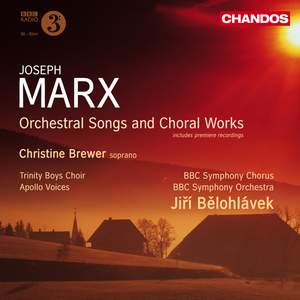
Chandos’ Record of the Month sees Jirí Belohlávek conduct the BBC Symphony Orchestra in the long overdue premiere of four choral works, along with the first complete recording of Marx’s orchestral songs for soprano, performed by Christine Brewer.
Three works are of particular note. Herbstchor an Pan, a single-movement cantata written in 1911, lasts very nearly twenty minutes and was Marx’s first, and for many years only, orchestral composition. It has inexplicably fallen into oblivion in the past five decades. However, it has turned out to be one of the masterpieces of its entire era. Ein Neujahrshymnus (A Hymn for the New Year) is richly orchestrated and demonstrates the profound romantic vein of Joseph Marx; it is here performed for the first time in its orchestral version. This disc represents not only the first recording of Berghymne but also its world premiere performance.
We are indebted to the Marx Society for their efforts to promote this composer, and allowing the wider public to hear the outstanding quality of his works. The greatness of the music is indisputable and this recording will make for an important addition to the classical music catalogue.
Joseph Marx: Herbstchor an Pan (Autumn Chorus to Pan)
Willst du es nicht glauben - sie knarren und stampfen und pressen Wein - Frist haben wir, nur mehr Frist
Der grosse Flurgott, trunken und schwer - es spielen die flitternden Birken voll Gold
Gramlich dahinter dehnt sich der grosse Pan - Nein, du muder Flurgott, nein!
Ziemlich langsam - Belebend - Kehr in dich! Kehr ein! - Etwas breiter
Joseph Marx: Barkarole
Barkarole
Joseph Marx: Zigeuner (Gypsy)
Zigeuner (Gypsy)
Joseph Marx: Der bescheidene Schafer (The unassuming Shepherd)
Der bescheidene Schafer (The unassuming Shepherd)
Joseph Marx: Selige Nacht
Selige Nacht
Joseph Marx: Sommerlied (Summer Song)
Sommerlied (Summer Song)
Joseph Marx: Marienlied (Song of Mary)
Marienlied (Song of Mary)
Joseph Marx: Maienbluten (May Blossoms)
Maienbluten (May Blossoms)
Joseph Marx: Waldseligkeit (Bliss in the Woods)
Waldseligkeit (Bliss in the Woods)
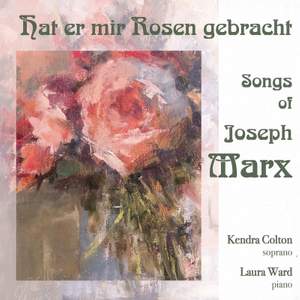
Joseph Marx: Und gestern hat er mir Rosen gebracht (He brought me roses yesterday)
Und gestern hat er mir Rosen gebracht (He brought me roses yesterday)
Joseph Marx: Piemontesisches Volkslied (Piemontesian Folk Song)
Piemontesisches Volkslied (Piemontesian Folk Song)
Joseph Marx: Standchen (Serenade)
Standchen (Serenade)
Joseph Marx: Hat Dich die Liebe beruhrt (If love hath entered thy heart)
Hat Dich die Liebe beruhrt (If love hath entered thy heart)
Joseph Marx: Morgengesang (Morning Chant) (orch. A. Wassermann)
Morgengesang (Morning Chant) (orch. A. Wassermann)
Joseph Marx: Berghymne (Mountain Hymn) (arr. for mixed choir and orchestra)
Berghymne (Mountain Hymn) (arr. for mixed choir and orchestra)
Joseph Marx: Ein Neujahrshymnus (A New Year's Hymn) (arr. for mixed choir and orchestra)
Ein Neujahrshymnus (A New Year's Hymn) (arr. for mixed choir and orchestra)
February 2009
****
“The luxuriantly recorded Chandos disc is particularly welcome for featuring premiere recordings of four relatively early choral pieces including the lavishly scored Herbstchor an Pan… Performed here with considerable emotional conviction by Jirí Belohlávek and the massed forces of the Trinity Boys Choir and the BBC Symphony Chorus and Orchestra, it is by far the most striking of these works... Those drawn to the creamy sonorities of a soprano voice soaring above a lush orchestral fabric will find much to savour in Christine Brewer's warm and ecstatic renditions of 'Barkarole', 'Selige Nacht' and 'Sommerlied'...”
March 2009
“Post-Wagnerian richness and lush harmony marks Marx's orchestral songs. Christine Brewer has the floating purity of voice to soar easily over Marx's beautifully judged textures in for instance "Selige Nacht" and "Maienblüten", both rapt in manner and unashamedly reflective, the latter suggesting the atmosphere of Strauss's Four Last Songs.”
2010
“The most substantial work in this selection of Joseph Marx's orchestral songs and choral pieces is the Herbstchor an Pan ('Autumn Hymn to Pan'), his first orchestral work (1911) but one in which his easy mastery of a rich instrumental palette is already evident. His idiom was formed early and changed little: indeed, he had little sympathy with change, and notoriously failed to mention Schoenberg, Berg or even Hindemith when he brought out Weltsprache Musik, a book of aesthetics and philosophy, in the last year of his life, 1964. It should be no surprise, then, to find that here is a rich, post-Wagnerian manner, luscious in harmony and sensuous in orchestration. Christine Brewer has the floating purity of voice to soar easily over Marx's beautifully judged textures in, for instance Selige Nacht and Maienblüten, both rapt in manner and unashamedly reflective, the latter suggesting the atmosphere of Strauss's Four Last Songs. Some similarity betwen Marx and Delius suggests that they had both moved away from Wagnerian harmony in comparable directions, influenced by a pantheistic response to nature: lovers of Delius's SeaDrift may appreciate the harmonic flavour and modulatory side-slips of the Herbstchor an Pan. It is in this vein that Marx seems at his most effective; the more exuberant songs sound rather laboured and their jollity contrived. Belohlávek draws a suitably rich manner from the orchestra and gives Brewer loyal support with textures that are full but always lucid, and served well by the recording.”
Click on any of the works listed above for alternative recordings.