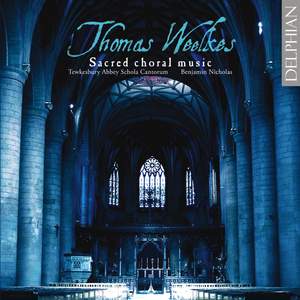
Thomas Weelkes is remembered as one of the outstanding English composers of the 17th century. This survey of Weelkes' services, verse anthems and sacred madrigals features first recordings of several works in new reconstructions by scholar Peter James. Benjamin Nicholas' Tewkesbury choir delivers telling performances passionately conveying the range, imagination and technical accomplishment of Weelkes' settings.
"It is very hard not to use superlatives when speaking of Ben Nicholas and his choir at Tewkesbury Abbey." Choir Schools Today 2008
“Committed performances reveal Tudor church music in it strongest colours. Weelkes is a composer to make you think again, and Tewkesbury Abbey currently has the choir to present him in strongest colours and with the most personal accent. The trebles splendidly vindicate the tradition that places them at the heart of English cathedral music. The men's voices are also powerful and resonant and the total effect is rich and forthright. Fine solo work and neat organ-playing are further assets, as is the introductory note by Dr Peter James.” Gramophone Magazine, April 2009
“There remains an intensity of passionate utterance in the most striking of Weelkes's works, balanced by a sober moderation in much else. He himself, as we learn from contemporary accounts, was not characterised by either moderation or sobriety, at least in his latter years, coming to his choir 'from the Taverne or Ale house' cursing and swearing 'most dreadfully'. You would never guess as much from the decorous verse anthems and evening canticles, but the intensity of the lament O Jonathan, which opens the present recital, might suggest a less bridled temperament, as might the concentrated fervour of Hosanna to the Son of David, which closes it.
Under Benjamin Nicholas, director of Tewkesbury Abbey's Schola Cantorum, the choir has developed a strong style, remarkable for its sense of personal (or corporate) commitment as for the sonority of its tone and the assurance of its delivery. The trebles splendidly vindicate the tradition that places them at the heart of English cathedral music. The men's voices are also powerful and resonant and the total effect is rich and forthright. If anything, the 'standard' level of volume is set too high – it is not until the sixth item, O how amiable are thy dwellings, that we find reassurance that the choir can sing quietly. Fine solo work and neat organ-playing are further assets, as is the introductory note by Dr Peter James.” Gramophone Classical Music Guide, 2010
“angelic purity” The Guardian, December 2007