Chaminade: Sombrero (1894) – Edouard Guinand

This page lists all recordings of Sombrero (1894) – Edouard Guinand, by Cécile Chaminade (1857-1944) on CD.

Prices shown exclude VAT. (UK tax is not payable for deliveries to United States.)
See Terms & Conditions for p&p rates.

Philippe Jaroussky: The Voice

Philippe Jaroussky: The Voice


anon.:

Ninna nanna di Gesù bambino

Bach, J C:

Ebben si vada...lo ti lascio: Ebben si vada

Orfeo ed Euridice: La legge accetto, o Dei

Sentimi, non partir...Al mio bene - Rondo: Al mio bene

Bassani, G B:

Ardendo sospiro (from In caligine umbrosa)

Bononcini, G B:

Chi d'Amor tra le catene

Caldara:

Tutto fa nocchiero (Ifigenia in Aulide)

Non tremar vassallo indegno (Temistocle)

Tutti nemici e rei (Adriano in Siria)

Chaminade:

Sombrero (1894) – Edouard Guinand

Fauré:

Requiem: Pie Jesu

Hahn, R:

A Chloris

Handel:

Scherza, infida (from Ariodante)

Ombra mai fu (from Serse)

Venti turbini (Rinaldo)

Mi lusinga il dolce affetto (from Alcina)

Lekeu:

Sur une tombe

Mattioli:

Ave Regina coelorum

Monteverdi:

Laudate Dominum

Pur ti miro (I gaze upon you) from L'Incoronazione di Poppea

Piazzólla:

Los Pajaros Perdidos

Porpora:

Alto Giove (from Polifemo)

Siface: Tu che d’ardire m’attendi

Purcell:

Music for a while, Z583

Rossi, Luigi:

Lasciate averno (from Orfeo)

Sances:

Stabat Mater: O quam tristis

Vivaldi:

Vanne perdida... Frà le procelle from Tito Manlio

Sento con qual diletto (from Ercole sul Termodonte)

Cantata RV676 'Pianti, sospiri e dimandar mercede': Cor ingrato dispietato

Vedro con mio diletto (from Giustino)

Mentre dormi amor fomenti from L’Olimpiade

Sento in seno from Tieteberga


Philippe Jaroussky (countertenor)

Philippe Jaroussky, described by Germany’s Die Zeit as “the Apollo of countertenors’, stands out among his many talented contemporaries as much for the soprano-like beauty of his tone as for the elegance and insight of his interpretations and his adventurous and erudite approach to repertoire – whether unearthing neglected scores by little-known composers or venturing beyond the Baroque into the 19th and 20th centuries.

Established as one of Virgin Classics’ bestselling artists, Jaroussky, now aged 34, has been honoured three times in the Victoires de la Musique awards in his native France and has also received Germany’s most prominent music prize, the Echo Klassik. His diverse achievements are saluted in two new collections on Virgin Classics – the 2CD set “The Voice” and the DVD and Blu Ray “La Voix des rêves: Greatest moments in Concert”.

“THE VOICE” 2 CD Best of Philippe Jaroussky comprises 31 tracks chosen by the singer himself and six previously unreleased tracks of music by Handel and Purcell. Vivaldi takes pride of place on the album, but other composers include Caldara, Porpora and JC Bach and, from later eras, Fauré, Reynaldo Hahn and even Argentina’s King of Tango, Ástor Piazzolla.

Virgin - 6026602

(CD - 2 discs)

$19.75

In stock - usually despatched within 1 working day.

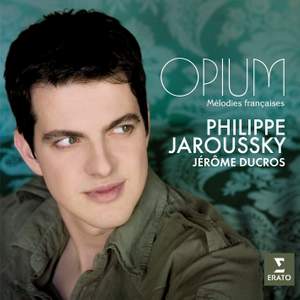
Opium (Mélodies Françaises)

Opium (Mélodies Françaises)


Caplet:

Viens, une flûte invisible soupire

Chaminade:

Sombrero (1894) – Edouard Guinand

Mignonne, à l'amour j'ai lié

Chausson:

Le temps des lilas

Debussy:

Romance

Dukas:

Sonnet – Ronsard

Dupont, G:

Les donneurs de sérénade

Fauré:

Automne, Op. 18 No. 3

Franck, C:

Nocturne

Hahn, R:

A Chloris

Fêtes galantes

Quand je fus pris au pavillon

Offrande

L'heure exquise

Indy:

Lied maritime

Lekeu:

Sur une tombe

Massenet:

Elégie

Nuit d'Espagne

Saint-Saëns:

Tournoiement ‘Songe d’opium’ Op. 26, No. 6

Violins dans le soir (de Noilles)


Philippe Jaroussky (contertenor) & Jérôme Ducros (piano)

Unsurprisingly, it is in the music of the Baroque era – the heyday of the castrato – that French countertenor Philippe Jaroussky has captured the attention of music-lovers lovers around the world. The ethereal, but sensuous beauty of his voice, his virtuosity and his sense of style have brought him critical praise, a number of major awards – including, in 2008, Germany’s prestigious Echo-Klassik prize for Male Singer of the Year, honouring his Virgin Classics album, Carestini: The Story of a Castrato – and impressive sales: more than 120,000 copies of his Vivaldi album Heroes and 90,000 of the Carestini release.

Jaroussky enters new territory with this programme of French songs from the late 19th and early 20th centuries – well over a hundred years after the end of the Baroque era. Taking its name, Opium, from a song by Saint-Saëns, it evokes the voluptuous, sometimes decadent spirit of the Belle Époque, the era of transition between Romanticism and Modernism. The programme includes a number of rarities by composers such as Dukas, Caplet, and Chaminade, as well as better-known numbers by figures like Fauré, Chausson and Hahn.

“Many people will probably wonder why a counter tenor should sing these songs,” says Jaroussky, “but if you think about it, the countertenor voice as such has no repertoire of its own, except the modern music written specifically for it. For the most part we sing music written for castratos who – as we know – had very different voices from ours. So why not venture into other musical worlds if we feel they are suited to our voices? … There has been David Daniels in Schubert, Max Emmanuel Cencic in Rossini, and even Andreas Scholl and Gérard Lesne in pop music.

“I’ve always felt a special affinity for French song, which was an area of focus in the early days of my studies with my teacher, Nicole Fallien. It was Renaud Capuçon -- whom I want to thank, along with Gautier Capuçon and Emmanuel Pahud for his valuable contribution to this disc -- who first had the idea of inviting me to sing Hahn, Chausson, Fauré in a recital. It was then that I met the pianist Jérôme Ducros, and we decided to work further on this rich and well-stocked repertoire, which contains some real undiscovered treasures. There is no theme to this album, but I wanted to record songs which have captured my heart and which suit my voice. Perhaps I can show them in a new light too.”

French song demands an acute sense of language and style, and today there are relatively few singers --- even native Francophones – who succeed in capturing its elusive magic. “I’ve decided to pronounce the texts in a way that is as close as possible to the spoken word – I don’t roll the ‘r’, for example,” continues Jaroussky. “The poetry should come to life without the imposition of too much interpretation or emotional contrivance. I’ve tried to approach it with humility.”

"Philippe Jaroussky is one of the best countertenors around. His voice is mellow, evenly toned, wide-ranging and largely free from intrusive mannerism and vocal strain” BBC Music Magazine, February 2007

“Philippe Jaroussky has a wide pitch range and absolute control throughout, with no tenseness at the top of hooting at the bottom, and his floated high notes are ravishing. Jérôme Ducros's accompanying is some of the best I have heard.” BBC Music Magazine, April 2009 ****

“His repertoire is fabulous, mixing gold star favourites with striking curios by non-song composers such as Dukas. The instrumental back-up from Jerome Ducros, the Capuçon brothers and Emmanuel Pahud is superb.” The Times, 28th March 2009 ***

Virgin - 2166212

(CD)

$12.50

In stock - usually despatched within 1 working day.

Copyright © 2002-13 Presto Classical Limited, all rights reserved.