All recordingsPrices shown exclude VAT. (UK tax is not payable for deliveries to United States.) See Terms & Conditions for p&p rates. | |  | Italia 1600 Argentina 1900
Verónica Cangemi was born in Mendoza, Argentina and was a cellist in the Mendoza Symphonic Orchestra before winning both the National Singing Competition in Argentina and the Francisco Viñas Competition in Barcelona. Her first European performance was in Gluck’s Armide with Les Musiciens du Louvre. She has concentrated largely on Mozart and the Baroque repertoire, working with such directors and ensembles as Giovanni Antonini, Ivor Bolton, William Christie, Adam Fischer, Nikolaus Harnoncourt, René Jacobs, Ton Koopman, Sir Neville Marriner and Zubin Mehta. The Baroque pieces on the album contain highly virtuosic music by composers like Nicola Porpora that would have been performed by the great castrato Farinelli, as well as arias by Vivaldi and Handel renowned for their challenging vocal lines. The Latin flavour of the disc is complemented by the inclusion of 20th century pieces by Piazzolla, Guastavino and Villa-Lobos all of whom hail from Cangemi’s native South America. | | | (also available to download from $10.50) | Usually despatched in 3 - 4 working days. (Available now to download.) |
|
|
| |  | The Art of Magdalena Kozena
Auber: | Le Domino noir: 'Je suis sauvée enfin - Ah! quelle nuit - Flamme vengeresse' Mahler Chamber Orchestra, Marc Minkowski | Bach, J C: | Lamento 'Ach daß ich Wassers gnug hätte' Musica antiqua Köln, Reinhard Goebel | Bach, J S: | Cantata BWV208 'Was mir behagt, ist nur die muntre Jagd!' Musica Florea, Marek Stryncl Mass in B minor, BWV232: Laudamus Te Musica Florea, Marek Stryncl | Bizet: | Les tringles des sistres tintaient (from Carmen) Mahler Chamber Orchestra, Marc Minkowski | Dvorak: | Biblical Songs, Op. 99: Slýs, ó, Boze Berliner Philharmoniker, Simon Rattle Biblical Songs, Op. 99: Hospodin Jest muj Pastýr Berliner Philharmoniker, Simon Rattle Biblical Songs, Op. 99: Boze, boze, pisen novou Berliner Philharmoniker, Simon Rattle Zajatá from Moravské dvojzpevy (Moravian Duets) with Dorothea Röschmann & Malcolm Martineau (piano) Prsten from Moravské dvojzpevy (Moravian Duets) with Dorothea Röschmann & Malcolm Martineau (piano) | Gounod: | Nuit resplendissante (from Cinq-Mars) Mahler Chamber Orchestra, Marc Minkowski | Handel: | Lascia ch'io pianga (from Rinaldo) Venice Baroque Orchestra, Andrea Marcon Dopo notte (from Ariodante) Venice Baroque Orchestra, Andrea Marcon Scherza, infida (from Ariodante) Venice Baroque Orchestra, Andrea Marcon | Janacek: | Lavecka (Bench) with Malcolm Martineau (piano) Moravian Folk Poetry: 12. Jabúcko with Malcolm Martineau (piano) Muzikanti [Musicians] with Malcolm Martineau (piano) | Kapsberger: | Felici gl'animi Private Musicke, Pierre Pitzl | Mahler: | Rheinlegendchen (Des Knaben Wunderhorn) Cleveland Orchestra, Pierre Boulez Lob des hohen Verstandes (Des Knaben Wunderhorn) Cleveland Orchestra, Pierre Boulez Um Mitternacht (Rückert-Lieder) Berliner Philharmoniker, Simon Rattle | Monteverdi: | Libro Nono di Magrigali e Canzonette: Si dolce è'l tormento Private Musicke, Pierre Pitzl | Mozart: | Non so più cosa son, cosa faccio (from Le nozze di Figaro) Orchestra of the Age of Enlightenment, Simon Rattle Voi che sapete (from Le nozze di Figaro) Orchestra of the Age of Enlightenment, Simon Rattle | Ravel: | Shéhérazade: Asie Berliner Philharmoniker, Simon Rattle | Rösler: | An die Entfernte with Malcolm Martineau (piano) | Strozzi: | L'Eraclito amoroso 'Udite amanti' Private Musicke, Pierre Pitzl | trad.: | Kebych bola jahodú | Vitali, F: | Bei lumi Private Musicke, Pierre Pitzl | Vivaldi: | Anderò, volerò, griderò (from Orlando finto pazzo) Venice Baroque Orchestra, Andrea Marcon Armatae face et anguibus (from Juditha Triumphans) Venice Baroque Orchestra, Andrea Marcon Gelido in ogni vena (from Il Farnace, RV711) Venice Baroque Orchestra, Andrea Marcon |
The Art of Magdalena Kožená is an anthology of her finest performances, documenting both the range of her voice and the breadth of repertoire to which she can bring authority, from early baroque of Monteverdi and Strozzi to sacred arias by Bach, opera arias by Handel, Vivaldi, Mozart, Gounod, Bizet and Auber, as well as orchestral songs by Mahler. To all she brings an absorbing emotional depth and maturity of her interpretative abilities. Unique to Kožená are the songs rooted in Bohemia and Moravia by Dvořak and Janáček. She still feels closely connected to her Czech roots. “It’s music that stays in your body forever”. This is Magdalena’s own selection of her favourite songs and arias, sung in French, Italian and German as well as in her mother tongue. 28-page Booklet, including new liner notes from Nick Kimberley. | 
| | | In stock - usually despatched within 1 working day. |
|
|
| |  | Sogno Barocco (Baroque Dream)
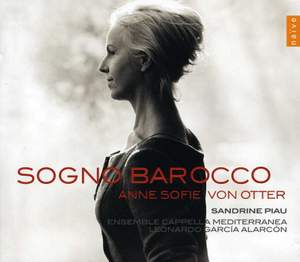
Following the best-seller 'Love Songs' with Brad Mehldau and a new recording of Berlioz’s 'Les Nuits d’été' with Marc Minkowski, 'Sogno Barocco' is the third project from eclectic Swedish mezzo-soprano Anne Sofie von Otter on naïve, which she toured 2010-11. Dedicated to early Italian opera protagonists such as Poppea, Penelope, Diana and Helena, this clever programme gathers baroque hit duets such as “Si Dolce è’l tormento” or “Pur ti miro” and the previously unreleased Provenzale cantata or Rossi’s Lamento of the Swedish Queen . . . This delicate and subtle series of baroque jewels is performed with an amazing cast, starring French soprano Sandrine Piau, in 3 breathtaking duets, and baroque rising-star conductor Leonardo García Alarcón, one of the current darlings of Italian baroque. This new release is offered with a 76-page booklet including complete sung texts and essays by Von Otter, Alarcón and musicologist Vincent Borel. It also includes 3 instrumental pieces by Cavalli in world premiere recordings. “Sogno Barocco is themed around female heroines of early Italian opera,
particularly those afflicted with what Francesco Cavalli, in "Vivo per Te",
calls "my resplendent pain".” The Independent, 15th September 2012 **** “Her voice shows little sign of wear and tear...Her still plush mezzo entwines ravishingly with Sandrine Piau’s brighter soprano, but the most remarkable parts of her “baroque dream” are Rossi’s Lament of the Swedish Queen and Provenzale’s astonishing parody of it.” Sunday Times, 21st October 2012 “von Otter’s ability to reinvent herself with the passing years is something to marvel at … compelling singing and playing...in the past she has had a reputation for coolness, but there is fire in her delivery of these passionate soliloquies...She is capable of earthiness, too, in the wheedling, street-singer timbre she summons up for Provenzale's 'Squarciato appena havea'” International Record Review, December 2012 “the mood of this CD is pleasingly melancholy, with von Otter’s many years of experience feeding into profound readings of some lovely music” Early Music Review, December 2012 “Every rhetorical device is skilfully exploited, every phrase glows...For many listeners, however, Von Otter's duets with Sandrine Piau will be the highlight. Stylistically, temperamentally and in terms of timbre, the two voices are a sensational match. Rarely have 'Pur ti miro' or 'Dolcissimi baci' sounded so erotic.” BBC Music Magazine, January 2013 ***** “Von Otter has a whale of a time [in Squarciato appena] and the instrumentalists join in with a chorus at the end. The exuberance is reminiscent of Christina Pluhar's L'arpeggiata. The excerpts from L'incoronazione di Poppea appear out of sequence. Particularly ravishing is 'Pur ti miro', von Otter's rich but not heavy tone erotically entwined with the equally passionate soprano of Sandrine Piau...A strange disc, oddly memorable.” Gramophone Magazine, February 2013 BBC Music Magazine
Opera Choice - January 2013 |
| | | (also available to download from $10.50) | In stock - usually despatched within 1 working day. |
|
|
| |  | Monteverdi: Arie et Lamenti; Madrigali Guerrieri et Amorosi
This set gathers 2 albums released in 1990 and 1994. Each of them definitely established Montserrat Figueras as one of the best performers of Claudio Monteverdi’s vocal music. At this time, she developed an innovative style of interpretation, characterised by great fidelity to historical sources, combined with an extraordinary creative and expressive power, that has exerted a decisive influence on the whole historical music movement. Vocal music before 1800 required a new technical and stylistic approach capable of restoring to the beauty and emotion of the voice, that most human of all forms of expression, the necessary balance between singing and declamation, with an emphasis on the poetic and spiritual dimension of the text. She is accompanied by Jordi Savall on CD1 and Ton Koopman on CD2. | | | In stock - usually despatched within 1 working day. |
|
|
| |  | Magdalena Kozená: Lettere Amorose
Magdalena Kožená explores the early Italian Baroque music of Monteverdi and his contemporaries with rewarding results. Inspired by the improvisational nature of much of this music, Kožená reveals yet another aspect of her musical personality. Teamed with the six string-instrumentalists and percussion of the acclaimed consort group Private Musicke, Magdalena Kožená delivers an album in a fascinatingly different setting from any of her previous Baroque recordings. In music ranging from simple lamento to rollicking dance tunes, Magdalena Kožená unleashes her refined vocal and expressive abilities to convey every nuance implicit in the music and the texts. “The Czech mezzo . . . produces one of the loveliest sounds to be heard on the world’s stages – a flowing, spring-water-like tone that evokes the term ‘luminous’.” (Opera News) “She soars the heights and plumbs the depths with fitting ardour...it is hard not to be swept away by such intensity felt and highly dramatic readings...[Pitzl] and his crack instrumental ensemble enrich the spare simplicity of the written scores with endlessly varied and inventive realisations...These are vibrant, virtuoso performances, never slacking in their spontaneity and energy.” BBC Music Magazine, November 2010 ***** “Her voice...is as mellifluous and pliable as ever, light and translucent in the upper reaches while brooding and dark in the lower ones...[Private Musicke] provides an imaginative and inventive accompaniment.” Gramophone Magazine, Awards Issue 2010 “If you agree that all interpretation is improvisation...then Kožená's thoroughly dramatic approach to the texts, enhanced by tasteful ornamentation, displays just as much freedom and ingenuity...In short, this is an exceptional release, the beauty and flexibility of Kožená's voice perfectly complemented by Private Musicke's intimate yet colourfully extrovert accompaniments.” International Record Review, December 2010 BBC Music Magazine
Choral & Song Choice - November 2010 |
| | | In stock - usually despatched within 1 working day. |
|
|
| |  | Monteverdi - Teatro d'Amore
This, L’Arpeggiata’s first release on Virgin Classics, explores music by Claudio Monteverdi, blending instruments and voices – including those of countertenor Philippe Jaroussky and soprano Núria Rial in a kind of intoxicating baroque jam session. It includes the final duet from L’incoronazione di Poppea, often cited as one of the most sensuous and beautiful love scenes in all opera. Founded in 2000, L’Arpeggiata is a French-based ensemble directed by Austrian-born harpist and lutenist Christina Pluhar. Its members, some of the leading European soloists in their field, join forces with exceptional singers from the worlds of baroque and traditional music. The group’s particular focus is on French, Italian and Neapolitan music of the 17th century and it works with often daring instrumental improvisations, exploiting rich textures created by blending a variety of plucked instruments, and a vocal style influenced by traditional music. The group tours extensively and its recordings on Alpha and Naïve have sold over 200,000 copies. Christina Pluhar describes L’Arpeggiata as "an international cocktail of musicians with lots of character. There is a basic ensemble of regular players and then they are joined by other performers for each project. I choose not to work with the same singers all the time, preferring to give myself the option of looking for voices that seem to me to be perfect for specific repertoire … There are so many different ways of using the human voice and I think there is so much experimentation one can do, even in early music. When I’m accompanying vocal music, I try to go as far as I can in terms of improvisation, searching for colours which reflect the voice of the chosen singer and which determine and support feelings. Emotions are very close to the surface in speech, the singer’s voice, and in the words whose meaning we’re trying to convey. This recording was made in the celebrated Vredenburg concert hall in Utrecht, where L’Arpeggiata was resident ensemble at the Festival Oude Muziek in 2006. ‘The marvellous part-early part-jazz group L'Arpeggiata gave us a brilliantly conceived programme of improvisations.’ The Daily Telegraph ‘A range of styles are explored…with a genial ease that belies the technical brilliance and musicianship without which it couldn’t possibly work. Aside from their superb music-making, the players convey a sense of utter conviction in what they are doing’ Gramophone ‘If you haven't met baroque harpist Christina Pluhar and her group l'Arpeggiata, then it's time you did.’ BBC Radio 3 “The gorgeous singing of the soloists and stylish instrumental performances, though dazzling and gimlet-eyed, are also elegant and respectful without being obsequiously slavish to convention.” BBC Music Magazine, May 2009 **** “The technical perfection, and the easy informality with each other and the music, with which these pieces are performed, makes for a captivating listen...Meld Philippe Jaroussky's sweet countertenor into the mix (who is also letting his hair down) and you've got something that is very special, and very surprising.” Charlotte Gardner, bbc.co.uk, 2nd March 2009 | | | In stock - usually despatched within 1 working day. |
|
|
| |  | Viva Villazón! (STANDARD)The Best of Rolando Villazón
Berlioz: | Dieu tout puissant, Dieu de l’aurore Thomas Gounet d’après Thomas Moore Chœur « Les Eléments » & Orchestre du Capitole de Toulouse, Michel Plasson | Bizet: | La fleur que tu m'avais jetée (from Carmen) Münchner Rundfunkorchester, Michel Plasson A cette voix quel trouble… Je crois entendre encore (from Les Pêcheurs de Perles) Münchner Rundfunkorchester, Michel Plasson | Cilea: | È la solita storia 'Lamento di Federico' (from L'Arlesiana) | Donizetti: | Una furtiva lagrima (from L'elisir d'amore) Tombe degl'avi miei … Fra poco a me ricovero...Tu che a Dio spiegasti l'ali (from Lucia di Lammermoor) Münchner Rundfunkorchester, Marcello Viotti | Gounod: | Quel trouble inconnu me pénètre… Salut! Demeure chaste et pure (from Faust) Orchestre Philharmonique de Radio France, Evelino Pido Polyeucte: Source délicieuse L'amour, l'amour... Ah, lève-toi soleil (from Roméo et Juliette) | Gruber, F: | Stille Nacht arr.Philippe Rombi Orchestre Symphonique Bel Arte, Philippe Rombi | Mascagni: | Mamma, quel vino (from Cavalleria Rusticana) with Teresa Blank (mezzo-soprano) Münchner Rundfunkorchester, Michel Plasson | Massenet: | Ah ! Parais, astre de mon ciel Zarastra from Le Mage Chœur et Orchestre Philharmonique de Radio France, Evelino Pido Roma - Je vais la voir! Je suis seul, seul enfin... Ah fuyez douce image (from Manon) Traduire ! Ah ! Bien souvent mon rêve s’envole… Pourquoi me réveiller (Werther) Ah! Tout est bien fini... O souverain (from Le Cid) Orchestre Philharmonique de Radio France, Evelino Pído | Monteverdi: | Libro Nono di Magrigali e Canzonette: Si dolce è'l tormento Le Concert d’Astrée, Emmanuelle Haim Eri già tutta mia Le Concert d’Astrée, Emmanuelle Haim | Offenbach: | Il était une fois à la cour d'Eisenach (from Les contes d'Hoffmann) With Florian Laconi (ténor) Münchner Rundfunkorchester, Michel Plasson | Puccini: | Che gelida manina (from La Bohème) Donna non vidi mai (from Manon Lescaut) (previously unreleased) Münchner Rundfunkorchester, Marcello Viotti Recondita armonia (from Tosca) | Sorozábal: | La Taberna del Puerto – ‘No puede ser’ Orquesta de la Communidad de Madrid, Placido Domingo | Tchaikovsky: | Kuda, Kuda 'Lensky's Aria' (from Eugene Onegin) | Verdi: | La donna è mobile (from Rigoletto) Münchner Rundfunkorchester, Marcello Viotti Lunge da lei…De’ miei bollenti spiriti (from La Traviata) Io l'ho perduta (from Don Carlos) Ma se m'è forza perderti (from Un ballo in maschera) Chor des Bayerischen Rundfunks & Münchner Rundfunkorchester, Michel Plasson | Vives: | Por el humo se sabe donde esta el fuego Fernando from Dona Frasquita Orquesta de la Communidad de Madrid, Placido Domingo | Wade: | O come, all ye faithful arr.Philippe Rombi |
Standard Version ““Villazón's singing offers a combination of intelligence and glamour not seen since the ascendancy of Domingo” The New Yorker | | | In stock - usually despatched within 1 working day. |
|
|
| |  | Italian Music of the 17th CenturyVocal works from the pre-Baroque Mannerist period in Italy
| | | In stock - usually despatched within 1 working day. |
|
|
| |  | Baroque OrientalWorks by Monteverdi, Ufki, Caccini & Çelebi
Valer Barna-Sabadus Pera Ensemble, Mehmet C. Yesicay A disc of medieval dance music with an oriental twist! This seemingly impossible combination produces an enchanting result, as in earlier centuries when the eastern Mediterranean with its trade routes enjoyed a cultural exchange which we can only dream of today. | | | Usually despatched in 4 - 5 working days. |
|
|
| |  | Franco Fagioli: Canzone e Cantate
Franco Fagioli (countertenor), Luca Pianca (lute), Marco Frezzato (cello), Jörg Halubek (harpsichord) | | | (also available to download from $10.50) | Usually despatched in 2 - 3 working days. (Available now to download.) |
|
|
| |
|