All recordingsPrices shown exclude VAT. (UK tax is not payable for deliveries to United States.) See Terms & Conditions for p&p rates. | |  | Robert Parsons: Sacred Music
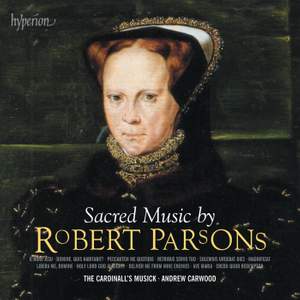
Gramophone award-winning ensemble The Cardinall’s Musick return to another master of the Renaissance, Robert Parsons. Very few records remain of the composer’s short life, and his musical output is often overlooked, perhaps in the shadow of the prolific William Byrd, his successor as a Gentleman of the Chapel Royal. However, his vocal writing is some of the most opulent of the period. The Cardinall’s Musick give sublime performances of some of the composer’s most sumptuous choral works, from the remarkably sophisticated Magnificat to the dramatic O bone Jesu. As demonstrated in their previous recordings, their resonant, pure-toned singing is the perfect advocate for such exquisite polyphony. The ensemble’s seemingly effortless and magical performance of the glorious Ave Maria is the perfect conclusion to an enlightening recording. “Carwood draws earthy, visceral performances; the ensemble's virile sound and Parsons's sinewy polyphony are a far cry from what some critics describe as the 'whitewashed', English choral tradition. Carwood and his singers highlights the inherent drama of Parson's [sic] style...Hyperion's detailed recording, swathed in the glowing acoustic of the Fitzala Chapel, Arundel Castle, enhances these seraphic performances.” BBC Music Magazine, December 2011 “The Cardinall's Musick are at their best in this repertoire, and their performances have confidence and authority...Like many composers of his time and place, Parsons can be heard to navigate between different styles according to the liturgical demands placed on him. He does so surefootedly...Parsons certainly deserves the hearing that Carwood's musicians afford us, so this addition to the catalogue is very valuable.” Gramophone Magazine, November 2011 “the disc is best in the three full choir numbers: Domine quis habitabit, where sopranos inspiringly contrast high and low; Solemnis urgebat, where they cling to the eternal heaven of a high cantus firmus; and the Magnificat where their top line canons wonderfully enrich the counterpoint. The lower-voice funeral Responds have an appropriately tomblike aura.” Classic FM Magazine, December 2011 **** | | | Usually despatched in 2 - 3 working days. |
|
|
| |  | Music from the Chirk Castle Part-Books
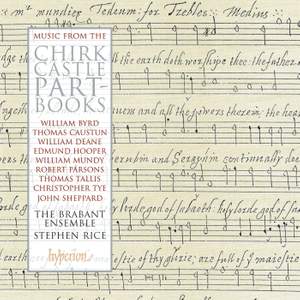
This disc presents a selection of works from the Chirk Castle part-books, a fascinating collection of devotional music from the Tudor period that remained hidden in the castle library for three hundred years. The Chirk manuscripts contain works for unaccompanied voices as well as verse anthems and services, scored for solo voices, chorus and organ. This recording focuses on the unaccompanied items, presenting for the first time a selection of the ‘full’ services and anthems found in the manuscripts, including seven unique to the Chirk collection. Among the ‘new finds’, the most significant are the Te Deum and Benedictus ‘for trebles’ by William Mundy. The two settings are designed on a large scale, exploiting the use of high trebles, and Mundy cleverly employs choral groupings of various types to provide maximum contrast. The textures throughout are reminiscent of Sheppard’s best Latin compositions and by intensifying the contrapuntal activity in the closing sections of both canticles, Mundy takes the music to an even higher level. This is the first recording of these important canticles “Here, the Brabant Ensemble turn their attention to English repertory of the same period: the Chirk Castle part–books' chequered history began in Wales, where they were copied for the choral establishment of a rich merchant turned landed gentry. One of the part–books was lost fairly early on, and has been reconstructed. It's been worth the effort, for although much of their repertory is known from other sources, a few significant pieces, here recorded for the first time, are not. These include two works by William Mundy, an English Te Deum and a Benedictus. Both are described as being 'for trebles' in the source; both are conceived on a large scale, and are undoubtedly significant additions to the repertoire. On that count alone this recording is self–recommending. An even greater name among the new additions is that of Tallis: his Notevery one that saith unto me is brief indeed, but then how often is the discovery of an unfinished sketch by Mozart or Bach hailed as a 'significant find'? A new departure it may be but the Brabant Ensemble is not on unfamiliar ground, for this is the repertory on which its singers cut their teeth. The predominant sonority is familiarly clear, transparent and assured, though in the lower range the voices are not quite so well defined as at the top. This soft centre is perhaps attributable to the sound recording, which is rather recessed and slightly unfocused. But for the sake of the new pieces alone, lovers of this repertory will welcome this enthusiastically.” Gramophone Classical Music Guide, 2010 “…the Brabant Ensemble is not on unfamiliar ground, for this is the repertory on which its singers cut their teeth. The predominant sonority is familiarly clear, transparent and assured.” Gramophone Magazine, May 2009 | | | Usually despatched in 2 - 3 working days. |
|
|
| |
|