All recordingsPrices shown exclude VAT. (UK tax is not payable for deliveries to United States.) See Terms & Conditions for p&p rates. | |  |
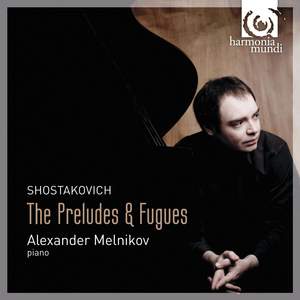
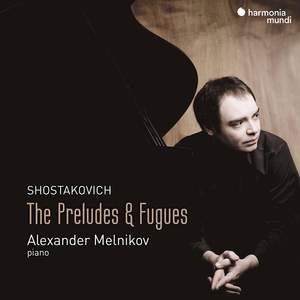
2CDs+DVD Shostakovich’s 1950 visit to Leipzig to attend the Bicentennial Bach competition, where he heard and was impressed by Tatiana Nikolayeva playing Bach’s Well-Tempered Clavier, served as an impetus to write his own set of Twenty-Four Preludes and Fugues, loosely modelled on Bach’s. This he accomplished with remarkable, almost unbelievable speed upon his return home (it took him a mere three and a half months). Nikolayeva, blessed as she was with a phenomenal musical memory, performed Op. 87 for the rest of her life, and her name became practically synonymous with the work. This Op. 87 from Alexander Melnikov approaches the work from first principles to come up with his own, eminently musical solutions. DVD About the Preludes & fugues, interview with Alexander Melnikov and Andreas Staier A film by Christian Leblé. Format: NTSC; Language: English; Subtitles: Fr, Ger; Total time: 23’14 “…throughout op.87 we hear the voice of a tormented man, finding again and again the superhuman force to face life as it is – in all its variety, ugliness, and sometimes beauty.” Alexander Melnikov "He has brought new audiences to [these works], and when you hear him play them, you understand why. Stylistically and temperamentally, they suit him remarkably well. This is music that is strenuous and searching without ever aspiring to flamboyance, and Melnikov is a self-effacing performer. He makes us aware of the music's paradox: that subordination to the rigours of Bach-like form permits great expressive, even political freedom. So we were reminded that the E Minor Prelude and Fugue is one of Shostakovich's big triumph-in-adversity pieces, and that the huge G Sharp Minor coupling into which the first half seemingly collapses is a tragic statement of searing intensity. All this was utterly mesmerising" (The Guardian on a live performance at the Wigmore Hall, 28th April 2011) “In this muscular, virile account, [Nikolayeva's] fellow Russian Alexander Melnikov makes you wonder why these works are considered monotonous or didactic. In his virtuosic hands, each one glints.” The Observer, 25th April 2010 “Melnikov unquestionably gives an impression of freshness and daring, as if he's discovering the music for the first time...Certainly one's bound to feel, listening to such superb playing, that this is indeed one of the greatest contrapuntal cycles since Bach. Overall, then, a magnificent achievement.” BBC Music Magazine, June 2010 ***** “For all his brilliance in the extrovertly Bachian numbers, Melnikov, more than either Nikolayeva or Ashkenazy, is especially compelling in the internalised movements (the C minor and D minor preludes and fugues), baring the innermost thoughts of Shostakovich’s tormented soul. Simply unforgettable.” Sunday Times, 20th June 2010 ***** “Few pianists have shown themselves to be so sensitive to music which is the response of a complex visionary to the corrosive banality of Soviet life at the time...[Melnikov] responds to all this with an impeccable all-Russian mastery and with a poetic commitment few could equal.” Gramophone Magazine, August 2010 “Melnikov is consistently alert to (and in control of) the music's dizzying variety of idioms and tones of voice...[He] conveys the scope of the collection as a totality with such consistent penetration and invention that this expertly engineered set can be enthusiastically endorsed for anyone seeking a complete recording” International Record Review, October 2010 “A towering achievement” International Piano, March/April 2011 CD Review
Critics' Disc of the Year - December 2010 |
| | | In stock - usually despatched within 1 working day. |
|
|
| |  |
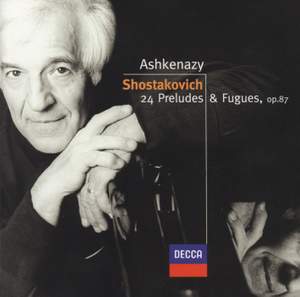
“Here's a Shostakovich Preludes and Fugues cycle to be reckoned with. It starts none too promisingly, with (by the highest standards) a rhythmically stiff, tonally lumpy C-major prelude and some overpedalling in the fugue. However, the neo-Baroque figuration of the A minor prelude and its spiky fugue, on the other hand, presents his true credentials. On form and well prepared, as here, Ashkenazy remains a formidably fluent pianist, and the clarity and energy he brings to the faster, denser pieces is surpassed only by Richter (Philips). The sound itself is quite 'pingy', with a generous ambience behind it. That serves to heighten the impact of the more demonstrative pieces, but makes it difficult for Ashkenazy to sustain the atmosphere of the more meditative ones. Or maybe he simply doesn't feel the music that way. In the final D minor Fugue (No 24), where you can almost hear Shostakovich's 10th Symphony being born, Ashkenazy fails to build the texture as mightily as the early stages lead you to expect. Nikolaieva surpasses him here, and ingeneral she reveals both subtler and grander perspectives, especially in her tauter, more drily recorded 1987 Melodiya set. Even so the balance-sheet for Ashkenazy comes out comfortably in the black. For consistency of pianism, straightforward integrity of interpretation and high quality of recording, his set can be warmly recommended.” Gramophone Classical Music Guide, 2010 | | | (Sorry, download not available in your country) | In stock - usually despatched within 1 working day. |
|
|
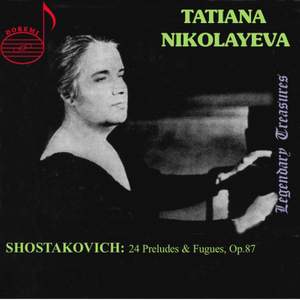
| | | |  | Tatiana Nikolayeva Volume 1
2 CDs + 1 DVD. Of the several recorded versions of Shostakovich’s Preludes and Fugues made by Nikolayeva, the first one of 1962 - presented in this set - is considered to be unique as Shostakovich himself was present at the recording sessions and affirmed it as the one he approved and recommended. | | | Usually despatched in 4 - 5 working days. |
|
|
| |  |
Lin’s CD “Preludes to a Revolution”, Russian piano music, also on this label was a critical success. Here she concentrates on an extensive work by Shostakovich which has been neglected. She is an exciting pianist and her mastery of the composer’s idiom is singular and compelling. “…Jenny Lin… brings distinct virtues of her own to Shostakovich's supreme contrapuntal opus: above all, a crystalline clarity of phrasing and voice-leading, and a remarkably sensitive range of touch and accent.” BBC Music Magazine, August 2009 **** | | | (also available to download from $21.00) | Usually despatched in 2 - 3 working days. (Available now to download.) |
|
|
| |  | Tatiana Nikolayeva
Broadcast 21-30 December 1992 “Nikolaeva in 1992 plays with matchless authority these dazzling works Shostakovich composed for her. The extra features interviews with Nikolaeva and film of the composer.” BBC Music Magazine, November 2008 ***** “If you invested in Marc-André Hamelin's recent CD 'In a State of Jazz' (see page 1328) you will have heard the eponymous Sonata and five Charles Trenet song transcriptions by Alexis Weissenberg. Here is Weissenberg himself seen first in the innovative black–and–white film of Three Movements from Petrushka directed by Åke Falck in 1965 which revived the pianist's flagging career. The print is remarkably crisp and vivid even if, as on the original film, the sound of this high–octane performance is not always in sync. The DVD's bonus features a short interview with the pianist talking about the work. The rest of the programme has performances that reveal what an uneven player Weissenberg was. His impassive face and economic gestures seem to reflect his disengagement with some of the music (try the Bach–Hess Jesu, Joy of Man'sDesiring and the slow movement – the only part of the work here – of Chopin's B minor Sonata). On the other hand there's a riveting Prokofiev Third Sonata (complete) and Scriabin Nocturne for the left hand alone. The longest work from the 150 minutes of the disc is Brahms's Second Piano Concerto, a lightweight reading conducted by the amiable Georges Prêtre in 1969. From the same label comes a 1989 recital from Sviatoslav Richter given in London's Barbican Centre by the light of a 40–watt bulb. Now expressing any criticism of the great man will invite a heap of invective, but when Richter comes on stage conveying the distinct impression that he would rather be anywhere else, it does appear rather graceless. What with that, the anglepoise and reading from the score you wonder if he is in the mood to play Mozart at all. Thank heavens he is. One can put up with any amount of eccentricity to hear K282, K545 (Sonata facile) and K310 played like this. Close your eyes – that's the best way of enjoying this, especially as the editing is a real distraction. The three (black–and–white) bonus tracks from 20 years earlier were broadcast in October 1969. Looking once more as though his cat's just been run over, Richter rampages through Rachmaninov's Etude–Tableau Op 9 No 3 and Chopin's Etudes Op 10 No 4 (ludicriously fast) and No 12. Then there is the endearing figure of Tatyana Nikolaieva in her signature work, the 24 Preludes and Fugues of Shostakovich. Filmed in December 1992 just 11 months before her death at the age of 69, the setting for the 150 minutes of the cycle appears to be a capacious Victorian drawing room, the instrument illuminated by an old–fashioned standard lamp (what is it about Russians and electricity?). Talking of which, Nikolaieva, looking every inch the archetypal babushka and clad in clothes that might have been worn by Clara Schumann, lights up these works from within. Here are old and intimate friends. It's doubtful whether we'll hear them better played – unsuprisingly, as she was the composer's inspiration for the cycle (she reveals as much in the brief interview that forms the DVD's bonus). Already, this is a valuable historical document.” Gramophone Classical Music Guide, 2010 | | | Usually despatched in 2 - 3 working days. |
|
|
| |  |
David Jalbert makes his long-awaited ATMA debut with a masterly interpretation of Shostakovich’s keyboard masterpiece, the 24 Preludes and fugues. The lifelong tension between Shostakovich and the Soviet musical establishment is well known. Most of his compositions reflect the fine musical line the composer had to tread, and the sometimes strained duality that often resulted. The 24 Preludes and fugues are among his few “private” works, in which he did not need to be so careful to camouflage his true voice. They are 'pure' music, stripped of all ideology or intent to stimulate patriotism. Canadian pianist Jalbert has a growing career as a soloist, and has also appeared on disc and in recital as a duo partner, particularly with cellist Denise Djokic, and as a chamber musician. Recorded in August and September, 2007, at the Domaine Forget’s Salle Françoys Bernier, by ATMA’s Anne-Marie Sylvestre. | | | (also available to download from $21.00) | Usually despatched in 2 - 3 working days. (Available now to download.) |
|
|
| |  | Shostakovich: Preludes & Fugues, Volume 1
Shostakovich: | Prelude & Fugue for piano, Op. 87 No. 1 in C major Prelude & Fugue for piano, Op. 87 No. 2 in A minor Prelude & Fugue for piano, Op. 87 No. 3 in G major Prelude & Fugue for piano, Op. 87 No. 4 in E minor Prelude & Fugue for piano, Op. 87 No. 5 in D major Prelude & Fugue for piano, Op. 87 No. 6 in B minor Prelude & Fugue for piano, Op. 87 No. 7 in A major Prelude & Fugue for piano, Op. 87 No. 8 in F sharp minor Prelude & Fugue for piano, Op. 87 No. 9 in E major Prelude & Fugue for piano, Op. 87 No. 10 in C sharp minor Prelude & Fugue for piano, Op. 87 No. 11 in B major Prelude & Fugue for piano, Op. 87 No. 12 in G sharp minor Prelude & Fugue for piano, Op. 87 No. 13 in F sharp major |
Marios Papadopoulos (piano) | | | Usually despatched in 4 - 5 working days. |
|
|
| |  |
“The Shostakovich is, quite simply, one of the touchstones of the keyboard literature, and the value of Jarrett’s committed advocacy of this piece cannot be overestimated. He really has done an outstanding job: listening to him is simply a joy.”- Fanfare | | | Usually despatched in 4 - 5 working days. |
|
|
| |  | Calefax plays Shostakovich
| | | Usually despatched in 2 - 3 working days. |
|
|
| |
|