Prices shown exclude VAT. (UK tax is not payable for deliveries to United States.) See Terms & Conditions for p&p rates. | |  | Joseph Phibbs: The Canticle of The Rose and other works
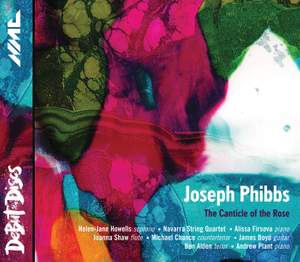
Joseph Phibbs studied at The Purcell School, King's College London, and Cornell University, and his teachers have included Param Vir, Harrison Birtwistle and Steven Stucky. His works have been performed by leading ensembles including the London Sinfonietta, Britten Sinfonia, BBC Symphony Orchestra, London Symphony Orchestra, and National Symphony Orchestra (Washington). Since 2003 Phibbs has combined his composing career with the editing and promoting of Britten's music, and he is a director of the Britten Estate. He was appointed to teach composition at Wells Cathedral School in 2008 and is currently a visiting member of staff at The Purcell School and King's College London.The Canticle of the Rose, the centrepiece of this recording, sets a series of poems by Edith Sitwell for soprano and string quartet (including one which also appeared in Walton's Facade) ranging from the foreboding (We are the darkness) to the frivolous (Through gilded trellises). It is one of a series for voice with string quartet commissioned by Sir Nicholas Goodison. From Shore to Shore combines the countertenor voice of Michael Chance with guitar, and was commissioned by guitarist James Boyd with funding from the Arts Council England’s National Lottery scheme to broaden the contemporary repertoire for voice and guitar. Premiered at Aldeburgh in 2012, it sets a series of old and new poems on the subject of the sea. Contrasting with these vocal works are Flex - a vivid work for piano, flute, viola and cello - and the short string quartet Agea, dedicated to George Vass of Presteigne Festival. | 
| | | Scheduled for release on 10 June 2013. Order it now and we will deliver it as soon as it is available. |
|
|
| |  | The NMC Songbook
Anderson, Julian: | Lucretius | Bainbridge: | Sonnet XVIII | Baker, R: | English Lullaby | Barry, G: | The Importance of Being Earnest | Basford: | Hour-glass | Bauld: | Titania's Song | Bawden: | Vocalise - Loch Lurgainn in the Sunshine | Bedford, D: | The Roman Centurion's Song | Bedford, L: | Upon St George's Hill | Berkeley, M: | Echo: hommage à Francis Poulenc | Bingham, J: | She walks in beauty like the night | Birtwistle: | This Silence before Light Arr. Colin Matthews | Blake, D: | A Swallow | Bryars: | Old Man and Sea | Burrell, D: | Love Song (for yoga) | Butler, M: | London | Carpenter, G: | Interlude | Cashian: | Daisy's Song | Casken: | Night and Morning | Causton: | English Encouragement of Art | Cole, J: | tss-k-haa | Cresswell: | A Recipe for Whisky | Crosse: | Dirge from Cymbeline | Cutler, J: | Bands | Davies, Maxwell: | Labyrinth to Light | Davies, T: | Destroying Beauty | Dench: | An Hypallage | Dennehy: | Swift's Epitaph | Dillon, J: | Upon the cloudy night | Duddell: | Cease Sorrows Now | Elias, B: | Meet Me in the Green Glen | Finnissy: | Outside Fort Tregantle | Foskett: | Driving | Fox, C: | The True Standard Advanced | Fujikura: | Lake Side | Gilbert, A: | Those Fenny Bells | Goehr: | Ulysses' Admonition to Achilles | Grange: | First Known When Lost | Grant, J: | Know They Kings and Queens | Grime: | Nobody Comes | Hall, E: | A Simple Neo-Georgian Summer | Harrison, B: | An Oblique | Harrison, S: | Easter Zunday | Harvey, J: | Ah! Sun-flower | Hayes, M: | A Dictionary of London | Holloway, R: | Go, lovely Rose | Holt, Simon: | Raju Raghuvanshi is a Ghost | Horne, D: | A curious thirsty fly | Howard, Emily: | Wild Clematis in Winter | Hunt, J: | An Aesthetic of Lines | Keeley: | Because I breathe not love to everyone | Kindsdottir: | haiku | Leach, R: | Out of Town | LeFanu: | The Bourne | Lloyd, Jonathan: | The Greenwood's Lament | MacMillan: | Mouth of the Dumb | MacRae: | The Lif of this World | Marsh, R: | Lullaby | Martin, P N: | Blaze of Noon | Matthews, C: | Galliard - Versions 1-13 & Complete Version based on a Galliard of Thomas Morley Out in the Dark | Matthews, D: | Plover's Peak | Mayo: | The Fitful Alternations of the Rain | McCabe: | A Cat | Meredith: | Fin like a Flower | Molitor: | My favourite Sound | Montague: | The Poison Tree | Moore, L: | Music, thou Queen of Souls | Musgrave: | A Winter's Morning | Northcott: | Poet and Star | O'Regan: | Darkness Visible | Panufnik, R: | That Mighty Heart | Payne: | Ghost Train | Phibbs: | The Moon's Funeral | Philips, J: | Blist's Hill | Poole, G: | Heynonnynonny Smallprint | Powell, J: | Stanzas 1814 | Powers: | Shining Plain | Roberts, J D: | Spoken to a Bronze Head | Roxburgh: | A Dangerous Crossing | Rushton: | With my Whip | Sackman: | Maiden in the moor | Sawer: | The Source | Saxton: | The beach in winter: Scratby (For Tess) | Simpson, J: | Bees a-zwarmen | Skempton: | Silence on Ullswater | Stoneham: | 25 | Swayne: | I look into my glass | Turnage: | Bellamy | Wallen: | Tree | Watkins, H: | Proud Maisie | Weir: | Blackbirds and Thrushes | White, John: | Houses and Gardens in the Heart of England | Wiegold: | A Cause for Wonder | Williams, Roderick: | A Coat | Wood, Hugh: | Easter | Woolrich: | Stendhal's Observation |
Sopranos - Claire Booth, Ailish Tynan, Elizabeth Atherton Mezzo-sopranos - Susan Bickley, Loré Lixenberg, Jean Rigby Countertenors - James Bowman, Michael Chance, Andrew Watts Tenors - Andrew Kennedy, Daniel Norman, Benjamin Hulett Baritones - Stefan Loges, Roderick Williams, George Mosley, Richard Jackson, David Stout Trebles - Andrew Swait, Sam Harris Pianists - Iain Burnside, Andrew Ball, Andrew Plant, Andrew West, Michael Finnissy, Huw Watkins, Jonathan Powell Lucy Wakeford harp; Jane Chapman harpsichord Owen Gunnell percussion Antonis Hatzinikolaou guitar ‘This extraordinary project confirms the robust health and endlessly varied landscape of Britain’s new music. There is no other document anywhere that has given such a snapshot of an artistic community that, while comprised of a hundred different ways of expressing itself, is of one voice when it comes to creative energy.’ JOHN ADAMS To mark its 20th Anniversary in 2009 NMC Recordings has commissioned the NMC Songbook. Nearly 100 composers, ranging from the country’s most highly regarded figures to the younger generation of emerging talents, have each written a song, loosely themed on ‘Britain’ and scored for single voice or duet and a range of accompanying instruments. Songs are interspersed with instrumental interludes from an arrangement of a Galliard by Thomas Morley, specially made for the Songbook by NMC’s Executive Producer, composer Colin Matthews. The songs have been set to text chosen by the composers and cover a vast array of subjects, from traditional poems by Blake and Byron through to a list of the Kings and Queens of England, extracts from a National Trust brochure, chants from the Leyton Orient terraces, a whisky recipe, and a colourful rant about our consumerist society. · The first recording to be made at the new state-of-the-art concert hall at Kings Place, London. 4-CD set with special packaging and a 60-page booklet. “…anyone listening to these discs will find many things to savour… It is, inevitably an eclectic mix, but, as in any well-planned song recital, the progressions and juxtapositions are continually stimulating,” BBC Music Magazine, May 2009 ***** “Unpredictable, audacious, exhilarating and continually fascinating the Songbook is an outstanding project” International Record Review “The performances are uniformly superb...The more one listens, the more one gains from this set.” The Guardian, 17th April 2009 *** “Composer Bayan Northcott gives an invaluable overview of British music in a programme essay. Recorded in London's Kings Place and beautifully sung and played by more than two dozen top performers.” The Observer, 12th April 2009 “NMC's 20th anniversary celebrations may or may not 'kick-start a new interest in the genre' (Bayan Northcott) but the initiative gives us a useful snapshot of British Music now, even if certain tendencies are better represented than others. There are full texts and the imaginative design concept reflects the disparity of the idiomatic options available. Whether tonal, atonal or pseudo-tonal, some of these are found as if by chance and loosely worn, others carefully nurtured and obsessively worked. Britten remains in some ways the key figure in that his example persuades many contributors to stick with conventionally accompanied solo voice(s). That said, his intuitive response to a text is less easily imitated than the externals of his style. Martin Butler's Blake setting upholds the tradition in its best and purest form. Other examples might lead you to conclude that dislocated consonance, high voicing and a certain infuriating feyness constitute the defining features of British song. There's room for the provocateurs as well. Luke Stoneham gets away with an electronic soundscape while Gerald Barry turns in a gleefully graceless recitation of Oscar Wilde. Jonathan Cole has Roderick Williams perform a sequence of phonemes while guesting on balloon. Is a song a song at all if its text is merely a jumping-off point, a colour without a context? Morgan Hayes's Dickensian passages, ideally chosen for such a project, are quickly sidelined amid dizzying virtuosity. Chris Dench is still sufficiently hard–core to represent what was once a New Complexity. Few others appear capable of writing fast music even in short bursts, hence perhaps Colin Matthews's decision to break up the sequence with instrumental interludes. In the tradition of Stanford's pseudonymous Karel Drofnatzki he may also be behind the modest haiku setting with its allusions to NMC marketing strategy. Call me old–fashioned but my own favourite items are those in which both the original text and the passion of a composer's response are intelligible in the finished product. In Hugh Wood's George Herbert setting, careful workmanship does not preclude a Tippettian sense of exaltation. There's a similar sense of engagement in Simon Holt's unaccompanied declamation (evoking a real-life incident in rural India) and Brian Elias's more subdued John Clare solo. The way in which the items are juxtaposed can be crucial too; the cooler limpidity of Howard Skempton and Gavin Bryars is doubly welcome in context. The performers range from good to excellent. The recordings were almost all made in Hall One, Kings Place, an acclaimed venue where instrumental voices are unfailingly well projected. Human ones, less comfortable with its zingy resonance, can become a little hectoring. But then only a critic or a fool would listen to the entire collection at a sitting. Much better to study at leisure what should prove to be an important cultural document.” Gramophone Classical Music Guide, 2010 | | | Usually despatched in 4 - 5 working days. |
|
|
| |
|