All recordingsPrices shown exclude VAT. (UK tax is not payable for deliveries to United States.) See Terms & Conditions for p&p rates. | |  | The English Song Series Volume 22 - Benjamin Britten
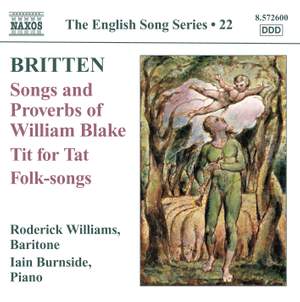
Britten wrote his Songs and Proverbs of William Blake, Op. 74 for the German baritone Dietrich Fischer-Dieskau in 1965. The singer admired the ‘concentration and enigmatic smile’ of the settings, and Britten constructed, through alternation of proverbs with songs, and an intense contemplation on the human and the eternal, one of his greatest song cycles. By contrast Tit for Tat sees Britten revisiting youthful, light-spirited settings of the poet Walter de la Mare. The folk-song arrangements are amongst his most famous, and beloved. Britten’s song cycles are some of the greatest produced in the twentieth century. This disc focuses on his Blake cycle, one of his deepest and most contemplative. It’s contrasted with a very different and youthful cycle of five called Tit for Tat, written when he was a teenager. The baritone Roderick Williams encompasses a wide repertoire, from baroque to contemporary music, in the opera house, on the concert platform and in recital. His recital appearances have taken him to London’s Wigmore Hall and many European festivals. He has an extensive discography and his recordings of English song with Iain Burnside have received particular acclaim. “this sombre, discomfiting song-cycle [the Blake settings] remains a strikingly modern-sounding work, thanks partly to Blake’s existential poetry and aphoristic proverbs. Williams illuminates the text, but it’s a relief to move on to Britten’s boyhood settings of Walter de la Mare” Financial Times, 12th May 2012 *** “Williams finds an ideal emotional stance - involved, totally word-conscious but never melodramatic...as a recorded recital, Williams - and Burnside, who is similarly colourful but keeps an interpretative distance from pumping up the text - have created an outstanding achievement.” Gramophone Magazine, June 2012 “Williams's voice is lighter than Fischer-Dieskau's, but his response to the texts is so intense, so well judged that there is never a lack of authority. The juvenile Walter De la Mare settings of Tit for Tat provide the perfect foil, followed by some of Britten's best-known folksong arrangements, all beautifully delivered without a trace of archness.” The Guardian, 24th May 2012 **** “Williams brings a gentler, more intimate touch to what Fischer-Dieskau called their 'enigmatic smile': Blake's Tyger burns bright but with less fierce teeth, and there is more melancholy than menace in this performance's view of the human condition. Every beautifully placed word is matched by Iain Burnside's recreation of Britten's pianistic subtext, glinting with many a revealing musical gloss.” BBC Music Magazine, July 2012 **** “It would be easy to exaggerate the claims of these songs [Tit for Tat], but presented so cleanly and with such understanding as do Williams and his superb pianist, Iain Burnside, they make just the effect the mature composer surely intended.” MusicWeb International, July 2012 | | | (also available to download from $6.00) | In stock - usually despatched within 1 working day. |
|
|
| |  | Peter Pears – The Decca Premieres
On 24 June 1936, Peter Pears joined his BBC Singers colleague, contralto Anne Wood, at Decca’s studio in Upper Thames Street in the City of London to make his very first commercial recording, of Peter Warlock’s setting of the Corpus Christi carol for unaccompanied voices. The year marked a turning-point for Pears: he met Benjamin Britten that April at the International Society for Contemporary Music festival in Barcelona, joined a vocal group, the New English Singers, and set off on his first trip to North America, on tour with them in November. This Warlock premiere makes its first ever appearance on Decca CD. Of course, Britten’s Serenade for tenor, horn and strings is inextricably linked with Pears as well as with Dennis Brain, and marks one of the most important of all Decca premieres, particularly given the label’s association with both Britten and Pears. But also of interest are the recorded premieres of Britten’s British and French folk song arrangements by Pears (British folk songs) and the Swiss soprano Sophie Wyss (French folk songs) in the 1940s. All of these make their first appearance on Decca CD, the Sophie Wyss recordings added as a sort of ‘bonus’ midway through the (Pears) CD. Vaughan Williams’s cycle On Wenlock Edge focuses more on the middle register of Pears’s voice (unlike the upper reaches in Britten’s Serenade). As with the Britten cycle, the first appearances of these recordings received glowing praise in the music press. “a most lovely piece of singing … ‘[his] clear diction and sense of word values ensures that justice is done to both poetry and music’” Gramophone Magazine (Vaughan Williams) “[it] is performed by them with a perfection that must have made the composer feel that his every intention has been realised. Dennis Brain’s tone is ravishingly beautiful, and – one out of many points of superb technical skill – the way he plays the high note near the end of the Prologue and Epilogue leaves one speechless with admiration” … “Dennis Brain – well, he was incomparable, that's all” Gramophone Magazine (Britten: Serenade) | | | In stock - usually despatched within 1 working day. |
|
|
| |  | Sandrine Piau: Aprés un Rêve
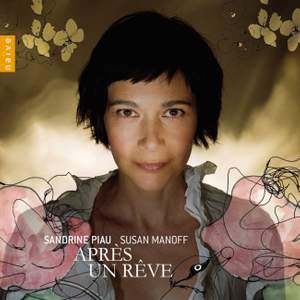
Bouchot: | Galgenlieder - Mondendinge Der Hecht Die Mitternachtsmaus Das Wasser Galgenkindes Wiegenlied | Britten: | Down by the Salley Gardens There's none to soothe I wonder as I wander | Chausson: | Amour d’antan, Op. 8 No. 2 Dans la forêt du charme et de l’enchantement, Op. 36 No. 2 Les Heures, Op. 27 No. 1 | Fauré: | Après un rêve, Op. 7 No. 1 Clair de Lune, Op. 46 No. 2 Les berceaux, Op. 23 No. 1 | Mendelssohn: | Nachtlied, Op. 71 No. 6 Neue Liebe, Op. 19a No. 4 Hexenlied, Op. 8 No. 8 Schlafloser Augen Leuchte (Byron) | Poulenc: | Montparnasse Hyde Park C Fêtes galantes | Strauss, R: | Die Nacht, Op. 10 No. 3 Das Geheimnis, Op. 17 No. 3 Morgen, Op. 27 No. 4 |
The award-winning pairing of soprano Sandrine Piau and pianist Susan Manoff received unanimous critical acclaim for their previous recital disc Evocation, (V5063). On their new CD Après un rêve they perform a fascinating collection of songs by some of the greatest composers for the voice of the 19th and 20th centuries, including Richard Strauss, Fauré, Mendelssohn, Chausson, Poulenc, Britten and Vincent Bouchot. After initially making her reputation in Baroque music alongside the likes of William Christie, Philippe Herreweghe, Christophe Rousset, and René Jacobs, Sandrine Piau now sings a broad repertoire reflected in her large discography. and she has now confirmed her position at the forefront of the new generation of French singers. Her Handel album with Christophe Rousset and Les Talens Lyriques (E8928), was an Editor’s Choice in Gramophone, and in 2007 she released an award-winning recital CD entitled Évocation (V5063), on which she was accompanied by the pianist Susan Manoff. Après un rêve demonstrates once again the strength of her musical relationship with Manoff, with whom she appears regularly at venues like the Carnegie Hall and the Wigmore Hall. Her solo discography for Naïve also includes a programme of Mozart opera arias with the Freiburger Barockorchester (V4932), and two recent bestselling Handel albums, duets with Sara Mingardo directed by Rinaldo Alessandrini (OP30483) and the solo album Between Heaven and Earth with Accademia Bizantina (OP30484). “Piau brings her limpid tone, refined phrasing and easy, silvery top notes to this eclectic programme, built around the themes of night, dreams and the fantastic...With virtually accent-free English, Piau gives true and touching performances of three Britten folksong arrangements.” Gramophone Magazine, July 2011 “Piau's exquisite voice has a limpid quality all through its range, an evennes of tone which seduces the ear and - art concealing art - she makes her performance sound as easy as breathing...Bouchot's Galgenlieder songs,m with their skewed harmonies, off-centre melodies and dark fairy-tale lyrics, are a fascinating addition to the repertoire too, and Manoff's accompanying is a treat.” Classic FM Magazine, July 2011 **** “surrender to Piau's gifts as a singer, the purity of her tone, with that light silvery quality that we should associate with the best of the French style, and the effortless, so it seems, spinning of a seamless legato...Everything is grist to her mill, it seems, even Britten's most English songs that she delivers with immaculate diction while sounding completely at home in a second language...this is a sophisticated and a fine artist at work.” International Record Review, July 2011 “This celebration of dreams and childhood is, on the purely sensuous level, an unending delight. Piau's sweet, unforced tone, her bright top notes perfectly integrated with her medium and exemplary diction combine to make this in many ways yet another exmaple of how well Baroque vocal technique translates into the later song repertoire.” BBC Music Magazine, July 2011 **** “It's a journey whose darkest depths are reached by Vincent Bouchot's use of Morgenstern's Galgenlieder (Gallow Songs), in which are encountered more surreal images – notably the inhabitants of the moon depicted "show[ing] their teeth to the sulphurous hyena" in "Moonthings".” The Independent, 1st July 2011 *** “there's exquisite playing from Susan Manoff, and no mistaking the beauty of Piau's voice, or her hypnotic way with words. This is singing that sends shivers down your spine.” The Guardian, 7th July 2011 **** | | | (also available to download from $10.50) | In stock - usually despatched within 1 working day. |
|
|
| |  | Britten - Before Life and After
It was on returning from a tour of the German concentration camps with Yehudi Menuhin, in 1945, that Britten finally realised his long-cherished project of setting to music the spiritual sonnets of John Donne (1572-1631). He succeeded admirably in conveying their skilful blend of passion and intellectual rigour. Mark Padmore was born in London and grew up in Canterbury. After beginning his musical studies on the clarinet he gained a choral scholarship to King's College, Cambridge and graduated with an honours degree in music. He has established a flourishing career in opera, concert and recital. His performances in Bach's Passions have gained particular notice throughout the world. His disc of Handel arias As Steals the Morn with The English Concert and Andrew Manze won the BBC Music Magazine Vocal Award in April 2008. Future releases for harmonia mundi include Die Winterreise with Paul Lewis. “Padmore is on happier ground with the idiosyncratic Purcell realisations, especially in a gem of an 'Evening Hymn', while the Hardy vignettes of Winter Words bring an ideally subtle sense of atmosphere from both singer and pianist.” BBC Music Magazine, August 2009 **** “This declamatory, religious-themed repertoire fits Padmore like a glove, marrying as it does his enduring success as a performer of early sacred music with his newer success as a chamber recitalist...A satisfying recital on every level.” Charlotte Gardner, bbc.co.uk, 21st December 2009 “The Holy Sonnets of John Donne were composed in 1945, soon after Britten's visit to German concentration camps, and the stark immediacy of that experience can be heard in the composer's own recordings. Padmore and Roger Vignoles, his warm-toned accompanist, take a more reflective line. ...the core of the cycle is some heartfelt singing in the sixth and most beautiful setting, "Since she whom I loved". The vivid picture-painting of Winter Words helps make it probably Britten's most popular song-cycle with piano. Several of the Thomas Hardy poems evoke a time of innocence now lost, a familiar Britten theme, and the evocative performance by Padmore and Vignoles captures that sense of longing particularly well.” Gramophone Magazine, September 2009 “Before life and after is the more consoling conclusion to the Hardy cycle, and Padmore lavishes a palette of tone colour to match or even outshine Pears here. His English diction has an unfussy naturalness, and Vignoles captures the descriptive imagery of the piano parts with their descriptions of the train whistle and the boy’s violin. Padmore’s voice now sounds dark for Purcell, but the three Britten realisations suit it well, and the disc is rounded off by five of Britten’s most attractive folk-song arrangements.” Sunday Times, 5th July 2009 ***** “Padmore's sound is more beautiful and easily expressive than Pears's ever was, but he never imposes his own personality too forcefully, content to let the natural inflections of the bespoke vocal lines in the Donne cycle follow their own course.” The Guardian, 26th June 2009 **** | | | In stock - usually despatched within 1 working day. |
|
|
| |  | Britten: Complete Scottish Songs
Steeped in an atmosphere of ancient Scottish musical tradition, Benjamin Britten’s setting of texts by Robert Burns in A Birthday Hansel was his final song-cycle. Who are these children? is another late cycle to poems by William Soutar, combining darkly dramatic musical depictions of wartime life with protest songs which hark back to the composer’s youth. Acclaimed Scottish tenor Mark Wilde’s sensitivities embrace both the vibrantly dramatic and “gently mellifluous” (Manchester Evening News) qualities in this deeply expressive repertoire. “This is a fascinating recital of all Britten’s “north of the border” settings, including his final song cycle A Birthday Hansel and familiar folk-songs such as Ca’the Yowes. The mood is mostly bleak, haunted and haunting: this is Britten at his most austerely romantic and melancholy.” The Telegraph, 11th August 2011 ***** “Sensitive harp accompaniment brings to life this setting of poems from Robert Burns and William Soutar” Financial Times, 13th August 2011 *** “The Scottish tenor has matured into one of our finest artists with time's passing, musically astute, vocally impressive and a generous communicator...the intense beauty of Wilde's lyric voice and the musical wisdom of these interpretations pay handsome compensation for the recital's want of spectacular contrasts.” Classic FM Magazine, October 2011 **** “[In "A Birthday Hansel"] Wilde takes his time and uses his pliable voice to play with light and shade in atmospheric performances. The Soutar cycle, "Who are these children?", is also unhurried, adding several minutes to the timing of Peter Pears's recording, though Wilde generally uses the time productively. The headlong violence of "Slaughter" is more intelligible at this speed and "The Children" has a properly haunting air.” Gramophone Magazine, Awards Issue 2011 | | | (also available to download from $6.00) | Usually despatched in 2 - 3 working days. (Available now to download.) |
|
|
| |  | Britten: Folk Songs of the British Isles
Judith Kogan (harp), Maria Jette (soprano) | |
|
| |
|