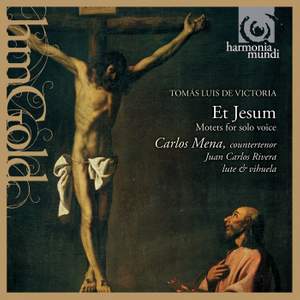
All recordingsPrices shown exclude VAT. (UK tax is not payable for deliveries to United States.) See Terms & Conditions for p&p rates. | |  | Victoria - Et Jesum & Motets à voix seule
Carlos Mena (countertenor), Juan Carlos Rivera (lute, vihuela) & Francisco Rubio Gallego (cornet) “It needs a special voice to focus the attention so clearly on itself, and Mena’s fits the bill. He has an extraordinary range…I suspect that those who dislike the ‘churchy’ manner in which the music is so often staged
will find it revelatory.” Gramophone Magazine, July 2004 | | | Usually despatched in 3 - 4 working days. |
|
|
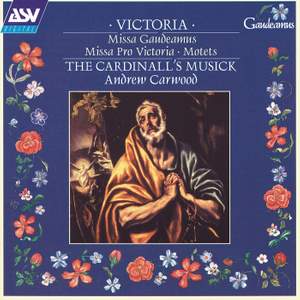
| |  | Victoria - Choral Works
“There have been some fine recordings of Victoria's music in recent years, but none finer than this one at its best. The Cardinall's Musick has become known for its CDs of English renaissance polyphony, but its approach, which joint directors Andrew Carwood and David Skinner describe as 'open and soloistic', works extremely well here, too. The two contrasted Mass settings are given the same highly expressive treatment as the motets, which, sung one to a part, have a madrigalian quality bringing out beautifully the natural, unforced rhetoric of Victoria's idiom. The Missa Gaudeamus, based on a Morales motet, is scored for six voices. Performed with only two singers on each part, it sounds as rich and dark as the strongest chocolate; the overall blend is superb, clear and strikingly well balanced. With only two female voices on the upper part, the polyphonic texture isn't, as is so often the case, top-heavy; each strand carries equal weight, just as the densely contrapuntal writing demands. The final canonic Agnus Dei is sublime, and throughout – even in the longer movements – Carwood's sure-footed pacing allows the polyphony to ebb and flow like the swell of the sea. The Missa pro Victoria, based on Janequin's chanson, La guerre, could hardly be more different in its forward-looking polychoral idiom. Here the writing is more condensed, more economical, but nevertheless highly dramatic. The ending of the Gloria is breathtaking, as is the magical opening of the Sanctus and the final 'dona nobis pacems' of the Agnus Dei. The clarion calls of the second Kyrie are equally striking. There are so many high spots on this disc that it's simply impossible to mention them all, and this is perhaps still more to the group's credit given that, as explained in the notes, a bout of flu among the singers can't have made for the easiest of recording sessions.” Gramophone Classical Music Guide, 2010 | | (Sorry, download not available in your country) | |
|
|
| |  | Victoria: Sacred Works
Ensemble Plus Ultra, Michael Noone Universal Spain have, over recent years, been releasing new recordings of works by the Spanish Renaissance composer Tomás Luis de Victoria (1548–1611), who stands alongside Palestrina and Lassus as one of the greatest composers of his age. The recordings were made by highly-regarded British Early Music group Ensemble Plus Ultra under Michael Noone (“a crack squad” –Early Music Today), who won critical acclaim for CDs of Morales and other Spanish composers on the Glossa label (“breathtakingly beautiful” – BBC Radio 3, CD Review). Altogether, 10 CDs of Victoria’s works have been released (the final two as recently as May 2011). Now we have seized the opportunity, in the year when we commemorate the 400th anniversary of Victoria’s death (27 August), to bring all of these recordings together in a single box that forms a remarkable wide-ranging compendium of works mainly from the Madrid period of his life (1586–1611). It is undoubtedly the largest collection available of Victoria’s music, with over 90 works on the 10 CDs, including three masses and six Magnificats never previously recorded – as well as many of the favourite motets and masses of the Victoria canon. These recordings have never before been available outside Spain. “The 11 hours of music on offer represent both a sizeable portion and a representative sample of Victoria's output....the Missa Ave Maris Stella boasts a particularly fine reading - lucid and sure-footed, with none of the parts having to stray outside their registral comfort zones. Slightly later is the famous setting of O quam gloriousum, one of the clearerer instances of Noone's attempt to blow some cobwebs off the ethereal vision of the composer.” Gramophone Magazine, November 2011 | | | (Sorry, download not available in your country) | Usually despatched in 2 - 3 working days. |
|
|
| |
|