Prices shown exclude VAT. (UK tax is not payable for deliveries to United States.) See Terms & Conditions for p&p rates. | |  | The Romantic Cello
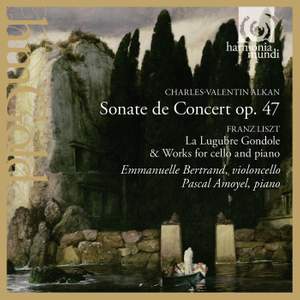
Alkan: | Cello Sonata, Op. 47 | Grieg: | Arietta, Op. 12 No. 1 Lyric Pieces Op. 43: No. 5 - Erotikon Allegretto, Op. 45 Lyric Pieces Op. 54: No. 3 - March of the Trolls Lyric Pieces Op. 68: No. 3 - At your feet Lyric Pieces Op. 43: No. 4 - Little bird Lyric Pieces Op. 62: No. 5 - Phantom Lyric Pieces Op. 57: No. 4 - Secret Lyric Pieces Op. 54: No. 2 - Gangar Lyric Pieces Op. 57: No. 6 - Homesickness Lyric Pieces Op. 71: No. 7 - Remembrances | Liszt: | Elegie No. 1, S130 Elegie No. 2, S131 La Lugubre Gondola for cello & piano, S134 Romance oubliée, for viola/cello/violin & piano, S. 132 | Saint-Saëns: | Cello Sonata No. 1 in C minor Op. 32 | Strauss, R: | Romance for cello and piano in F Major, AV 75 Cello Sonata in F major, Op. 6 |
“Underrated, like most of Bloch's music, they are played here with aristocratic dignity by Emmanuelle Bertrand.” The Guardian “The enthusiastic playing of Bertrand and Amoyel captures Saint-Saëns’ characteristic youthful vigour and gleeful virtuosity.” Classic FM Magazine “Rich pickings! Alkan and R Strauss Sonatas are given suitably grandiose performances. Bertrand and Amoyel complement each other superbly.” BBC Music Magazine, December 2011 ***** | | | In stock - usually despatched within 1 working day. |
|
|
| |  | Trio Wanderer play Smetana & Liszt
This resolutely elegiac disc offers an opportunity to discover, through their chamber music, the dark side of two composers who are not often associated. Smetana’s primary purpose was to give utterance to a cry of pain at his daughter’s death through the appropriate medium of the piano trio. In the Liszt pieces, elegies and funeral gondolas remind us of the deeply human and tormented nature of a composer haunted by death and who, more than any other, was capable of expressing its icy smile. The Trio Wanderer realise all this in deeply moving performances. Since 1999, the Trio Wanderer has released, on Le Chant du Monde and harmonia mundi, a series of recordings that have received a warm welcome from the press, winning notably a best of the year award from Le Monde de la Musique for its CD of Haydn trios, and numerous international awards for Schubert’s ‘Trout’ Quintet and the trios of Shostakovich and Saint-Saëns. Its recording of the Brahms piano trios was honoured by a Diapason d’Or of the year 2006 and the Midem Classical Award in the chamber music category in January 2007. In 2009, the Trio Wanderer was voted ‘Best chamber music ensemble’ at the Victoires de la Musique for the third time (after 1997 and 2000). Jean-Marc Phillips plays a violin by Giovanni Battista Guadagnini (1738). Raphaël Pidoux plays a violoncello by Gioffredo Cappa (1680). “they excel together in Liszt's "Tristia" and separately in "Romance oubliée" and "La lugubre gondola".” The Independent on Sunday, 9th January 2011 “What a fascinating issue this is. The combination of arrangements and original compositions variously for piano, violin and cello by Liszt and Smetana's marvellous G minor Piano Trio is appropriate...The Wanderer Trio are very successful in the six chamber works by Liszt, negotiating the fearsome virtuosity of Tristia...with confidence.” BBC Music Magazine, February 2011 **** “Trio Wanderer captures the various shades of melancholy and nostalgia that Liszt voiced in these and four other works in a similar vein, and in Smetana’s Trio evokes the heartache and anguish that the composer expressed on the death of his young daughter.” The Telegraph, 21st January 2011 **** “Finding a coupling for Smetana’s grief-stricken G minor trio — written in response to the death of his four-year-old daughter — is not easy... but the Wanderers have come up with the brilliant idea of Liszt...It’s a programme heavy on existential angst, but the Wanderers bring a Wagnerian intensity and abandonment to Liszt’s almost orchestral writing, which is uplifting.” Sunday Times, 30th January 2011 **** “Smetana opens his Trio with an outpouring of anguish and grief that the Trio Wanderer projects with fearless intensity...Never has the Presto finale's hurtling forward momentum been so powerfully conceived...Recorded at a discrete distance, the Trio Wanderer's probingly expert playing is a constant of pleasure and illumination.” Classic FM Magazine, March 2011 **** “The individual playing throughout is remarkably fine, but it's the trio playing which impresses most; the players are responsive to each other's playing and pay meticulous attention to dynamic markings...the players explore extremes of tempo, so that the faster music is more incendiary and slower passages more poetic.” International Record Review, March 2011 | | | In stock - usually despatched within 1 working day. |
|
|
| |  | Liszt: Originals and transcriptions for cello and piano
Liszt: | Romance oubliée, for piano, S. 527 Elegie No. 1, S130 Die Zelle in Nonnenwerth, S382 Elegie No. 2, S131 La Lugubre Gondola for cello & piano, S134 Schlaflos Frage und Antwort, S203 RESIGNAZIONE, S187a (c1877) Receuillement, S204 Piano Piece in E major (No. 1 from Fünf Klavierstücke), S192/1 (1865) Piano Piece in A flat major (No. 2 from Fünf Klavierstücke), S192/2 (1865) Piano Piece in F sharp major (No. 3 from Fünf Klavierstücke), S192/3 (1873) Piano Piece in F sharp major (No. 4 from Fünf Klavierstücke), S192/4 (1876) Nuages gris, S199 Consolations, Six Pensées poétiques, S. 172 DEM ANDENREN PETOFIS (PETOFI SZELLEMENEK), S195 (1877) |
Harro Ruijsenaars (cello) & Rian de Waal (piano) This recording is a welcome reissue of Liszt’s own transcriptions of his piano works for cello and piano. Rian de Waal, who unfortunately passed away last year, was famous for his Liszt interpretations. Together with Harro Ruysenaars, who was the first cellist of the Royal Concertgebouw Orchestra for many years, he recorded this program, which is unique in its kind. There are only very few recordings available and thus is this set a very welcome addition to the catalogue again. | 
| | | Usually despatched in 2 - 3 working days. |
|
|
| |  | Liszt, Dohnányi & Kodály: Music For Cello & Piano
Dohnányi: | Cello Sonata in B flat minor, Op. 8 Ruralia Hungarica for Cello and Piano, Op. 32d | Kodály: | Sonata for Cello and Piano, Op. 4 Sonatina for Cello and Piano Adagio for viola (or cello or violin) & piano | Liszt: | Elegie No. 1, S130 Elegie No. 2, S131 Romance oubliée, for viola/cello/violin & piano, S. 132 La Lugubre Gondola for cello & piano, S134 Die Zelle in Nonnenwerth, S382 Consolations, Six Pensées poétiques, S. 172 Transcribed by Jules de Swert O du, mein holder Abendstern - Rezitativ und Romanze aus Tannhäuser S444 Reconstruction by Leslie Howard |
| 
| | | Usually despatched in 4 - 5 working days. |
|
|
| |  | Liszt: Works for Cello and Piano
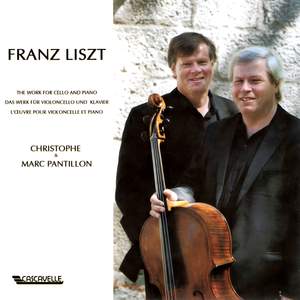
Christophe Pantillon (cello) & Marc Pantillon (piano) This release features the complete works for Cello and piano beautifully performed by the Pantillen brothers, Christophe and Marc. Christophe Pantillen is an acclaimed Swiss cellist who now resides in Vienna and is the first cellist of the Wiener Kammer Orchester and the founder of the Aron Quartett. The CD contains many rarities and will be of great interest to cello, piano and Liszt admirers alike. | | | Usually despatched in 4 - 5 working days. |
|
|
| |  | Schumann: Cello Concerto
Schumann’s Cello Concerto was long regarded as a minor achievement; it has also been accused of treating the solo instrument unfavourably. As is often the case with the compositions of Schumann’s middle and late periods, interpreters must to understand its singularity in order to bring it out. It is thanks to great performers such as the legendary cellist Pablo Casals, for whom Schumann’s Cello Concerto was “one of the finest works one could wish to hear – sublime music from beginning to end”, that this work now at last has its rightful place in the repertoire. Although relations between Schumann and Liszt were often clouded by Clara’s lack of understanding, and even jealousy, Liszt recognised his friend’s genius better than anyone, and at Weimar conducted scores that had not been understood when they were first performed. We do not know whether or not Liszt knew the Cello Concerto, but he was reliant on transcriptions as a source of incme. Ophélie Gaillard has chosen five pieces for cello and piano: two were originally songs with piano accompaniment written in his youth; the other three pieces, dating from the end of Liszt’s life, show the soberness and bold language that characterise his late works. Although a Baroque specialist, Gaillard is also very fond of Romantic repertoire. Her recording for Ambroisie of the complete cello works of Schumann, Fauré, then Chopin were highly acclaimed by the press, while the solo album Dreams (Aparté), made at the legendary Abbey Road Studios in London with the Royal Philharmonic Orchestra, proved to be a great public success. Ophélie Gaillard plays a cello by Francesco Goffriller (1737), generously loaned to her by CIC, and also an anonymous Flemish violoncello piccolo. | | | Usually despatched in 3 - 4 working days. |
|
|
| |  | Katsaris plays Liszt Vol.1
Liszt: | Hungarian Rhapsody, S244 No. 2 in C sharp minor Hungarian Rhapsody, S244 No. 3 in B flat major Hungarian Rhapsody, S244 No. 7 in D minor Hungarian Rhapsody, S244 No. 5 in E minor 'Héroïde-élégiaque' Fünf Klavierstücke, S. 192 Piano Piece in A flat major (No. 2 from Fünf Klavierstücke), S192/2 (1865) Piano Concerto No. 2 in A major, S125 Deutsches Symphonie-Orchester Berlin, Arild Remmereit Trauer-Vorspiel und Trauermarsch, S206 (1885) Unstern: sinistre disastro S208 Nuages gris, S199 La Lugubre Gondola I, S200 No. 1 La Lugubre Gondola II, S200 No. 2 Richard Wagner - Venezia, S201 Am Grabe Richard Wagners, S202 (1883) Piano Sonata in B minor, S178 Liebestraum, S541 No. 3 (Nocturne in A flat major) Elegie No. 1, S130 Elegie No. 2, S131 |
This first CD in Katsaris’ Liszt series illustrates five aspects of Liszt, all equally fascinating. Separated onto two CDS, Disc 1 is themed ‘Gipsy and Romantic’ and Disc 2 ‘Avant-Garde’, ‘Homage a Wagner’ and ‘The Philosopher’. | | | Usually despatched in 2 - 3 working days. |
|
|
| |  | Liszt: Complete Works for Cello and Piano
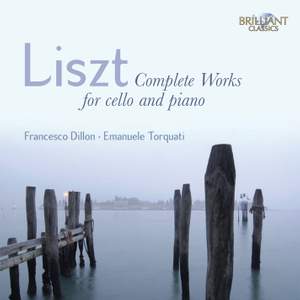
Francesco Dillon (cello) & Emanuele Torquati (piano) Many of Liszt’s works were transcribed for other instruments; both by the composer himself and other musicians. These hauntingly beautiful pieces for cello and piano were originally written for piano solo or the voice. They are from the final period of his life and are the product of his old age and his quest for spirituality. Far from the virtuoso brilliance of his earlier works, their intense and romantic melodies express melancholy and desolation, the sparse textures and harmonic instability daringly looking forward to the twentieth century. The rich and warm expressive qualities of the cello undoubtedly make these pieces even more effective. The most significant work in this collection is La lugubre gondola, a compelling piece written after Liszt had a premonition of Wagner’s death. It was inspired by the Venetian gondola funeral processions he observed during a visit to the city to see Wagner. The music conveys the stillness of a Venetian lagoon, the unsettling harmonies also evoking the underlying darkness and despair. Another work with a very personal connection is the nostalgic Die Zelle in Nonnenwerth, a transcription of one of his songs. Nonnenwerth was an island in the Rhine where Liszt spent time with Marie d’Agoult and their children, and his fondness for the work resulted in many different versions for solo piano, voice and piano duet as well as this version for cello and piano. There are also transcriptions for cello and piano by other musicians of some of his most popular piano works, including the six Consolations, Angelus! From the third volume of Années de Pelèrinages and the Liebestraum No.3. The performers of this moving collection of works are the Italian cellist Francesco Dillon and the pianist Emanuele Torquati. Francesco Dillon performs as a soloist and with chamber groups all over the world and has made several recordings of unusual cello repertoire, including an album of Schumann rarities for Brilliant Classics. | | | Usually despatched in 4 - 5 working days. |
|
|
| |  | Liszt: Works for Violin and Piano Volume 1
Liszt: | Elegie No. 1, S130 Elegie No. 2, S131 Die drei Zigeuner for violin & piano, S. 383 Romance oubliée, for viola/cello/violin & piano, S. 132 La Lugubre Gondola for cello & piano, S134 Grand duo concertant sur la romance 'Le Marin', S. 128 Epithalam, S129 Benedictus S381, No. 1 Offertorium S381, No. 2 |
Friedemann Eichhorn (piano) & Rolfe-Deiter Arens (violin) Friedemann Eichhorn is a German violinist with the unique gift of projecting into different musical idioms. While generally not known as a composer of chamber music, Liszt wrote music for violin and piano throughout his career. While several pieces are arrangements of songs or works originally composed for piano solo, many are original compositions and explore the same stylistic explorations that can be found in Liszt's more famous compositions - including the use of folk materials, harmonic and melodic experimentations and cyclical forms. “…the second Elegie and the Romance oubliée… best suit violinist Friedemann Eichhorn, the slight graininess in his tone never oversweetening Liszt's potent austerity; his tuning, too, is impeccable.” Gramophone Magazine, Awards Issue 2009 | | | (also available to download from $10.50) | Usually despatched in 2 - 3 working days. (Available now to download.) |
|
|
| |  | Alkan - Cello Sonata
| | | Usually despatched in 3 - 4 working days. |
|
|
| |
|