This page lists all recordings of Eight Poems of Emily Dickinson, by Aaron Copland (1900-90) on CD & download (MP3 & FLAC). Generally, more recent releases are listed first, but with priority given to those that are in stock. |
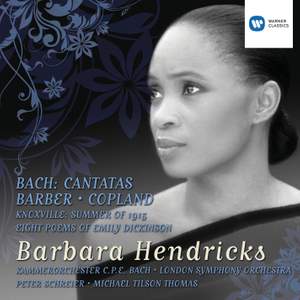
Prices shown exclude VAT. (UK tax is not payable for deliveries to United States.) See Terms & Conditions for p&p rates. | |  | Barbara Hendricks sings Bach, Barber & Copland
Barbara Hendricks' voice — particularly suited to Mozart, Debussy, Fauré, and the lighter roles of Puccini and Richard Strauss — has a warm, crystalline quality that has kept her in demand on stage and in recording studios. Her performances have embraced everything from contemporary music to popular standards, including songs of Duke Ellington and several world premieres. She has been careful with her choices of repertoire, avoiding roles that would overextend her essentially lyric instrument. Aside from music, she is deeply committed to humanitarian work, with a particular concern for refugees and those in war or poverty zones. She sang a concert in Sarajevo in 1993 while the city was being shelled, in which she had to wear a bulletproof vest and helmet. Hendricks has appeared on nearly 80 recordings spread over a variety of major labels. Her first of many recordings for EMI was in the small part of the Celestial Voice in Don Carlo in 1978. For nearly twenty years her solo recordings have been made exclusively for EMI Classics. “This lovely singer is here at her best...she is ideal in the purity and sweetness of her singing.” BBC Music Magazine, December 2010 **** | | | In stock - usually despatched within 1 working day. |
|
|
| |  | Between the Bliss and Me… Songs to Poems of Emily Dickinson
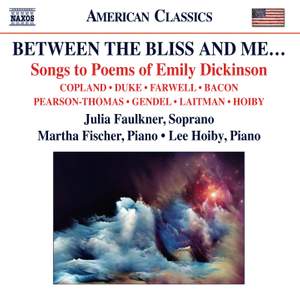
Bacon: | To make a prairie Julia Faulkner (soprano), Martha Fischer (piano) It's all I have to bring Julia Faulkner (soprano), Martha Fischer (piano) And this of all my hopes Julia Faulkner (soprano), Martha Fischer (piano) | Copland: | Eight Poems of Emily Dickinson Julia Faulkner (soprano), Martha Fischer (piano) | Duke, J W: | Bee! I'm expecting you! Julia Faulkner (soprano), Martha Fischer (piano) | Farwell: | The Butterfly Julia Faulkner (soprano), Martha Fischer (piano) Aristocracy Julia Faulkner (soprano), Martha Fischer (piano) I'm nobody! Who are you? Julia Faulkner (soprano), Martha Fischer (piano) Wild Nights! Julia Faulkner (soprano), Martha Fischer (piano) | Gendel: | Forgotten Light Julia Faulkner (soprano), Martha Fischer (piano) | Hoiby: | The Shining Place Lee Hoiby (piano) | Laitman: | I gained it so Julia Faulkner (soprano), Martha Fischer (piano) | Thomas, R P: | I never saw a moor Julia Faulkner (soprano), Martha Fischer (piano) |
| 
| | | (also available to download from $6.00) | Usually despatched in 2 - 3 working days. (Available now to download.) |
|
|
| |  | David Curtis conducts Copland, Barber & Gershwin
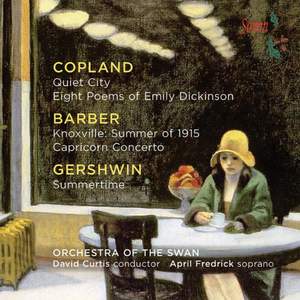
April Fredrick (soprano) Orchestra of the Swan, David Curtis These live recordings showcase the spectacular voice and wonderful musicianship of American soprano April Fredrick whose star is now firmly in the ascendent. Much of this American repertoire is tailor-made for this artist, highlighting her expressive voice and sensitivity. | | | Usually despatched in 2 - 3 working days. |
|
|
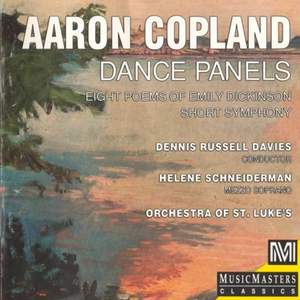
| |  | Dennis Russell Davies conducts Copland
Dance Panels, is probably the least familiar of the works on this CD to a general audience. It was written in 1959 at the suggestion of Jerome Robbins and is scored for six woodwinds, five brass, two percussion and strings. It was first performed in Munich in 1963. Copland wrote that “it is more abstract, and it is lyrical and slower in tempo than most of my other ballet music. It does not tell a story or paint a picture of American life.” Copland was originally attracted by Emily Dickinson’s poem The Chariot, which contains the famous line “Because I could not stop for death, he kindly stopped for me.” The original cycle, was written between 1948 and 1950; in the late 1960s, Copland orchestrated eight of the songs for the version performed here. The Short Symphony of 1933 is unquestionably a major work; it may stand as one of Copland’s most assertive and radical expressions of his own distinctive modernism. It is now usually heard in Copland’s own 1937 rearrangement of the music for sextet. Copland was always proud of the original work and referred to it as one of his ‘neglected children’. “If I expended a great deal of time and effort on the Short Symphony, it was because I was determined to write as perfected a piece as I possibly could.” | | | Usually despatched in 4 - 5 working days. |
|
|
| |  | Copland: Appalachian Spring
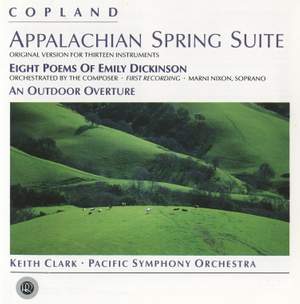
Marni Nixon Pacific Symphony Orchestra, Keith Clark | | | Usually despatched in 2 - 3 working days. |
|
|
| |  |
| | | Usually despatched in 4 - 5 working days. |
|
|
| |
|