Prices shown exclude VAT. (UK tax is not payable for deliveries to United States.) See Terms & Conditions for p&p rates. | |  | Fischer-Dieskau sings Brahms & Schumann
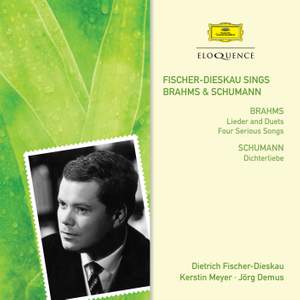
Brahms: | Vier ernste Gesänge, Op. 121 Sommerabend, Op. 85 No. 1 Mondenschein, Op. 85 No. 2 Es liebt sich so lieblich, Op. 71 No. 1 Meerfahrt, Op. 96 No. 4 Es schauen die Blumen, Op. 96 No. 3 Der Tod, das ist die kühle Nacht, Op. 96 No. 1 Mit vierzig Jahren, Op. 94 No. 1 Steig auf, geliebter Schatten, Op. 94 No. 2 Mein Herz ist schwer, Op. 94 No. 3 Kein Haus, keine Heimat, Op. 94 No. 5 Herbstgefühl, Op. 48 No. 7 Alte Liebe, Op. 72 No. 1 Abenddämmerung, Op. 49 No. 5 Heimweh, Op. 63 No. 8 Auf dem Kirchhofe, Op. 105 No. 4 Verzagen, Op. 72 No. 4 Regenlied (No. 3 from Acht Lieder und Gesänge, Op. 59) Nachklang (No. 4 from Acht Lieder und Gesänge, Op. 59) Fruhlingslied, Op. 85, No. 5 Auf dem See (No. 2 from Acht Lieder und Gesänge, Op. 59) Feldeinsamkeit, Op. 86 No. 2 An eine Äolsharfe, Op. 19 No. 5 Der Frühling, Op. 6 No. 2 Wie die Wolke nach der Sonne (No. 5 from Sechs Gesänge, Op. 6) Treue Liebe, Op. 7, No. 1 Heimkehr, Op. 7 No. 6 Juchhe! (No. 4 from Sechs Gesänge, Op. 6) Nachwirkung, Op. 6 No. 3 Mondnacht, WoO 21 Ein Sonett, Op. 14 No. 4 (Herder) Ständchen, Op. 14 No. 7 Vor dem Fenster Op. 14 No. 1 Scheiden und Meiden, Op. 19, No 2 Gang zur Liebsten, Op. 14 No. 6 Von verwundeten Knaben, Op. 14 No. 2 Murrays Ermordung, Op. 14 No. 3 Sehnsucht 'Mein Schatz ist nicht da', Op. 14 No. 8 Volkslied Kerstin Meyer (contralto) Duette (4), Op. 28 | Schumann: | Dichterliebe, Op. 48 |
‘You sing as if you had written it yourself!’ Jean Cocteau once told Dietrich Fischer-Dieskau. This anthology of lieder by Brahms and Schumann is a prime example of the great singer doing just that, mining every nuance of emotion from a song while, at the same time, sounding as spontaneous and free as if he were making it up on the spot. One of the hallmarks of Fischer-Dieskau’s legacy is the ease with which he creates the spell of each individual song, drawing the listener – apparently effortlessly – into the drama created by the words and the music. Fischer-Dieskau recorded extensively for Deutsche Grammophon, and the bulk of his archive has been mined on CDs. These recordings, however, are rarities. The songs on CD1 appeared only as part of the Fischer-Dieskau Edition for his 75th birthday. The Brahms songs on CD2 make their first appearance on CD. And the 1957 recording of Schumann’s Dichterliebe with his long-time pianist Jörg Demus, only appeared as part of Deutsche Grammophon’s centenary edition. CD2 includes the Four Duets, Op. 28 in which Fischer-Dieskau is partnered by an artist not heard enough on records, the contralto Kerstin Meyer. This release marks the launch of an Eloquence series of notable recitals of songs and opera arias by some of the great voices of Decca and Deutsche Grammophon. “A moving Brahms Four Serious Songs from a young and physically impassioned Fischer-Dieskau, and a fascinatingly exploratory Dichterliebe from 1957, both incomparably accompanied.” BBC Music Magazine, June 2012 ***** “Fischer-Dieskau is a superb interpreter of the cycle” Gramophone Magazine (Dichterliebe) “this is a masterly performance, a towering interpretation of these dark, noble songs” Gramophone Magazine (Brahms: Four Serious Songs) “Fischer-Dieskau is splendid in the furious little Hahm setting, Kein Haus, keine Heimat, the shortest of all Brahms’s songs, and gives a ravishing account of Feldeinsamkeit. … [His] performance is clearly among the greatest” Gramophone Magazine (Brahms) | | | In stock - usually despatched within 1 working day. |
|
|
| |  | Dietrich Fischer-Dieskau sings Lieder
Brahms: | Feldeinsamkeit, Op. 86 No. 2 Auf dem See (No. 2 from Acht Lieder und Gesänge, Op. 59) Abenddämmerung, Op. 49 No. 5 Alte Liebe, Op. 72 No. 1 Verzagen, Op. 72 No. 4 Regenlied (No. 3 from Acht Lieder und Gesänge, Op. 59) | Schubert: | Liebesbotschaft, D957 No.1 Der Atlas, D957 No. 8 Ihr Bild, D957 No. 9 Das Fischermädchen D957 No. 10 Die Stadt, D957 No. 11 Am Meer, D 957 No. 12 Die Taubenpost, D965A (D957 No. 14) Am feierabend (No. 5 from Die schöne Müllerin, D795) Trockne Blumen (No. 18 from Die schöne Müllerin, D795) Nacht und Träume, D827 | Schumann: | In der Fremde (No. 1 from Liederkreis, Op. 39) Waldesgesprach (No. 3 from Liederkreis, Op. 39) Mondnacht (No. 5 from Liederkreis, Op. 39) Schöne Fremde (No. 6 from Liederkreis, Op. 39) Auf einer Burg (No. 7 from Liederkreis, Op. 39) Wehmut (No. 9 from Liederkreis, Op. 39) Im Walde (No. 11 from Liederkreis, Op. 39) Frühlingsnacht (No. 12 from Liederkreis, Op. 39) |
“The main purpose of this frustratingly fragmentary and unevenly mastered compilation of Lieder treasure seems to be to give a sampler tasting of the young Fischer-Dieskau in the 1950s, with a varied palette of accompanists.” BBC Music Magazine, February 2010 **** “The voice is again in finest condition, the art wonderfully flexible in its transitions from light-heartedness to the intensity of despair. The Liederkreis songs include a magical "Mondnacht" and a vividly "faced" "Im Walde". The Brahms group opens with Feldeinsamkeit, masterly in control, technical and expressive. The remastered sound is very immediate, sometimes almost uncomfortably so, but the impression is strong, probably ineffaceable.” Gramophone Magazine, December 2009 | | | In stock - usually despatched within 1 working day. |
|
|
| |  | Fischer-Dieskau 85th Birthday Edition: Brahms LiederBerlin Philharmonie, 1972 (live)
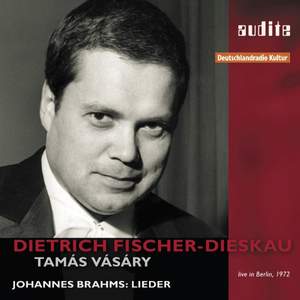
Brahms: | Nachtwandler, Op. 86 No. 3 Wehe, so willst du mich wieder, Op. 32 No. 5 Abenddämmerung, Op. 49 No. 5 Meerfahrt, Op. 96 No. 4 Wie rafft' ich mich auf Op. 32,1 (v.Platen) Geheimnis, Op. 71 No. 3 Wir wandelten, wir zwei zusammen Op. 96/2 Botschaft, Op. 47 No. 1 Lindes Rauschen in den Wipfeln, Op. 3, No. 6 Regenlied (No. 3 from Acht Lieder und Gesänge, Op. 59) Ständchen, Op. 106 No. 1 Wie bist du, meine Königin Op. 32 No. 9 Fruhlingslied, Op. 85, No. 5 Unüberwindlich, Op. 72 No. 5 Sonntag, Op. 47 No. 3 Der Gang zum Liebchen, No. 1, Op. 48 Wehe, so willst du mich wieder, Op. 32 No. 5 Feldeinsamkeit, Op. 86 No. 2 |
These releases from the archives of the RIAS and the Sender Freies Berlin document the unequalled quantitative and qualitative spectrum which baritone Fischer-Dieskau acquired during the five decades of his career. They offer a fascinating insight into the breadth of his repertoire as well as his artistic approach, with which he maintained a careful balance of development and continuity until the end. These recordings – spanning Beethoven’s sacred songs Op. 48 of 1806, through Schumann, Brahms, Mahler and Reger, to Heinrich Sutermeister’s expressive psalm setting of 1948 – demonstrate the essential Fischer-Dieskau. Not only do they document the artistic partnership with pianists such as Hertha Klust, Daniel Barenboim, Cord Garben, Aribert Reimann and Tamás Vásáry, but also the delightful collaboration with the organist Ulrich Bremsteller. Furthermore, Dietrich Fischer-Dieskau can be heard together with his wife and musical partner, Julia Varady. This is a documentary edition both in the sense of a historic and an artistic legacy: it reveals the riches of lieder from the last two centuries which Fischer-Dieskau, in his role of musical chronicler, made accessible for the present age; and it is an impressive record of an incomparable interpretational art, according to which word and music were always treated and realised as a unit. | | | Usually despatched in 3 - 4 working days. |
|
|
| |  | Schumann - Dichterliebe
Brahms: | Nachtigallen schwingen, Op. 6 No. 6 Lerchengesang Op. 70 No. 2 Nicht mehr zu dir zu gehen, Op. 32 No. 2 Über die Heide Op. 86 No. 4 Wie rafft' ich mich auf Op. 32,1 (v.Platen) Auf dem Kirchhofe, Op. 105 No. 4 Von ewiger Liebe, Op. 43 No. 1 O kühler Wald, Op. 72 No. 3 Es schauen die Blumen, Op. 96 No. 3 Feldeinsamkeit, Op. 86 No. 2 Nachtwandler, Op. 86 No. 3 Verzagen, Op. 72 No. 4 An eine Äolsharfe, Op. 19 No. 5 Nachtigall, Op. 97 No. 1 Abenddämmerung, Op. 49 No. 5 An die Nachtigall, Op. 46 No. 4 (Text: L.C.H. Hölty) | Schumann: | Dichterliebe, Op. 48 |
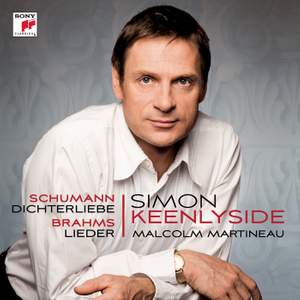
“Here is a singer-actor who has it all…” The Sunday Times “In a league of his own…” The Sunday Telegraph “The king of barnstorming performances…” The Independent Sony Music Entertainment UK is pleased to present the first of three albums by British baritone Simon Keenlyside, who has recently signed a new exclusive recording contract with the Sony UK company. The first recording under this exciting new agreement features Schumann’s Dichterliebe, Op.48, and a selection of Lieder by Brahms, sensitively accompanied by pianist Malcolm Martineau. Simon Keenlyside was born in London and studied zoology at Cambridge before attending the Royal Northern College of Music for vocal studies. One of the world’s most sought-after and charismatic singers, he has appeared at many of the world’s major opera houses and concert halls, and is noted for his versatility and highly charged performances. Highlights of his career so far include his acclaimed performance of Billy Budd at the ENO, Prospero in the world premiere of Thomas Ades' The Tempest, at the Royal Opera House, Covent Garden; Count Almaviva in Milan and Vienna under Muti; Don Giovanni in Ferrara under Abbado and Pelleas in San Francisco, Geneva and Paris. Simon Keenlyside won the 2006 Olivier Award for outstanding achievement in Opera for his performance of Billy Budd at ENO and Winston in the world premiere of 1984 at the Royal Opera House, Covent Garden, and in 2007 he won a Gramophone Award for Tales Of Opera, his album of operatic arias recorded for Sony Music in Germany. “Throughout, the baritone combines a detailed approach with an overview, demonstrating an exceptional ability to seek out the meaning of both text and music, holding them together in one single image. …a great Lieder singer at the peak of his powers. He is well served by his accompanist, who deploys a huge range of tone and colour with an equally firm artistic intent.” BBC Music Magazine, November 2009 ***** | | | Usually despatched in 3 - 4 working days. |
|
|
| |  | Edition Fischer-Dieskau Vol. 4 - Beethoven & Brahms Lieder
Beethoven: | Maigesang, Op. 52 No. 4 Marmotte, Op. 52 No. 7 Zärtliche Liebe 'Ich liebe dich', WoO 123 In questa tomba oscura, WoO.133 Andenken, WoO 136 Neue Liebe, Neues Leben, Op. 75, 2 Mephistos Flohlied, Op. 75, 3 Wonne der Wehmut, Op. 83 No. 1 Sehnsucht, Op. 83, 2 An die Hoffnung, Op. 94 | Brahms: | Heimkehr, Op. 7 No. 6 Ein Sonett, Op. 14 No. 4 (Herder) Wie rafft' ich mich auf Op. 32,1 (v.Platen) Botschaft, Op. 47 No. 1 Abenddämmerung, Op. 49 No. 5 Es träumte mir (No. 3 from Acht Lieder und Gesänge, Op. 57) Eine gute, gute Nacht (No. 6 from Acht Lieder und Gesänge, Op. 59) Dein blaues Auge, (No. 8 from Acht Lieder und Gesänge, Op. 59) Sommerabend, Op. 85 No. 1 Mondenschein, Op. 85 No. 2 Ständchen, Op. 106 No. 1 |
Hans Mayer wrote “He knew exactly what he wanted to sing and how to go about it. The word ‘magnetism’ – so frequently misappropriated for all types of advertising – fully applied in his case.” Beginning in the late 1940s “FiDi,” as he was already known in his Berlin years, elevated lied singing to an unparalleled level associated with his mellifluous baritone, superb vocal technique, and the credibility of his interpretations. Fortunately the persuasive powers of his early years are attested to not only by ear witnesses but by many radio recordings. These two sets of lieder by Johannes Brahms and Ludwig van Beethoven are taken from two recording sessions held at Berlin’s RIAS broadcasting company in 1951/52. Beethoven’s lieder did not belong to the standard repertoire at the time, and it was Fischer-Dieskau who first popularized them. | | | Usually despatched in 3 - 4 working days. |
|
|
| |
|