All recordingsPrices shown exclude VAT. (UK tax is not payable for deliveries to United States.) See Terms & Conditions for p&p rates. | |  | Opium (Mélodies Françaises)
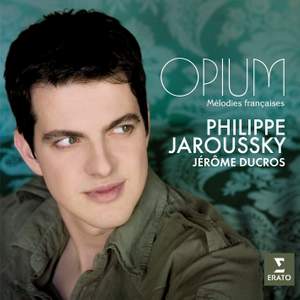
Unsurprisingly, it is in the music of the Baroque era – the heyday of the castrato – that French countertenor Philippe Jaroussky has captured the attention of music-lovers lovers around the world. The ethereal, but sensuous beauty of his voice, his virtuosity and his sense of style have brought him critical praise, a number of major awards – including, in 2008, Germany’s prestigious Echo-Klassik prize for Male Singer of the Year, honouring his Virgin Classics album, Carestini: The Story of a Castrato – and impressive sales: more than 120,000 copies of his Vivaldi album Heroes and 90,000 of the Carestini release. Jaroussky enters new territory with this programme of French songs from the late 19th and early 20th centuries – well over a hundred years after the end of the Baroque era. Taking its name, Opium, from a song by Saint-Saëns, it evokes the voluptuous, sometimes decadent spirit of the Belle Époque, the era of transition between Romanticism and Modernism. The programme includes a number of rarities by composers such as Dukas, Caplet, and Chaminade, as well as better-known numbers by figures like Fauré, Chausson and Hahn. “Many people will probably wonder why a counter tenor should sing these songs,” says Jaroussky, “but if you think about it, the countertenor voice as such has no repertoire of its own, except the modern music written specifically for it. For the most part we sing music written for castratos who – as we know – had very different voices from ours. So why not venture into other musical worlds if we feel they are suited to our voices? … There has been David Daniels in Schubert, Max Emmanuel Cencic in Rossini, and even Andreas Scholl and Gérard Lesne in pop music. “I’ve always felt a special affinity for French song, which was an area of focus in the early days of my studies with my teacher, Nicole Fallien. It was Renaud Capuçon -- whom I want to thank, along with Gautier Capuçon and Emmanuel Pahud for his valuable contribution to this disc -- who first had the idea of inviting me to sing Hahn, Chausson, Fauré in a recital. It was then that I met the pianist Jérôme Ducros, and we decided to work further on this rich and well-stocked repertoire, which contains some real undiscovered treasures. There is no theme to this album, but I wanted to record songs which have captured my heart and which suit my voice. Perhaps I can show them in a new light too.” French song demands an acute sense of language and style, and today there are relatively few singers --- even native Francophones – who succeed in capturing its elusive magic. “I’ve decided to pronounce the texts in a way that is as close as possible to the spoken word – I don’t roll the ‘r’, for example,” continues Jaroussky. “The poetry should come to life without the imposition of too much interpretation or emotional contrivance. I’ve tried to approach it with humility.” "Philippe Jaroussky is one of the best countertenors around. His voice is mellow, evenly toned, wide-ranging and largely free from intrusive mannerism and vocal strain” BBC Music Magazine, February 2007 “Philippe Jaroussky has a wide pitch range and absolute control throughout, with no tenseness at the top of hooting at the bottom, and his floated high notes are ravishing. Jérôme Ducros's accompanying is some of the best I have heard.” BBC Music Magazine, April 2009 **** “His repertoire is fabulous, mixing gold star favourites with striking curios by non-song composers such as Dukas. The instrumental back-up from Jerome Ducros, the Capuçon brothers and Emmanuel Pahud is superb.” The Times, 28th March 2009 *** | | | In stock - usually despatched within 1 working day. |
|
|
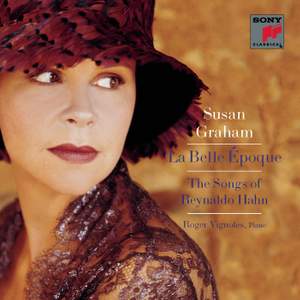
| |  | La Belle Époque: The Songs of Reynaldo Hahn
| | | In stock - usually despatched within 1 working day. |
|
|
| |  | The Exquisite Hour
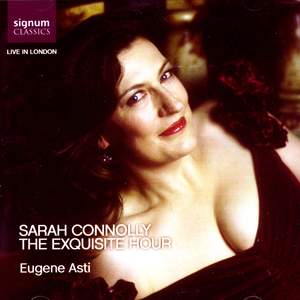
Brahms: | Ständchen, Op. 106 No. 1 Da unten im Tale (No. 6 from Deutsche Volkslieder, WoO 33) Nachtwandler, Op. 86 No. 3 Feldeinsamkeit, Op. 86 No. 2 Alte Liebe, Op. 72 No. 1 Die Mainacht, Op. 43 No. 2 Von ewiger Liebe, Op. 43 No. 1 | Britten: | Tit for Tat | Hahn, R: | À Chloris L'Enamourée Trois jours de vendange L'heure exquise Quand je fus pris au pavillon | Haydn: | Arianna a Naxos, cantata, Hob.XXVIb/2 | Ireland: | Her song | Korngold: | Glückwunsch Alt-Spanisch Sterbelied Gefasster adschied | Weill, K: | Lost in the stars Speak low |
“a hugely impressive disc, testifying to the versatility and range of a singer who has already drawn comparisons with Janet Baker” The Guardian “A national treasure” Evening Standard “Connolly's lovely singing reaches to the sensuous core” The Telegraph “Almost seven years ago we went to the Wigmore Hall expecting to hear a well known soprano only to find that she had been replaced by a less well-known mezzo. Sarah Connolly had already appeared with the English National Opera in major roles such as Handel's Xerxes and Donizetti's Mary Stuart. Disappointment at missing the scheduled artist vanished with the completion of the substitute's first phrases. Delight took its place and increased steadily throughout the recital. It was a clear, fresh and powerful voice, used with intelligent assurance, and by the final groups (Duparc and Falla) she had established with the audience the rapport of a much more experienced artist. What was true at the Wigmore holds for this concert at St John's, Smith Square, where her success with the audience is again unmistakable and fully merited. Again, her choice of programme contributes to the success: a judicious mixture of the familiar and out-of-the-way, and well suited to voice and style. The Brahms group is particularly satisfying, with Die Mainacht broadly phrased, Nachtwandler imaginatively hushed and Von ewigerLiebe warmly felt. The Hahn songs are equally (if contrastingly) delightful, the two pastiche pieces, A Chloris and Quand je fus pris au pavillon charmingly in period. Weill's Speak Low and Ireland's Her Song are winning encore pieces. That leaves Haydn's Arianna a Naxos, the long and demanding concert aria which opens the programme. Here we find a substantial achievement and a limitation. The style is admirably clean and the emotional range well probed, but the whole remains a little impersonal and one is driven to comparisons. Janet Baker brings warmer humanity and a more memorable timbre while Cecilia Bartoli is more vivid – hear her intense 'Tradita io sono' for instance, or the pale 'Già più non reggo' or the furious final 'Barbaro ed infedel'. That comparison does, however, throw into a very favourable light Eugene Asti's accompaniment: where András Schiff (for Bartoli) is over– assertive, Asti is sensitive and keeps proportion. And indeed he does so throughout: a constant pleasure and a major contribution to the recital's undoubted success.” Gramophone Classical Music Guide, 2010 “Connolly woos her audience with the calling-card for any and every mezzo: Haydn's dramatic cantata, Arianna a Naxos. And every second of its nervous and emotional life - its hopes, fears and final despair - are uncovered in Connolly's superbly observant voice and imagination.” BBC Music Magazine, March 2006 ***** “…a clear, fresh and powerful voice, used with intelligent assurance… The Brahms group is particularly satisfying, with Die Mainacht broadly phrased, Nachtwandler imaginatively hushed and Von ewiger Liebe warmly felt. The Hahn songs are equally… delightful, the two pastiche pieces, A Chloris and Quand je fus pris au pavillon charmingly in period. ...Weill's Speak Low and Ireland's Her Song are winning encore pieces.” Gramophone Magazine, May 2006 | | | Usually despatched in 3 - 4 working days. |
|
|
| |  | Annette Celine
Annette Celine (soprano), Christopher Gould (piano) | | | Usually despatched in 2 - 3 working days. |
|
|
| |  | Airs Chantés
Hélène Guilmette (soprano); Delphine Bardin (piano) | | | Usually despatched in 3 - 4 working days. |
|
|
| |  | Voyage à ParisChansons Françaises
| | | Usually despatched in 4 - 5 working days. |
|
|
| |
|