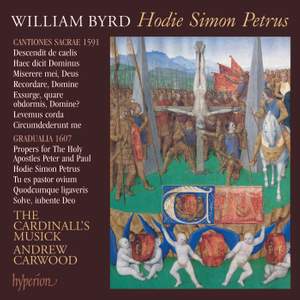
“All save one of these works come from two collections published by William Byrd, Cantiones Sacrae, of 1591, and the 1607 Gradualia, the former among his most deeply touching pieces. Descendit de caelis, a setting of a respond for Christmas Day, tells of anguish rather than joy, betraying the heavy oppression that recusant Catholics, of whom Byrd was one, suffered in Elizabethan England. The pieces from Gradualia are all six-voice motets for the feast of Saints Peter and Paul, in which we hear Byrd at his most modern, with lively rhythms and dense, closely imitative counterpoints. Carwood and his 10 singers relish the music’s expressivity and sophistication to the full.” Sunday Times, 15th February 2009 ****
“The performances are admirably directed, responsive to words, clear in their exposition of counterpoint, carefully blended in the homophonic passages. The Cardinall's Musick is an expert body of singers who know exactly what they are doing.” Gramophone Magazine, April 2009
“…this performance is unparalleled in its depth of expression and intelligence. The Cardinall's Musick unerringly leads the listener to musical events that unlock Byrd's conception. These may be either one word invested with meaning ('miseracordium' in the celebrated 'Miserere mei, Deus'), a climax throughout a movement (in 'Circumdederunt me'), or a gesture that accrues meaning (the descending triad in 'Hodie Simon Petrus'). Crystalline sound reproduction ensures that every detail is captured.” BBC Music Magazine, April 2009 *****
“The works for St Peter and St Paul … positively shimmer with exuberance … the beauties of these performances are revealed: litheness, energy and intelligence” International Record Review
“The completion of this series will be a landmark, but don’t wait to hear this beautiful disc” Fanfare
“Andrew Carwood's programme-note begins with a comment on the motet Haec dicit Dominus with which the programme ends. The lament of Rachel weeping for her children is thematic, if indeed we are to see these Cantiones sacrae of 1591 as a cry on behalf of the old, true believers besieged in a Protestant stronghold. As Rachel wept then, so (it is suggested) does the Church now. And yet there is hope ('et est spes') and this is the message reiterated throughout these heartfelt works of a master craftsman.
This is the 11th volume in The Cardinall's Musick's edition of Byrd's Latin settings. Apart from the Cantiones, the other major source is the Gradualia of 1607, probably written for the Catholics of Ingatestone Hall in Essex. The Litany from Book 2 (1605) is the principal variant in the mode of composition, which is dense in imitative polyphony, usually in six parts, concentrated in the intensity of their utterance.
Particularly fine examples are the Miserere mei,Deus and the vigorous Exsurge, quare obdormis,Domine? with its strong, well defined climax.
The performances are admirably directed, responsive to words, clear in their exposition of counterpoint, carefully blended in the homophonic passages. The Cardinall's Musick is an expert body of singers who know exactly what they are doing. Even so, balance and tone are not everywhere ideal: the bass-line, for instance, though utterly reliable, has been so stripped of natural vibrancy that the tone is dulled. A small point, no doubt, in relation to the riches their work is opening up.” Gramophone Classical Music Guide, 2010