Prices shown exclude VAT. (UK tax is not payable for deliveries to United States.) See Terms & Conditions for p&p rates. | |  | Trio Wanderer play Smetana & Liszt
This resolutely elegiac disc offers an opportunity to discover, through their chamber music, the dark side of two composers who are not often associated. Smetana’s primary purpose was to give utterance to a cry of pain at his daughter’s death through the appropriate medium of the piano trio. In the Liszt pieces, elegies and funeral gondolas remind us of the deeply human and tormented nature of a composer haunted by death and who, more than any other, was capable of expressing its icy smile. The Trio Wanderer realise all this in deeply moving performances. Since 1999, the Trio Wanderer has released, on Le Chant du Monde and harmonia mundi, a series of recordings that have received a warm welcome from the press, winning notably a best of the year award from Le Monde de la Musique for its CD of Haydn trios, and numerous international awards for Schubert’s ‘Trout’ Quintet and the trios of Shostakovich and Saint-Saëns. Its recording of the Brahms piano trios was honoured by a Diapason d’Or of the year 2006 and the Midem Classical Award in the chamber music category in January 2007. In 2009, the Trio Wanderer was voted ‘Best chamber music ensemble’ at the Victoires de la Musique for the third time (after 1997 and 2000). Jean-Marc Phillips plays a violin by Giovanni Battista Guadagnini (1738). Raphaël Pidoux plays a violoncello by Gioffredo Cappa (1680). “they excel together in Liszt's "Tristia" and separately in "Romance oubliée" and "La lugubre gondola".” The Independent on Sunday, 9th January 2011 “What a fascinating issue this is. The combination of arrangements and original compositions variously for piano, violin and cello by Liszt and Smetana's marvellous G minor Piano Trio is appropriate...The Wanderer Trio are very successful in the six chamber works by Liszt, negotiating the fearsome virtuosity of Tristia...with confidence.” BBC Music Magazine, February 2011 **** “Trio Wanderer captures the various shades of melancholy and nostalgia that Liszt voiced in these and four other works in a similar vein, and in Smetana’s Trio evokes the heartache and anguish that the composer expressed on the death of his young daughter.” The Telegraph, 21st January 2011 **** “Finding a coupling for Smetana’s grief-stricken G minor trio — written in response to the death of his four-year-old daughter — is not easy... but the Wanderers have come up with the brilliant idea of Liszt...It’s a programme heavy on existential angst, but the Wanderers bring a Wagnerian intensity and abandonment to Liszt’s almost orchestral writing, which is uplifting.” Sunday Times, 30th January 2011 **** “Smetana opens his Trio with an outpouring of anguish and grief that the Trio Wanderer projects with fearless intensity...Never has the Presto finale's hurtling forward momentum been so powerfully conceived...Recorded at a discrete distance, the Trio Wanderer's probingly expert playing is a constant of pleasure and illumination.” Classic FM Magazine, March 2011 **** “The individual playing throughout is remarkably fine, but it's the trio playing which impresses most; the players are responsive to each other's playing and pay meticulous attention to dynamic markings...the players explore extremes of tempo, so that the faster music is more incendiary and slower passages more poetic.” International Record Review, March 2011 | | | In stock - usually despatched within 1 working day. |
|
|
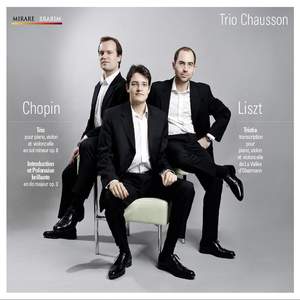
| |  | Trio Chausson play Chopin & Liszt
Frederic Chopin’s Polonaise Brillante, Op. 3, is one of the few pieces this composer ever wrote for an instrument besides piano. Written when he was only 19 years old, in the autumn of 1829, Chopin had fallen head over heels for a young woman in Warsaw. Unfortunately for Chopin, the love was unrequited. Chopin's father, in hopes of easing Chopin's heartbreak took his son on a week-long trip to visit the estate of Prince Radziwill, who had two beautiful young daughters. At least one of the daughters, Wanda, was a pianist. He composed the Polonaise Brillante for her to practice with her cello-playing father. Chopin wrote later to a friend that the piece was merely a salon piece to be enjoyed casually and that he had written it in a manner so as to show off the young Wanda's pretty fingers. However, he must have held it in some high regard, for he included it on a concert tour in 1830, dedicating it to Joseph Merk, a renowned cellist. Chopin also later added an introduction to the Polonaise, making the piece Introduction and Polonaise Brillante. His friend, the great cellist August Joseph Franchomme, helped Chopin make necessary revisions before its publication in 1833. | | | In stock - usually despatched within 1 working day. |
|
|
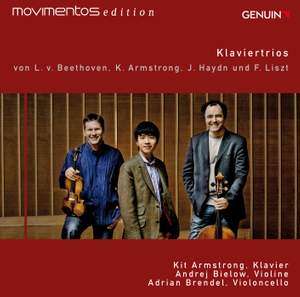
| |  | Beethoven, Armstrong, Haydn & Liszt: Piano Trios
Kit Armstrong (piano), Andrej Bielow (violin) & Adrian Brendel (cello) This trio includes the exceptionally talented Kit Armstrong, pianist, composer and pupil of Alfred Brendel. The cellist, Adrian Brendel, is Alfred Brendel’s son and Andrej Bielow leads the Szymanovski Quartet. | |
|
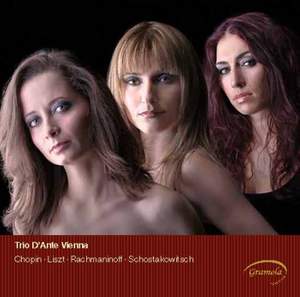
| |  | Chopin, Rachmaninov & Shostakovich: Piano Trios
| | | (also available to download from $10.50) | Usually despatched in 2 - 3 working days. (Available now to download.) |
|
|
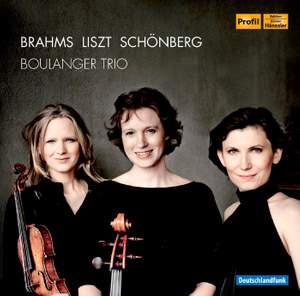
| |  | Boulanger Trio play Brahms, Liszt & Schoenberg
“The peaks of Brahms's first movement are scaled with utmost vehemence, the second theme surges on without let-up, the development is seized with nervous violence. Their reluctance to hold back lends an oppressive compulsion to Liszt's late, despair-filled transformation of Valle d'Obermann...It's a gripping disc from start to finish.” Gramophone Magazine, May 2012 | | | (also available to download from $10.50) | Usually despatched in 2 - 3 working days. (Available now to download.) |
|
|
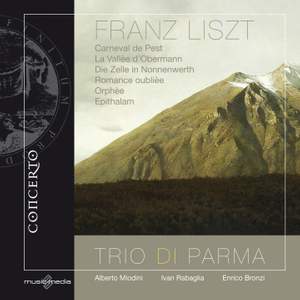
| |  | Liszt: Carneval de Pest - La Vallèe d'Obermann - Die Zelle in Nonnenwerth - Romance oublièe - Orphèe - Epithalam
Liszt: | Rapsodie hongroise XII, S379a Tristia, S723 (arranged from Vallée d'Obermann S160/6) Orpheus, symphonic poem No. 4, S98 arr. C. Saint-Saens for piano trio Die Zelle in Nonnenwerth, S382 Romance oubliée, for viola/cello/violin & piano, S. 132 La Lugubre Gondola for cello & piano, S134 Epithalam, S129 Grand duo concertant sur la romance 'Le Marin', S. 128 |
Alberto Miodini (piano), Ivan Rabaglia (violin), Enrico Bronzi (cello) Trio di Parma | | | (also available to download from $10.50) | Usually despatched in 4 - 5 working days. (Available now to download.) |
|
|
| |
|