Bartók: Kossuth Symphonic Poem Sz21

This page lists all recordings of Kossuth Symphonic Poem Sz21, by Béla Bartók (1881-1945) on CD, SACD & download (MP3 & FLAC).

Prices shown exclude VAT. (UK tax is not payable for deliveries to United States.)
See Terms & Conditions for p&p rates.

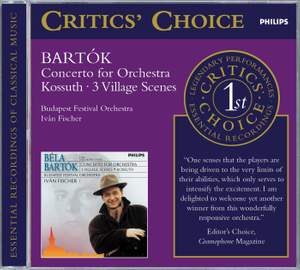
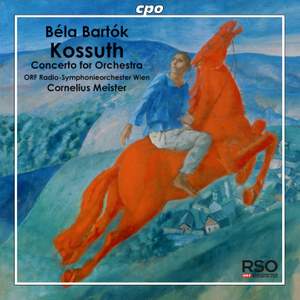
Bartók: Kossuth

Bartók: Kossuth


Bartók:

Kossuth Symphonic Poem Sz21

Concerto for Orchestra, BB 123, Sz.116

Romanian Folk Dances for orchestra, Sz. 68, BB 76


ORF Radio-Symphonieorchester Wien, Cornelius Meister

Béla Bartók’s symphonic poem Kossuth stands in the shadow of his later works and is hardly ever performed. It was written when Bartók was a mere twenty-year-old and celebrates the Hungarian freedom fighter Lajos Kossuth. It is a brilliantly instrumented, fiery work of his youth, and the opportunity to get to know it is a rewarding experience.

Cornelius Meister debuted at the Hamburg State Opera at the young age of twenty-one and numbers among today’s top young conducting marvels.

“In both the Concerto for Orchestra and the set of Romanian Dances included as an extra, there is plenty of characterful, extrovert playing, but Kossuth...needs much more cogency and tightly focused energy if it is not to seem just episodic” The Guardian, 4th April 2013 ***

Released or re-released in last 6 months

Super Audio CD

Format:

Hybrid Multi-channel

CPO - 7777842

(SACD)

$16.75

(also available to download from $10.50)

Usually despatched in 2 - 3 working days. (Available now to download.)

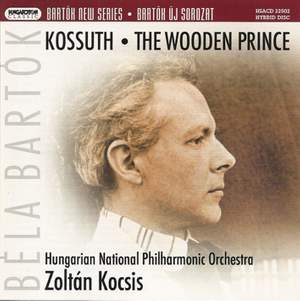
Bartok: The Wooden Prince and Kossuth

Bartok: The Wooden Prince and Kossuth


Bartók:

Kossuth Symphonic Poem Sz21

The Wooden Prince


The year 1848 is one of the most eventful in Hungarian history. It was the year of the Hungarian revolt – a life and death struggle of the nation for freedom. These events serve as the basis for the symphonic poem. The idea and its orchestration are Straussian, but the melody and harmony follow Liszt. Bartók wanted consciously to emphasize its Hungarian national character, and for this he found an example in Liszt’s symphonic poems, in particular those parts with a particularly Hungarian musical voice. This misled critics at the time, who heard in the Kossuth Symphony a direct continuation of Hungarian nineteenth century music. Today the Kossuth Symphony strikes us as remote and alien even when compared to such early works as for example the Bagatelles finished in 1908 or the First String Quartet. But with a modern ear we can hear moments in the humorous or funeral music which project in advance traces of the musical thinking of the mature Bartók.

The story of The Wooden Prince was published in scenario form on December 16th 1912, giving a detailed description of the staging and the content of eight dances. Its author was the writer, poet and film critic Béla Balázs (1884–1949) who was also the librettist of Bartók’s opera Bluebeard’s Castle finished in 1911, and who – as he said himself – wrote the ballet specially for Bartók.

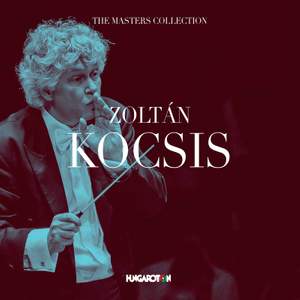
“Kocsis's account of Kossuth is terrific - the best we now have, I'd say. The Wooden Prince ballet has enjoyed a rather more distinguished recorded history than Kossuth… Kocsis is a master of idiomatic rubato, of holding the crest of a phrase (the first dance) and of course he fully understands, even relishes, the rustic element (ie. the fourth dance with its spicy col legno strings). If you already have Fischer's equally fine Wooden Prince I wouldn't suggest swapping... but if you haven't and the present coupling appeals then I would wholeheartedly recommend this new CD.” Gramophone Magazine, June 2007

“Kocsis's account of Kossuth is terrific – the best we now have. The budding composer's youthful essay has rarely sounded more engaging, for example in the tangy portrait at the start of the piece, the Wagnerian picture of 'The Battlefield', and the cynical minor-key distortion of the Austrian Hymn in the eighth section, the bizarre way Hungarian and Austrian motives collide. Heldenleben is an obvious forebear and Kocsis directs a performance that suggests a paprika-flavoured variant on Straussian exuberance.
The Wooden Prince ballet has enjoyed a rather more distinguished recorded history than Kossuth, with Fischer, Boulez and, from the analogue era, Dorati offering the best versions thus far. As with Bartók's piano music, Kocsis is a master of idiomatic rubato, of holding the crest of a phrase (the first dance) and of course he fully understands, even relishes, the rustic element (ie, the fourth dance with its spicy col legno strings). Like Fischer, he knows how to focus a narrative, for example the drooping brass glissandi when the prince is 'in greatest despair'.
And there's the humour – the tipsy-sounding bassoon as the disorderly prince unsuccessfully attempts to dance with the princess. Swathes of post-impressionist tone-painting (the enchantment scene) alternate with passages of great delicacy and Hungaroton's fairly close-set recording captures it all vividly. If you already have Fischer's equally fine Wooden Prince stick with it, but if you haven't and the present coupling appeals then I would wholeheartedly recommend this new CD.”
Gramophone Classical Music Guide, 2010

“Kocsis relishes both the impressionistic colours and the earthy Hungarian rhythms and humour of the ballet score The Wooden Prince; his account of the tone poem Kossuth is widely recognised as the best available.” BBC Music Magazine, September 2010

GGramophone Awards 2007

Finalist - Orchestral

Super Audio CD

Format:

Hybrid Multi-channel

Hungaroton Bartók New Series - HSACD32502

(SACD)

$15.75

This item is currently out of stock at the UK distributor. You may order it now but please be aware that it may be six weeks or more before it can be despatched.

Copyright © 2002-13 Presto Classical Limited, all rights reserved.