Prices shown exclude VAT. (UK tax is not payable for deliveries to United States.) See Terms & Conditions for p&p rates. | |  | Hermann Uhde
Albert, E: | Hüll' in die Mantille dich fester ein (from Tiefland) | Bizet: | Votre toast je peux vous le rendre 'Toreador Song' (from Carmen) | Handel: | Dall'ondoso periglio (from Giulio Cesare) Aure, deh, per pietà (from Giulio Cesare) | Verdi: | Cortigiani, vil razza dannata (from Rigoletto) Tutte le feste (from Rigoletto) | Wagner: | Die Frist ist um (from Der fliegende Holländer) Dank, König, dir, daß du zu richten kamst! (from Lohengrin) Erhebe dich, Genossin meiner Schmach! (from Lohengrin) Leb wohl, du kühnes, herrliches Kind! (from Die Walküre) | Weber: | Hier im ird'schen Jammertal (from Der Freischütz) Schweig, schweig (from Der Freischütz) |
Hermann Uhde was a German Wagnerian baritone. In December 1961 Audrey Williamson wrote in Opera magazine: “On the opera stage the connection of intellect and passion is seldom. This is why stage singers like Hermann Uhde deserve the greatest appreciation; they uplift the opera to the highest level of musical drama.” All arias are sung in German | | | Usually despatched in 2 - 3 working days. |
|
|
| |  | Jaro Prohaska
Jaro Prohaska (bass-baritone) One of the most outstanding bass-baritones between 1920 and 1950. For twelve years he was one of the most outstanding performers at Bayreuth. | | | Usually despatched in 2 - 3 working days. |
|
|
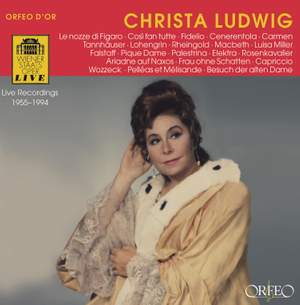
| |  | Christa Ludwig - Vienna State Opera
Beethoven: | Abscheulicher! Wo eilst du hin? (from Fidelio) | Berg: | Dort links geht's in die Stadt (from Wozzeck) | Berlioz: | Pardonne, Iopas...O pudeur! Tout conspire (from Les Troyens) | Bizet: | L'amour est un oiseau rebelle 'Habanera' (from Carmen) sung in German | Debussy: | Voici ce qu'il ecrit a son frere (from Pelléas et Mélisande) | Einem: | Das Herz mit deinem und meinem Namen | Mozart: | Non so più cosa son, cosa faccio (from Le nozze di Figaro) Ah, guarda, sorella (from Così fan tutte) Sento, o Dio (from Cosi fan tutte) Il core vi dono (from Così fan tutte) sung in German | Pfitzner: | Schonste ungnad'ge Dame (from Palestrina) | Rossini: | Nacqui all'affanno, al pianto...Non più mesta (from La Cenerentola) sung in German | Strauss, R: | Ich furchte, Frau Grafin Sie werden nach dieser Einfuhrung (from Capriccio) Sein wir wieder gut (from Ariadne auf Naxos) Da geht er hin (from Der Rosenkavalier, Op. 59) Ach, du bist wieder da! (from Der Rosenkavalier, Op. 59) Die Zeit, die ist ein sonderbar Ding from Der Rosenkavalier,Op. 59 Mir ist die Ehre widerfahren (from Der Rosenkavalier) Was willst du? Seht doch dort! (from Elektra) | Tchaikovsky: | Countess's Scene (from Pique Dame) sung in German | Verdi: | Nel dì della vittoria … Ambizioso spirto … Vieni t'affretta! … Or tutti sorgete (Lady Macbeth) La luce langue (from Macbeth) Una macchia è qui tutt'ora (from Macbeth) Duchessa, Duchessa tu m'appelli! (from Luisa Miller) Reverenza...Buon giorno, buona donna (from Falstaff) sung in German | Wagner: | Erhebe dich, Genossin meiner Schmach! (from Lohengrin) Elsa!... Wer ruft? (from Lohengrin) Entweihte Götter (from Lohengrin) Weiche, Wotan, weiche! (from Das Rheingold) Geliebter, komm! (from Tannhäuser) |
Christa Ludwig (mezzo) Choir and Orchestra of the Vienna State Opera, Böhm, Krips, Erede, Karajan, Prêtre, Heger, Maazel, Bernstein, Stein, Albrecht, Mehta, Kitaenko, Abbado & Hollreiser Live Recordings 1955 - 1994. The wide-ranging repertory in which Christa Ludwig appeared at the Vienna State Opera, often surprising her audiences over a period of many years, is central to the present set of three CDs issued to mark her 80th birthday. It begins with her Cherubino from Le nozze di Figaro and her Composer from Strauss' Ariadne auf Naxos, both of which she sang at the Salzburg Festival soon after her Vienna State Opera début in 1955. Another of her early roles in Vienna was Dorabella, while Angelina in Rossini's La Cenerentola was a lyric mezzo-soprano part that she sang only infrequently but to which she brought a stupendous coloratura technique. Her increasingly dramatic roles are represented by excerpts from Fidelio, Wozzeck,Tannhäuser, Lohengrin and Verdi's Macbeth, which also demonstrate the astute use of her resources in those roles that extend well into the soprano register, without ever sacrificing any quality or intensity. Under Leonard Bernstein, the subdued melancholy of her Marschallin is even more overwhelming than it was in the studio. No less impressive is the way in which Christa Ludwig was able to forge a successful working relationship with each of the very different conductors with whom she appeared, be it Karl Böhm, Herbert von Karajan, Lorin Maazel, Claudio Abbado or the conductor of the most recent New Year's Day Concert from Vienna, Georges Prêtre.Throughout her career, she retained a company spirit, happy to appear in smaller roles and, towards the end of her career, in character parts, including Klytämnestra in Elektra, the role in which she bade farewell to the stage in 1994.This final appearance - almost 40 years after her Viennese début - also brings to an end our musical tribute to Christa Ludwig, recalling an altogether exceptional career by this honorary member of the Vienna State Opera. | | | Usually despatched in 3 - 4 working days. |
|
|
| |
|