Prokofiev: Visions fugitives, Op. 22, No. 17

This page lists all recordings of Visions fugitives, Op. 22, No. 17, by Sergei Sergeievitch Prokofiev (1891-1953) on CD & download (MP3 & FLAC). Generally, more recent releases are listed first, but with priority given to those that are in stock.

Prices shown exclude VAT. (UK tax is not payable for deliveries to United States.)
See Terms & Conditions for p&p rates.

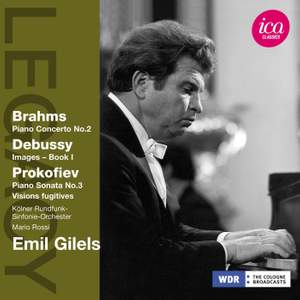
Emil Gilels plays Brahms, Debussy & Prokofiev

Emil Gilels plays Brahms, Debussy & Prokofiev


Brahms:

Piano Concerto No. 2 in B flat major, Op. 83

Saal 1, Funkhaus, Cologne, 19 March 1971

Kolner Rundfunk-Sinfonie-Orchester, Mario Rossi

Debussy:

Images pour piano - Book 1

Saal 2, Funkhaus, Cologne, 11 December 1974

Prokofiev:

Piano Sonata No. 3 in A minor, Op. 28

Saal 2, Funkhaus, Cologne, 11 December 1974

Visions fugitives, Op. 22, No. 3

Saal 2, Funkhaus, Cologne, 11 December 1974

Visions fugitives, Op. 22, No. 5

Saal 2, Funkhaus, Cologne, 11 December 1974

Visions fugitives, Op. 22, No. 10

Saal 2, Funkhaus, Cologne, 11 December 1974

Visions fugitives, Op. 22, No. 11

Saal 2, Funkhaus, Cologne, 11 December 1974

Visions fugitives, Op. 22, No. 17

Saal 2, Funkhaus, Cologne, 11 December 1974


Emil Gilels (piano)

The Russian pianist Emil Gilels (1916–1985) was born in Odessa. After completing his studies with Heinrich Neuhaus in 1937, he was awarded first prize at the 1938 Ysaÿe International Festival in Brussels. After the war, he toured the Soviet Bloc countries of Eastern Europe as a soloist. He was one of the first Soviet artists, along with David Oistrakh, allowed to travel and concertise in the West.

His US debut in 1955, playing Tchaikovsky’s Piano Concerto No.1, was a triumph. His UK debut in 1959 was met with similar acclaim while his Salzburg Festival debut came in 1969. Emil Gilels is regarded by many as one of the most significant pianists of the twentieth century and is universally admired for his superb technical control and burnished tone. His interpretations of the central German-Austrian classics formed the core of his repertoire, in particular Beethoven, Brahms and Schumann as well as twentieth-century music like Debussy, Bartók and Prokofiev.

Gilels made two commercial recordings of the Brahms Piano Concerto No.2 in the studio with Fritz Reiner and Eugen Jochum.

The live magisterial performance of Brahms’s Piano Concerto No.2 dates from 1971when Gilels was at his peak, prior to his studio performance with Jochum.

The live recital dates from 1974 and features vibrant performances of Debussy and Prokofiev, all particular favourites of the pianist. Recorded in brilliant stereo, these WDR-sourced performances have never been released before.

Previous live recordings of Gilels on ICA Classics have been Beethoven Piano Concertos Nos. 1 & 3 (ICAC5000) and Beethoven Piano Concerto No. 4 & Tchaikovsky’s Piano Concerto No.2 (ICAC5032) – both CDs have met with outstanding reviews.

“The characteristics of the [Brahms] performance are nobility and breadth...Despite the existence of the Jochum, this Rossi-conducted performance is still a worthwhile acquisition for Gilels admirers.” MusicWeb International, January 2013

ica classics Legacy - ICAC5077

(CD)

$15.25

(also available to download from $9.00)

In stock - usually despatched within 1 working day.

Prokofiev plays Prokofiev

Prokofiev plays Prokofiev


Prokofiev:

Toccata in D minor, Op. 11

The Love for Three Oranges: Intermezzo

Pieces (10), Op. 12: No. 3 - Rigadon

Pieces (10), Op. 12: No. 10 - Scherzo

Sarcasm Op. 17 No. 1

Sarcasm Op. 17 No. 2

Pieces (10), Op. 12: No. 1 - March

Etude, Op. 52, No. 3

Piano Sonata No. 4 in C minor, Op. 29 (Andante)

Landscape, Op. 59 No. 2

The tales of the old grandmother Op. 31 Nos. 2 & 3

Gavotta, Op. 32/3

Sonatine Pastorale, Op. 59, No. 3

Visions fugitives, Op. 22, No. 9

Visions fugitives, Op. 22, No. 3

Visions fugitives, Op. 22, No. 17

Visions fugitives, Op. 22, No. 18

Visions fugitives, Op. 22, No. 11

Visions fugitives, Op. 22, No. 10

Visions fugitives, Op. 22, No. 16

Visions fugitives, Op. 22, No. 6

Visions fugitives, Op. 22, No. 5

Classical Symphony Op. 25: Gavotte

Suggestion diabolique, Op. 4 No. 4

Piano Concerto No. 3 in C major, Op. 26

The London Symphonic Orchestra, Piero Coppola


Sergei Prokofiev (piano)

These archival recordings from the 1920s and 1930s of Prokoviev interpreting his own compositions will be of great interest. They reflect different aspects of his works. The collection includes a famous recording of his Piano Concerto No.3 with the London Symphony Orchestra.

“Prokofiev was a musician of enormous warmth and seriousness. The dry glitter of his playing reflected intense discipline; his Toccata is relaxed, his Visions fugitives have charm. Revelatory.” BBC Music Magazine, February 2013 *****

Melodiya - MELCD1002000

(CD)

$15.50

Usually despatched in 2 - 3 working days.

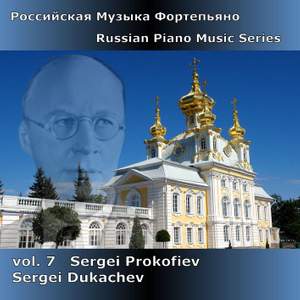
Russian Piano Music Series Volume 7 - Prokofiev

Russian Piano Music Series Volume 7 - Prokofiev


Prokofiev:

Piano Sonata No. 2 in D minor, Op. 14

Visions fugitives, Op. 22, No. 1

Visions fugitives, Op. 22, No. 3

Visions fugitives, Op. 22, No. 4

Visions fugitives, Op. 22, No. 7

Visions fugitives, Op. 22, No. 10

Visions fugitives, Op. 22, No. 6

Visions fugitives, Op. 22, No. 11

Visions fugitives, Op. 22, No. 17

Visions fugitives, Op. 22, No. 5

Ten Pieces from Romeo and Juliet, Op. 75

1937 Piano Version

Piano Sonata No. 7 in B flat major, Op. 83


Sergei Dukachev (piano)

Prokofiev is regarded by many as one of the most complex and progressive composers of the early twentieth century. His catalogue of music numbers some 135 works in such varied genres as symphony, sonata, ballet, opera, art-song, string quartet and film music. He was one of the last in a long tradition of pianist-composers and the nine piano sonatas are all testament to the quality and fertility of the composer’s mind. Prokofiev’s output within the piano sonata genre represents the most important and influential in the Twentieth Century.

His melodic, rhythmic and harmonic material encompasses a new world, far removed from the conventional romantic ideals of the time. The structure of this sonata is conventional but the unusual sonorities, juxtaposition of harmonies and syncopated rhythmic patterns all come together to produce a radical style of composition.

However, despite all of these new ideas, tonality as a structural base is essential for Prokofiev in all his works.

Sergei Dukachev was born in Magnitogorsk, a city in the Ural Mountains on the border between Europe and Asia, where he began to learn the piano at the age of six. In 1989, he distinguished himself by being a prize winner in the International Beethoven Competition in Vienna.

Sergei developed close artistic links with Britain during his years at the Moscow Conservatoire, and in the late 1990s, began a series of annual visits to give concerts in England. Now a sought-after performer in England, Sergei’s appearances have included illustrated talks and masterclasses at many venues – in particular the Chetham’s Summer School in Manchester.

“Dukachev [is] a virile interpreter of the music of his homeland. He races into a truly exciting reading of the second piano sonata before exploiting every opportunity offered by the 20 tiny pieces that make up Visions Fugitives to display his colourful pianistic palette.” The Observer, 14th August 2011

Divine Art Russian Piano Music Series - DDA25096

(CD)

$15.75

(also available to download from $10.50)

Usually despatched in 4 - 5 working days. (Available now to download.)

Emil Gilels

Emil Gilels


Beethoven:

Piano Sonata No. 27 in E minor, Op. 90

Debussy:

Reflets dans l'eau (No. 1 from Images pour piano - Book 1)

Pour le piano

Prokofiev:

Piano Sonata No. 3 in A minor, Op. 28

Visions fugitives, Op. 22, No. 1

Visions fugitives, Op. 22, No. 3

Visions fugitives, Op. 22, No. 5

Visions fugitives, Op. 22, No. 10

Visions fugitives, Op. 22, No. 11

Visions fugitives, Op. 22, No. 17

Scarlatti, D:

Keyboard Sonata K141 in D minor

Keyboard Sonata K518 in F major

Keyboard Sonata K32 in D minor

Keyboard Sonata K533 in A major

Keyboard Sonata K27 in B minor

Keyboard Sonata K125 in G major

Keyboard Sonata K466 in F minor

Scriabin:

Piano Sonata No. 4 in F sharp major, Op. 30


Emil Gilels (piano)

Recorded: St. John’s, Smith Square, London, 15 October 1984 (Scarlatti, Debussy)

Memorial Hall, Farringdon Street, London, 22 April 1957 (Beethoven, Scriabin, Prokofiev)

This CD contains some of the first and last recordings the great Russian pianist Emil Gilels (1916-1985) made for the BBC. The lunchtime concert at the church of St. John's, in Smith Square, London on 15 October 1984 was to be his last performance in London.

Gilels liked to play a selection of Scarlatti's sonatas - what he referred to as 'a bouquet'. He included five of them on his first BBC Legends CD (BBCL40152) from his April 1957 BBC studio recording. Here we have another 7 Scarlatti sonatas recorded in excellent stereo.

Gilels first performed Debussy's 'Pour le Piano' in December 1953 only playing it a few times. After the mid 1950s, he did not play it again until the end of May 1984, five months prior to this stereo live concert. When referring to this concert Nicholas Kenyon wrote of Gilels performance of 'Pour le Piano'; 'But this is… more than the sheer creation of sound. For every wonderfully contrived sound reflects a conviction about the music: it is a total fusion of composer and interpreter that tells us for a few exalting moments, that the music can only sound this way.'

Although he toured the UK for the first time at the end of 1952, Gilels did not record for the BBC until April 1957. Apart from the five sonatas by Scarlatti which were issued on BBCL 4015-2, we have here works by Beethoven, Scriabin and Prokofiev. As persuasive and pliant as his performance is here, it would appear that Gilels did not play this sonata again until he came to record it commercially in the studio in 1974. From Scriabin's ten Piano Sonatas, Gilels only played No.1 in the early 1950s, No.3 only in 1983-84, and No.4 in 1955-57. In this performance of No. 4, Gilels ability to combine great delicacy and enormous controlled power are ideal for this work. From Prokofiev's Piano Sonatas Gilels only played Nos. 2, 3, 7 and 8.

“The Scarlatti, Debussy and Beethoven were recorded live in London in 1984, towards the end of Gilels's life; he's dazzling in the Russian repertoire captured in 1957. The later recital is magisterial, but he's struggling.” BBC Music Magazine, Christmas 2009 ****

“…Emil Gilels… in all his imperious and aristocratic glory. Seven Scarlatti sonatas show him in an inimitable if unfashionable mood, slow and romantically free in the repeated notes of the D minor Sonata, Kk141. His Debussy…sings and expands in a style far remote from a more classic French performing tradition...” Gramophone Magazine, January 2010

“The Scarlatti sonatas have a crystalline purity and breathtaking range of articulation, while the Beethoven conveys all the wholeness missing from the Waldstein, and the Scriabin musters exactly the obsessive intensity such highly wrought music demands.” The Guardian, 18th September 2009 *****

BBC Legends - Pianists - BBCL42612

Download only from $10.50

Available now to download.

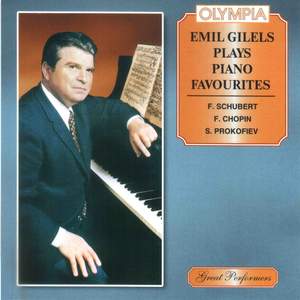
Emil Gilels plays Piano Favourites

Emil Gilels plays Piano Favourites


Chopin:

Étude Op. 25 No. 2 in F minor

Etude No. 26 in A-flat major, Op. posthumous

Prokofiev:

Piano Sonata No. 8 in B flat major, Op. 84

Visions fugitives, Op. 22, No. 1

Visions fugitives, Op. 22, No. 3

Visions fugitives, Op. 22, No. 5

Visions fugitives, Op. 22, No. 7

Visions fugitives, Op. 22, No. 8

Visions fugitives, Op. 22, No. 10

Visions fugitives, Op. 22, No. 11

Visions fugitives, Op. 22, No. 17

The Love for Three Oranges: Suite Op. 33a: March

Schubert:

Moments Musicaux (6), D780, Op. 94


Emil Gilels (piano)

ADD

Olympia Great Performers - MKM161

(CD)

$16.75

Usually despatched in 8 - 10 working days.

Copyright © 2002-13 Presto Classical Limited, all rights reserved.