This page lists all recordings of Marche héroique, Op. 34, by Charles Camille Saint-Saëns (1835-1921) on CD, SACD, DVD & download (MP3 & FLAC). Generally, more recent releases are listed first, but with priority given to those that are in stock. |
All recordingsPrices shown exclude VAT. (UK tax is not payable for deliveries to United States.) See Terms & Conditions for p&p rates. | |  | Saint-Saëns: Danse macabre
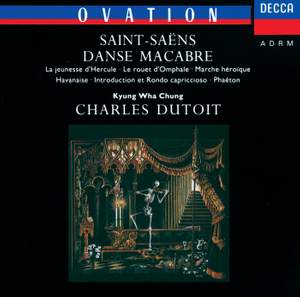
“It's enough to make you weep – Saint-Saëns wrote his first tune at the age of three, analysed Mozart's Don Giovanni from the full score when he was five, and at 10 claimed he could play all Beethoven's 32 piano sonatas from memory. There's some consolation that, according to a contemporary, physically 'he strangely resembled a parrot', and perhaps even his early brilliance was a curse rather than a blessing, as he regressed from being a bold innovator to a dusty reactionary. In his thirties (in the 1870s) he was at the forefront of the Lisztian avant-garde. He was the first Frenchman to attempt Liszt's new genre, the 'symphonic poem', bringing to it a typically French concision, elegance and grace. Charles Dutoit has few peers in this kind of music; here's playing of dramatic flair and classical refinement that exactly matches Saint-Saëns intention and invention. Decca's sound has depth, brilliance and richness.” Gramophone Classical Music Guide, 2010 “Beautifully played performances, recorded in the Kingsway Hall with splendid atmosphere and colour. Charles Dutoit shows himself an admirably sensitive exponent of this repertoire, revelling in the composer's craftsmanship and revealing much delightful orchestral details...Altogether a splendid collection.” Penguin Guide, 2011 edition | | | (Sorry, download not available in your country) | In stock - usually despatched within 1 working day. |
|
|
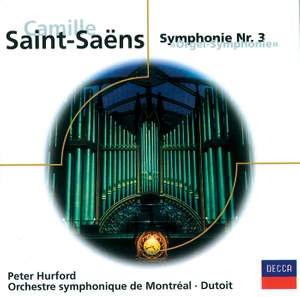
| |  | Essential Organ Classicsplayed by leading concert organists on seven famous organs
| 
| | | Usually despatched in 8 - 10 working days. |
|
|
| |  | Saint-Saëns: 3 Symphonies
Orchestre National d’Île de France, Yoel Levi Saint-Saëns composed a total of five symphonies, three of which bear a number. These three appear on this 2 CD set from Cascavelle, plus the four symphonic poems - Le Rouet d’Omphale, Phaéton, Danse macabre and Marche héroïque. These recordings have little or no competition in this format. | | | Usually despatched in 4 - 5 working days. |
|
|
| |  | Iveta Apkalna: L’Amour et la Mort
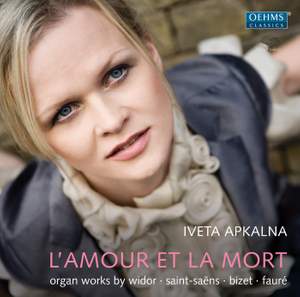
Prize winning organist Iveta Apkalna performs these works on the Kuhn organ in the Philharmonie Essen. She has established herself as a virtuoso and combines a deep sense of musicality and masterful technique with an unerring instinct for the effect of the music. | | | (also available to download from $10.50) | Usually despatched in 2 - 3 working days. (Available now to download.) |
|
|
| |  | Proustor How The Heart Skips A Beat
Stéphanie Romberg, Eleonora Abbagnato, Manuel Legris, Stephane Bullion, Hervé Moreau (dancers) Orchestre de l'Opéra National de Paris & Ballet de l'Opéra National de Paris, Koen Kessels In 1974, Roland Petit, probably the greatest and certainly one of the most prolific of 20th century French choreographers he was the first person to create a work based on Proust's novel, A la recherche du temps perdu, completed in 1922, the year of his death.The book, better known to Anglo-Saxon readers as In Search of Lost Time, in which the author's homosexuality is latent, was written over the last 14 years of his life. Marcel Proust mingles childhood souvenirs with adolescent memories and is full of nostalgia for places once visited and exhibitions he'd seen. He dwells lengthily on love, passion, and jealousy and inevitably questions one's reason for living. Proust ou les intermittences du coeur has now happily entered into the repertoire of the Paris Opéra Ballet.It consists of 13 vignettes inspired by the seven lengthy tomes which complete the unabridged work, Petit has chosen to convey the spirit of the novel via a succession of impressionistic tableaux which reflect the changing moods of the writer as he oscillated between periods of intense happiness and deep depression. And although the choreographer paints a merciless portrait of the aristocracy and bourgeoisie during the Belle Epoque, the highlights of the work lie in the series of poetical pas de deux, which at times might have seemed a little disconnected, but at which the French choreographer is past master. Choreography & stage direction Roland Petit; Designer Luisa Spinatelli; Sets Bernard Michel; Lighting Jean-Michel Désire Palais Garnier, March 2007 | | | Usually despatched in 3 - 4 working days. |
|
|
| |
|