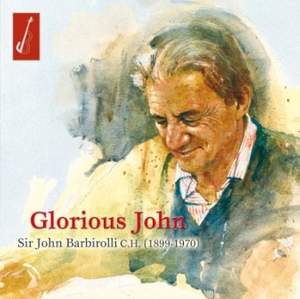
Prices shown exclude VAT. (UK tax is not payable for deliveries to United States.) See Terms & Conditions for p&p rates. | |  | Glorious JohnAnniversary Set
Bach, J S: | Sheep May Safely Graze, from Cantata BWV208 (arr: Barbirolli). 1969 Hallé Orchestra | Balfe: | The Bohemian Girl overture 1933 Symphony Orchestra | Biene: | The Broken Melody 1911 John Barbirolli (cello) | Collins, A: | Sir Andrew and Sir Toby - Overture 22 March 1942, ‘live’ in Carnegie Hall, New York | Delius: | The Walk to the Paradise Garden 20 August 1947 ‘live’ in the Festspielhaus, Salzburg Vienna Philharmonic Orchestra | Falla: | Seguidilla murciana (No. 2 from Siete canciones populares españolas) (arr: Halffter). 1957 Marina de Gabarain | Grieg: | Lyric Pieces Op. 57: No. 4 - Secret (arr: Barbirolli). 1953 Hallé Orchestra | Lehár: | Gold und Silber Walzer, Op. 79 1966 Hallé Orchestra | Mascagni: | Santuzza’s Aria from Cavalleria Rusticana 1927 Lilian Stiles-Allen | Mozart: | String Quartet No. 16 in E flat, K428 1925 Cassation K63 1950 Hallé Orchestra Divertimento No. 11 in D major, K251 1952 Hallé Orchestra | Puccini: | Tre sbirri...Una carozza...Presto 'Te Deum' (from Tosca) 1929 Giovanni Inghilleri | Saint-Saëns: | Wedding Cake - Valse-Caprice for piano & strings, Op. 76 1932 Yvonne Arnaud | Strauss, J, II: | Die Fledermaus: Bruderlein und Schwesterlein 1930 | Stravinsky: | Concerto in D for string orchestra 'Basler' 1948 Hallé Orchestra | Verdi: | Niun mi tema (from Otello) 1928 Renato Zanelli | Villa-Lobos: | Bachianas Brasileiras No. 4 for piano or orchestra 1955 Hallé Orchestra | Weber: | Euryanthe Overture | Weinberger: | Christmas 24 December 1939, ‘live’ in Carnegie Hall, New York New York Philharmonic Orchestra |
plus: REHEARSAL SEQUENCE BERLIOZ The Damnation of Faust, op.24 • Hallé Orchestra 1957 INTERVIEW Sir John Barbirolli and R. Kinloch Anderson The complete interview, recorded by EMI – 1964
This 2-CD set marks the 40th anniversary of the death of Sir John Barbirolli (1899-1970) and features recordings ranging from boy cellist in 1911 to international conductor 1969 – in both ‘live’ and studio recordings. John Barbirolli was born in Southampton Row, Bloomsbury, on 2 December 1899, a Cockney as he proudly boasted. Or, to be accurate, Giovanni Battista Barbirolli was born, son of an Italian émigré violinist and his French wife. English-born with Italo-French parentage – a wonderful pedigree for a musician. And so it proved, for he conducted Elgar, Verdi and Debussy, Vaughan Williams, Puccini and Ravel, with equal sensitivity and perception and intuition. This album of recordings forms a kind of musical biography; and Michael Kennedy’s notes (with many rare photos) trace that life alongside the recordings. A special bonus is the 1947 Austrian Radio recording of two works, Weber’s Euryanthe overture and Delius’s Walk to the Paradise Garden, from the Salzburg Festival concert on 20 August at which he conducted the Vienna Philharmonic. Was this, Michael Kenneday asks, the first time this orchestra had played the Delius? Two rare mementos of the New York period are included in this album. Anthony Collins had long been a friend of Barbirolli (they played in the LSO together) and worked in the USA from 1936 to 1945 and his Sir Toby and Sir Andrew, based on the two comic characters in Twelfth Night, is an example of his overlooked talent. Another composer almost forgotten today is the Czech-born Jaromir Weinberger whose opera Schwanda the Bagpiper enjoyed inter-war popularity. His Christmas for organ and orchestra was composed in 1929. In 1939 he dedicated his Variations and Fugue on an old English tune, ‘Under the Spreading Chestnut Tree’ to Barbirolli and the New York Philharmonic. | | | Usually despatched in 4 - 5 working days. |
|
|
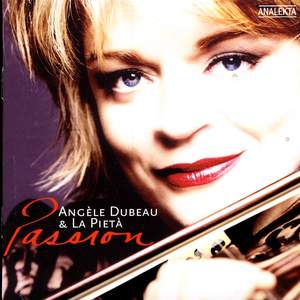
| |  | Passion
Angèle Dubeau (violin) La Pietà | | | Usually despatched in 2 - 3 working days. |
|
|
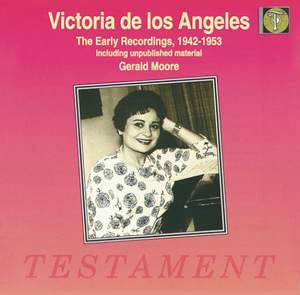
| |  | Victoria de los Angeles: The Early Recordings 1942-1953
Brahms: | Von ewiger Liebe, Op. 43 No. 1 | Falla: | El pano moruna (No. 1 from Siete canciones populares españolas) Seguidilla murciana (No. 2 from Siete canciones populares españolas) Jota (No. 4 from Siete canciones populares españolas) | Fuste: | Háblame de amores | Granados: | Tonadillas: No. 3, La maja dolorosa Tonadillas: No. 4, El majo discreto Tonadillas: No. 8, El mirar de la maja | Guridi Bidaola: | Jota (from Six canciones castellanas) No quiero tus avellanas (from Six canciones castellanas) | Handel: | Joshua: Oh! had I Jubal's lyre | Nin: | El paño murciano (from Cantos populares españoles) El Vito (from Cantos populares españoles) | Respighi: | Stornellatrice E se un giorno tornasse, P. 96 | Schumann: | Widmung, Op. 25 No. 1 Der Nussbaum, Op. 25 No. 3 Ich grolle nicht (No. 7 from Dichterliebe, Op. 48) | Toldrá: | Madre, unos ojuelos ví | trad.: | Hungarian folksongs & Csárdás | Turina: | Farruca (from Triptico, Op. 45) Saeta en forme de Salve a la Virgen de la Esperanza, Op. 60 Poema en forma de canciones, Op. 19: No. 3, 'Cantares' | Valverde: | Clavelitos | Vives: | El retrato de Isabela El amor y los ojos |
“The two Respighi songs are magical performances – Stornellatrice, with the golden voice at its richest and E se un giorno tornasse, a study in subtle shading of tone, a dialogue between a mother and her dying, jilted daughter. For those two brief items alone, superbly transferred, this collection is an essential for all admirers of this singer, but there's much more. Handel's 'O had I Jubal's lyre' in German rather than English may be odd, but the performance sparkles and among the Lieder it's good to have not just 'Der Nussbaum' – the Schumann song which was always special to her – but two previously unpublished, 'Widmung' from the Myrthe songs and 'Ich grolle nicht' from Dichterliebe. Through the whole collection the superb transfers capture the full–throated glory of los Angeles's voice at the beginning of her career. The 1942 recordings of two Hungarian folk– songs, previously unpublished, may be rough and limited – made when the singer was only 18 – but they amply demonstrate that already the voice was fully developed in its beauty. No fewer than 18 of the 27 items are of Spanish songs, and though in one or two instances los Angeles was destined to make even more idiomatic readings later with a Spanish accompanist, these ones with Gerald Moore as her partner have a freshness and brilliance that has rarely been matched in this repertory. In particular it's good to have her first recording of the encore number which she made her own, Clavelitos.” Gramophone Classical Music Guide, 2010 | | | Usually despatched in 4 - 5 working days. |
|
|
| |
|