All recordingsPrices shown exclude VAT. (UK tax is not payable for deliveries to United States.) See Terms & Conditions for p&p rates. | |  | Saint-Saëns: Carnaval des Animaux & Septuor
Saint-Saëns: | Le carnaval des animaux Michel Béroff & Jean-Philippe Collard (piano duet) Septet in E flat major for piano, trumpet, 2 violins, viola, cello and double bass Op. 65 Maurice Andre (trumpet), Alain Moglia (violin), Jacques Cazauran (double bass), Michel Debost (flute/piccolo), Claude Desurmont (clarinet), Guy-Joel Cipriani (percussion), Gerard Perotin (percussion) |
Camille Saint-Saëns originally wrote his humorous suite "The Carnival of the Animals" for private performance to a group of friends, but today it is one of the French Romantic composer's best-known works: particularly authentic in this recording by his fellow countrymen. | | | In stock - usually despatched within 1 working day. |
|
|
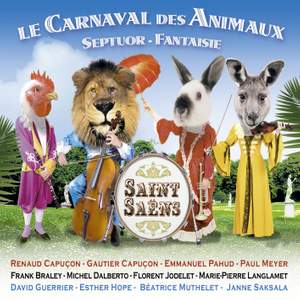
| |  | Saint-Saëns - Le Carnaval des Animaux
Renaud Capuçon (violin), Gautier Capuçon (cello), Frank Braley (piano), Michel Dalberto (piano), Emmanuel Pahud (flute), Paul Meyer (clarinet), David Guerrier (trumpet), Marie-Pierre Langlamet (harp), Béatrice Muthelet (viola), Esther Hoppe (violin), Janne Saksala (double bass), Florent Jodelet (percussion) “'What hard things,' wrote Saint-Saëns, 'have been said against virtuosity!… The fact must be proclaimed from the house-tops – in art a difficulty overcome is a thing of beauty.' There are many such beauties in Le Carnaval des animaux, and their difficulties aren't for the faint-hearted or the technically challenged, especially where the two pianists are concerned. On this disc not only are the difficulties overcome, but dispatched with tremendous verve and wit. In the Septet the players rightly refuse to make more of the music than is really there. This light touch allows us to relish Saint-Saëns's professionalism: every part in the texture has its own shape and colour and, if there were compositional difficulties to be overcome, you'd never know. The four shorter pieces on this splendid disc include the delicious Fantaisie for violin and harp, and three arrangements for cello and piano taken from the horn, organ and operatic repertoires.” Gramophone Classical Music Guide, 2010 | | | In stock - usually despatched within 1 working day. |
|
|
| |  | Saint-Saens: Carnival of the Animals and other works
| | | In stock - usually despatched within 1 working day. |
|
|
| |  | Saint-Saëns: Chamber Music with Winds
Saint-Saëns: | Bassoon Sonata in G major, Op. 168 Maurice Allard (bassoon), Annie d'Arco (piano) Clarinet Sonata in E flat major, Op. 167 Maurice Gabai (clarinet), Annie d'Arco (piano) Oboe Sonata in D major Op. 166 Maurice Bourgue (oboe), Annie d'Arco (piano) Romance in F major, Op. 36 Gilbert Coursier (horn), Annie d'Arco (piano) Cavatine, for trombone & piano, Op. 144 Jacques Toulon (trombone), Annie d'Arco (piano) Septet in E flat major for piano, trumpet, 2 violins, viola, cello and double bass Op. 65 Roger Delmotte (trumpet), Jeanne Marie Darre (piano), Gaston Logerot (double bass) Quatuor Pascal |
This historical testimony demonstrates that Saint-Saëns is the origin of the worldwide famous “French winds tradition”. In his twilight years and aged eighty five, Saint-Saëns came back to wind sonatas. Although being very classical, the three 1921 sonatas announce the “Groupe des Six” neo-classicism, and particularly Poulenc. In that respect, even at the very end of his life, Saint-Saëns remained an innovator. | 
| | | Usually despatched in 2 - 3 working days. |
|
|
| |  | Saint-Saëns: Piano Trios
Paul Rickard-Ford (piano II) & Catherine Hewgill (cello) The Australian Trio | | | Usually despatched in 2 - 3 working days. |
|
|
| |  | Saint-Saëns - Complete Chamber Music with Winds
Saint-Saëns: | Septet in E flat major for piano, trumpet, 2 violins, viola, cello and double bass Op. 65 Romance in F major, Op. 36 Tarantelle in A minor for flute, clarinet & piano/orchestra Op. 6 Le carnaval des animaux: Le Cygne Romance in D flat major, Op. 37 Cavatine, for trombone & piano, Op. 144 Romance, Op. 67 Mon cœur s'ouvre à ta voix (from Samson et Dalila) (transcription for bassoon and piano by Marc Trenel) Clarinet Sonata in E flat major, Op. 167 Prière for cello & piano, Op. 158 Oboe Sonata in D major Op. 166 Odelette in D major, Op. 162 Bassoon Sonata in G major, Op. 168 Le carnaval des animaux: L'éléphant Caprice sur des airs danois et russes for piano, flute, oboe and clarinet Op. 79 |
In a century mostly inspired by German romantic orchestral pieces, Saint-Saëns considered wind instruments as on the same level as violin and piano. He is the origin of the French Wind tradition and in the evening of his life, aged 85, came back to composing sonatas turning to wind instruments with enthusiasm. | | | Usually despatched in 2 - 3 working days. |
|
|
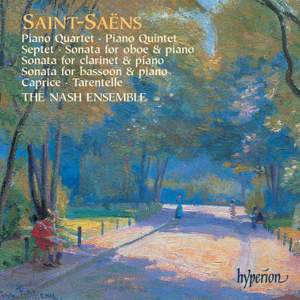
| |  | Saint-Saëns - Chamber Music
Saint-Saëns: | Septet in E flat major for piano, trumpet, 2 violins, viola, cello and double bass Op. 65 Tarantelle in A minor for flute, clarinet & piano/orchestra Op. 6 Bassoon Sonata in G major, Op. 168 Piano Quartet in B flat major, Op. 41 Piano Quintet in A minor Op. 14 Oboe Sonata in D major Op. 166 Clarinet Sonata in E flat major, Op. 167 Caprice sur des airs danois et russes for piano, flute, oboe and clarinet Op. 79 |
“Saint-Seëns in full vigour and mastery - a wonderful pair of discs” BBC Music Magazine, 1st July 2008 “Saint-Saëns's chamber music fares better in the concert hall than the recording studio, perhaps because musicians tend to listen less to academic name-calling ('conservative', 'too prolific') than to the music itself. The three late wind sonatas in particular have received far fewer recordings than their status as repertoire staples deserves. Try the kinky-Baroque first movement of the Oboe Sonata, jauntily phrased by Gareth Hulse, or the animato second of the Clarinet Sonata, garbed in rich Mozartian cloth by Richard Hosford. The Bassoon Sonata is notable for its fresh and gentle wit and skirting of cliché: Ursula Leveaux does it proud, with especially luscious tone in the opening Allegretto. Surprises are fewer in the earlier works, but none is less than,'finely put together' to echo Ravel's assessment. Hummability quotient is high in the Piano Quartet and Quintet, and off the scale in the Septet. The late Lionel Salter used to complain in Gramophone that recordings of the Septet tend to sound like a trumpet concerto; not this one. If you employ hit artists like Maurice André they will tend to hog the microphone but, happily, Mark David is a more sensitive soul who's fully imbibed the Nash's joyous spirit of corporate music-making, and Hyperion's engineers have placed him at a respectable distance. If anything it's Ian Brown's piano that takes centre-stage, and that's no bad thing, except in the extensive fugal finales to the Piano Quartet and Quintet where Saint-Saëns, most unusually, seems to over-run himself. The Caprice and Tarantelle, for all Philippa Davies's sparkling contributions, perhaps bear fewer repetitions, but the set is really sheer delight: let's hear it for imaginative conservatism.” Gramophone Classical Music Guide, 2010 BBC Music Magazine
Chamber Choice - July 2005 |
| | | Usually despatched in 2 - 3 working days. |
|
|
| |  | A European OdysseyA remarkable musical adventure with the London Schubert Players
The London Schubert Players A European Odyssey is the fruit of the London Schubert Players’ international project Invitation to Composers – one of the 87 selected from 296 by the European Commission in 2009 for its innovative, creative and educational profile. The two-year project challenged composers to write for specific instrumental combinations that were missing or seldom encountered in the chamber music repertoire. For some of these, they were asked to draw inspiration from masterworks of classical composers from the 18th, 19th and 20th centuries. The London Schubert Players chamber orchestra was founded in 1989 by pianist Anda Anastasescu as the orchestra-in-residence of the French Institute in London. The Players’ concert tours in Europe, Asia and South America have been greeted with enthusiasm and critical acclaim. The London Schubert Players Trust promotes, maintains, improves and advances public education in classical music. The RMA (Romanian Musical Adventure) was formed to record outstanding works by Romanian composers, new and lesser-known repertoire and well known repertoire interpreted in a fresh light. “The importance of music in the cultural heritage of Europe cannot be overestimated. A European Odyssey taps into this wonderful tradition, making a serious and passionate contribution to its repertoire.” Pianist Anda Anastasescu, project and artistic director of the London Schubert Players. | | | Usually despatched in 4 - 5 working days. |
|
|
| |  | Saint-Saëns: Concertos
Saint-Saëns: | Le carnaval des animaux Cello Concerto No. 1 in A minor, Op. 33 Paul Tortelier (cello) Septet in E flat major for piano, trumpet, 2 violins, viola, cello and double bass Op. 65 Piano Concertos Nos. 1-5 Aldo Ciccolini (piano) Piano Quintet in A minor Op. 14 Etude en forme de valse Op. 52 No. 6 Aldo Ciccolini (piano) Violin Concerto No. 1 in A Major Op. 20 Ulf Hoelscher (violin) Violin Concerto No. 2 in C Major Op. 58 Ulf Hoelscher (violin) Etude en forme de valse Op. 52 No. 6 Romance in C major, Op. 48, for violin and orchestra Ulf Hoelscher (violin) Romance in D flat major, Op. 37 Violin Concerto No. 3 in B minor, Op. 61 Ulf Hoelscher (violin) La Muse et le Poète, Op. 132 Havanaise, Op. 83 Morceau de concert in G major, Op. 62, for violin and orchestra Introduction & Rondo capriccioso, Op. 28 Ulf Hoelscher (violin) Caprice andalou, Op. 122 Prélude to Le Deluge Op. 45 |
| | | In stock - usually despatched within 1 working day. |
|
|
| |
|