In stock - usually despatched within 1 working day.
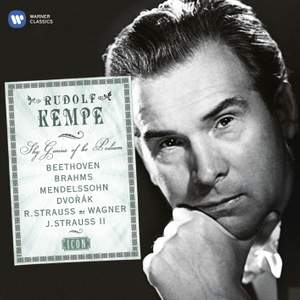
The German conductor Rudolf Kempe (1910–1976) began his musical career playing the oboe in various symphony orchestras. He eventually graduated to being a conductor after working for several years as an operatic repetiteur. His modest manner on the podium belied his great authority in controlling an orchestra, and his warm but meticulously detailed interpretations of the main classical repertoire established him as one of the leading conductors of his time.
The programme begins with recordings of four Beethoven Symphonies that Kempe made with the Munich Philharmonic Orchestra in 1971–72 as part of a complete cycle that has been critically acclaimed, although it has not previously been widely available.
These are followed by Symphonies 3 and 4 by Brahms with the Berlin Philharmonic Orchestra and the Royal Philharmonic Orchestra respectively, two orchestras with which Kemper was closely associated throughout his career.
The next CD shows Kempe’s skill with descriptive ‘programme’ music in Mendelssohn’s delightful incidental music to Shakespeare’s ‘A Midsummer Night’s Dream’ and Rimsky-Korsakov’s colourful orchestral suite Scheherazade depicting a number of tales from the 1001 Arabian Nights.
Then comes music by three Bohemian composers: the opening of the famous ‘Largo’ from Dvorák’s ‘New World’ Symphony; the Polka from Schwanda the Bagpiper by Weinberger; and a suite from Smetana’s lively opera The Bartered Bride.
CDs 6 and 7 present several of the main orchestral works by Richard Strauss, including Don Juan., Ein Heldenleben, Till Eulenspiegel, Tod und Verklärung and Don Quixote, all except the last recorded with the Staatskapelle Dresden, an orchestra closely associated with the works of Richard Strauss.
CD 8 moves to the opera house and includes vocal extracts from Richard Strauss’s Ariadne auf Naxos and Wagner’s Lohengrin and Die Meistersinger von Nürnberg. The next CD covers orchestral pieces from opera, including a suite arranged by Kempe himself from Hansel und Gretel by Humperdinck
On CD 10 we find Kempe in lighter mood with the Vienna Philharmonic Orchestra in a programme of orchestral bon-bons that was called Vienna Philharmonic ‘On Holiday’ when it was originally released on LP. Tthe final CD covers some of the best loved music by the Strauss family. The very last track in the album is the waltz Gold und Silber by Franz Lehár, which Kempe considered the finest studio recording he ever made.
Click on any of the works listed above for alternative recordings.