Wolf, H: Nein, junger Herr, so treibt man’s nicht, fürwahr (No. 12 from Italienisches Liederbuch) (Giovinottino, non si fa cosí)

This page lists all recordings of Nein, junger Herr, so treibt man’s nicht, fürwahr (No. 12 from Italienisches Liederbuch) (Giovinottino, non si fa cosí), by Hugo Wolf (1860-1903) on CD & download (MP3 & FLAC).

Prices shown exclude VAT. (UK tax is not payable for deliveries to United States.)
See Terms & Conditions for p&p rates.

Wolf: Liederabend

Wolf: Liederabend


Wolf, H:

Im Frühling (No. 13 from Mörike-Lieder)

Elfenlied (No. 16 from Mörike-Lieder)

Lebe wohl (No. 36 from Mörike-Lieder)

Schlafendes Jesuskind (No. 25 from Mörike-Lieder)

Phänomen (No. 32 from Goethe-Lieder)

Die Spröde (No. 26 from Goethe-Lieder)

Die Bekehrte (No. 27 from Goethe-Lieder)

Anakreons Grab (No. 29 from Goethe-Lieder)

Blumengruss (No. 24 from Goethe-Lieder)

Epiphanias (No. 19 from Goethe-Lieder)

Wie lange schon war immer mein Verlangen (No. 11 from Italienisches Liederbuch)

Was soll der Zorn, mein Schatz, der dich erhitzt? (No. 32 from Italienisches Liederbuch)

Nein, junger Herr, so treibt man’s nicht, fürwahr (No. 12 from Italienisches Liederbuch)

Mein Liebster hat zu Tische mich geladen (No. 25 from Italienisches Liederbuch)

Bedeckt mich mit Blumen (No. 26 from Spanisches Liederbuch: Weltliche Lieder)

Herr, was trägt der Boden hier (from Spanisches Liederbuch)

In dem Schatten meiner Locken (No. 2 from Spanisches Liederbuch: Weltliche Lieder)

Mögen alle bösen Zungen (No. 13 from Spanisches Liederbuch: Weltliche Lieder)

Wie Glanzet der Helle Mond

Wiegenlied im Sommer (from Sechs Lieder für eine Frauenstimme)

Nachtzauber (No. 8 from Eichendorff-Lieder)

Die Zigeunerin (No. 7 from Eichendorff-Lieder)


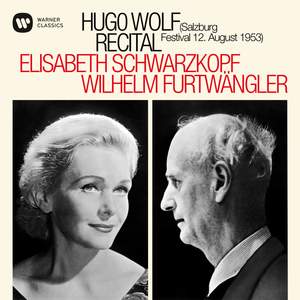
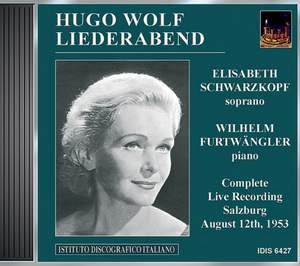
On 12th August 1953, at the Salzburg Festival, Elisabeth Schwarzkopf gave a memorable concert entirely dedicated to Hugo Wolf’s Lieder. She was accompanied, at the piano, by Wilhelm Furtwängler. IDIS now has the pleasure to offer a new edition, of exceptional sound quality, of that unforgettable evening, which is unanimously considered one of the finest performances in the career of the great Austrian soprano. The many appreciators of Hugo Wolf’s music - and all those who, outside the German-speaking countries, still do not know it - will welcome this CD as an essential document to enter the rich and fascinating expressive world of one of greatest lied composers of all times.

Istituto Discografico Italiano - IDIS6427

Download only from $10.50

Available now to download.

Elisabeth Schwarzkopf: A Tribute

Elisabeth Schwarzkopf: A Tribute

Great recordings 1946-54. Arias & lieder, including a complete concert in Aix-en-Provence with Hans Rosbaud.


Includes

anon.:

S'Schatzli

arr. Brahms

Bach, J S:

Bist du bei mir, BWV508

Beethoven:

Wonne der Wehmut, Op. 83 No. 1

Brahms:

Da unten im Tale (No. 6 from Deutsche Volkslieder, WoO 33)

(two performances)

Och Moder, ich well en Ding han! (No. 33 from Deutsche Volkslieder, WoO. 33)

Vergebliches Ständchen, Op. 84 No. 4

Von ewiger Liebe, Op. 43 No. 1

Charpentier, G:

Depuis le jour (from Louise)

Gluck:

Einem Bach der fließt

Handel:

Care selve (from Atalanta)

Martini, G B:

Plaisir d'amour

Mozart:

L'amerò, sarò costante (from Il re pastore)

Welche Kummer herrscht in meiner Seele (from Die Entführung aus dem Serail)

Traurigkeit (from Die Entführung aus dem Serail)

Martern aller Arten (from Die Entführung aus dem Serail)

Crudele? Ah no, mio bene! ... Non mi dir, bell'idol mio (from Don Giovanni)

In quali eccessi ... Mi tradì quell'alma ingrate (from Don Giovanni)

Porgi amor (from Le nozze di Figaro)

E Susanna non vien! … Dove sono i bei momenti (from Le nozze di Figaro)

Giunse alfin il momento... Deh, vieni, non tardar… (from Le nozze di Figaro)

Abendempfindung an Laura, K523

Warnung 'Männer suchen stehts zu naschen', K433

Pergolesi:

Se tu m'ami

Puccini:

Donde lieta usci (from La Bohème)

Un bel di vedremo (from Madama Butterfly)

Schubert:

Litanei auf das Fest Allerseelen, D343

Seligkeit D433 (Holty)

Die Forelle, D550

Ungeduld (No. 7 from Die schöne Müllerin, D795)

An Sylvia, D891

Die Liebe hat gelogen D751 (Platen)

Der Einsame, D800

Die Vogel D691

Ungeduld (No. 7 from Die schöne Müllerin, D795)

Schumann:

Der Nussbaum, Op. 25 No. 3

(two performances)

Aufträge, Op. 77 No. 5

(two performances)

Verdi:

Addio del passato (from La Traviata)

Wolf, H:

Mignon IV 'Kennst du das Land' (No. 9 from Goethe-Lieder)

Wir haben beide lange Zeit geschwiegen (No. 19 from Italienisches Liederbuch)

In dem Schatten meiner Locken (No. 2 from Spanisches Liederbuch: Weltliche Lieder)

Liebesqual

Nein, junger Herr, so treibt man’s nicht, fürwahr (No. 12 from Italienisches Liederbuch)

Nachtzauber (No. 8 from Eichendorff-Lieder)

Die Zigeunerin (No. 7 from Eichendorff-Lieder)

Sohn der Jungfrau

Plus operetta arias by J Strauss II and Lehar


Stock is now available again of this historical collection of performances by a world famous artist. It includes opera excerpts from 78rpm discs of performances with Karajan, Ackermann, Kripps and Galliera as well as lieder accompanied by Gerald Moore. The set includes the complete Aix en Provence Concert of 1954 with Hans Rosbaud accompanying.

Andromeda - ANDRCD5006

(CD - 3 discs)

$18.25

In stock - usually despatched within 1 working day.

Elisabeth Schwarzkopf sings Schubert & Wolf

Elisabeth Schwarzkopf sings Schubert & Wolf


Schubert:

Vedi quanto adoro (Didone abbandonata) D510A (Metastasio)

13th August 1960

with Gerald Moore (piano)

Wandrers Nachtlied I 'Der du von dem Himmel bist', D224

13th August 1960

with Gerald Moore (piano)

Auf dem Wasser zu singen, D774

13th August 1960

with Gerald Moore (piano)

Die Liebe hat gelogen D751 (Platen)

13th August 1960

with Gerald Moore (piano)

Seligkeit D433 (Holty)

13th August 1960

with Gerald Moore (piano)

Der Einsame, D800

13th August 1960

with Gerald Moore (piano)

Die Vogel D691

13th August 1960

with Gerald Moore (piano)

Das Lied im Grünen, D917

13th August 1960

with Gerald Moore (piano)

Rosamunde, D797: Romance 'Der Vollmond Strahlt auf Bergeshöh'n'

13th August 1960

with Gerald Moore (piano)

Gretchen am Spinnrade, D118

13th August 1960

with Gerald Moore (piano)

Du bist die Ruh D776 (Rückert)

13th August 1960

with Gerald Moore (piano)

An Sylvia, D891

13th August 1960

with Gerald Moore (piano)

An mein Klavier D342 (Schubart)

13th August 1960

with Gerald Moore (piano)

Liebe schwarmt auf allen Wegen, D239 No. 6 (Goethe)

13th August 1960

with Gerald Moore (piano)

Ganymed, D544 (Goethe)

13th August 1960

with Gerald Moore (piano)

Nähe des Geliebten, D162

13th August 1960

with Gerald Moore (piano)

Fischerweise, D881 (Schlechta)

13th August 1960

with Gerald Moore (piano)

Wiegenlied, D498

13th August 1960

with Gerald Moore (piano)

An die Musik D547

13th August 1960

with Gerald Moore (piano)

Heidenröslein, D257

13th August 1960

with Gerald Moore (piano)

Ungeduld (No. 7 from Die schöne Müllerin, D795)

(encore) 7th August 1956

with Gerald Moore (piano)

Wolf, H:

Die Spröde (No. 26 from Goethe-Lieder)

12th August 1953

with Wilhelm Furtwängler (piano)

Phänomen (No. 32 from Goethe-Lieder)

12th August 1953

with Wilhelm Furtwängler (piano)

Epiphanias (No. 19 from Goethe-Lieder)

12th August 1953

with Wilhelm Furtwängler (piano)

Blumengruss (No. 24 from Goethe-Lieder)

12th August 1953

with Wilhelm Furtwängler (piano)

Anakreons Grab (No. 29 from Goethe-Lieder)

12th August 1953

with Wilhelm Furtwängler (piano)

Die Bekehrte (No. 27 from Goethe-Lieder)

12th August 1953

with Wilhelm Furtwängler (piano)

Ganymed (No. 50 from Goethe-Lieder)

27th July 1958

with Gerald Moore (piano)

Frühling übers Jahr (No. 28 from Goethe-Lieder)

27th July 1958

with Gerald Moore (piano)

Der Schäfer (No. 22 from Goethe-Lieder)

27th July 1958

with Gerald Moore (piano)

Philine (No. 8 from Goethe-Lieder)

27th July 1958

with Gerald Moore (piano)

Im Frühling (No. 13 from Mörike-Lieder)

12th August 1953

with Wilhelm Furtwängler (piano)

Elfenlied (No. 16 from Mörike-Lieder)

12th August 1953

with Wilhelm Furtwängler (piano)

Lebe wohl (No. 36 from Mörike-Lieder)

12th August 1953

with Wilhelm Furtwängler (piano)

Schlafendes Jesuskind (No. 25 from Mörike-Lieder)

12th August 1953

with Wilhelm Furtwängler (piano)

Der Genesene an die Hoffnung (No. 1 from Mörike-Lieder)

19th August 1957

with Gerald Moore (piano)

Auf eine Christblume I (No. 20 from Mörike-Lieder)

27th July 1958

with Gerald Moore (piano)

In der Frühe (No. 24 from Mörike-Lieder)

17th August 1963

with Gerald Moore (piano)

An den Schlaf (No. 29 from Mörike-Lieder)

17th August 1963

with Gerald Moore (piano)

Ein Stündlein wohl vor Tag (No. 3 from Mörike-Lieder)

17th August 1963

with Gerald Moore (piano)

Nimmersatte Liebe (No. 9 from Mörike-Lieder)

19th August 1957

with Gerald Moore (piano)

Der Knabe und das Immlein (No. 2 from Mörike-Lieder)

19th August 1957

with Gerald Moore (piano)

Storchenbotschaft (No. 48 from Mörike-Lieder)

19th August 1957

with Gerald Moore (piano)

Lied vom Winde

19th August 1957

with Gerald Moore (piano)

Selbstgeständnis (No. 52 from Mörike-Lieder)

19th August 1957

with Gerald Moore (piano)

Mausfallen-Sprüchlein (from Lieder für eine Frauenstimme)

27th July 1958

with Gerald Moore (piano)

Nachtzauber (No. 8 from Eichendorff-Lieder)

12th August 1953

with Wilhelm Furtwängler (piano)

Die Zigeunerin (No. 7 from Eichendorff-Lieder)

12th August 1953

with Wilhelm Furtwängler (piano)

Tretet ein, hoher Krieger

27th July 1958

with Gerald Moore (piano)

Singt mein Schatz wie ein Fink

27th July 1958

with Gerald Moore (piano)

Du Milchjunger Knabe

27th July 1958

with Gerald Moore (piano)

Wandl' ich in dem Morgentau

27th July 1958

with Gerald Moore (piano)

Das Köhlerweib ist trunken

27th July 1958

with Gerald Moore (piano)

Wie Glanzet der Helle Mond

27th July 1958

with Gerald Moore (piano)

Mühvoll komm ich und beladen (No. 7 from Spanisches Liederbuch: Geistliche Lieder)

19th August 1957

with Gerald Moore (piano)

Herr, was trägt der Boden hier (from Spanisches Liederbuch)

19th August 1957

with Gerald Moore (piano)

Bedeckt mich mit Blumen (No. 26 from Spanisches Liederbuch: Weltliche Lieder)

27th July 1958

with Gerald Moore (piano)

Wer tat deinem Füßlein weh? (No. 30 from Spanisches Liederbuch: Weltliche Lieder)

19th August 1957

with Gerald Moore (piano)

Klinge, klinge, mein Pandero (No. 1 from Spanisches Liederbuch: Weltliche Lieder)

19th August 1957

with Gerald Moore (piano)

Sie blasen zum Abmarsch (No. 28 from Spanisches Liederbuch: Weltliche Lieder)

19th August 1957

with Gerald Moore (piano)

Wehe Der, Die Mir Verstrickte

19th August 1957

with Gerald Moore (piano)

Trau nicht der Liebe (No. 67 from Spanisches Liederbuch: Weltliche Lieder)

17th August 1963

with Gerald Moore (piano)

Mögen alle bösen Zungen (No. 13 from Spanisches Liederbuch: Weltliche Lieder)

19th August 1957

with Gerald Moore (piano)

In dem Schatten meiner Locken (No. 2 from Spanisches Liederbuch: Weltliche Lieder)

19th August 1957

with Gerald Moore (piano)

Geh' Geliebter, geh' jetzt (No. 34 from Spanisches Liederbuch: Weltliche Lieder)

19th August 1957

with Gerald Moore (piano)

Wie lange schon war immer mein Verlangen (No. 11 from Italienisches Liederbuch)

12th August 1953

with Wilhelm Furtwängler (piano)

Was soll der Zorn, mein Schatz, der dich erhitzt? (No. 32 from Italienisches Liederbuch)

12th August 1953

with Wilhelm Furtwängler (piano)

Nein, junger Herr, so treibt man’s nicht, fürwahr (No. 12 from Italienisches Liederbuch)

12th August 1953

with Wilhelm Furtwängler (piano)

Mein Liebster hat zu Tische mich geladen (No. 25 from Italienisches Liederbuch)

12th August 1953

with Wilhelm Furtwängler (piano)

Wer rief dich denn? Wer hat dich herbestellt?

19th August 1957

with Gerald Moore (piano)

Gebet; Nun lass uns Frieden schliessen

19th August 1957

with Gerald Moore (piano)

Ich esse nun mein Brot nicht trocken mehr

19th August 1957

with Gerald Moore (piano)

Nein, junger Herr, so treibt man’s nicht, fürwahr (No. 12 from Italienisches Liederbuch)

19th August 1957

with Gerald Moore (piano)

O wär dein Haus durchsichtig wie ein Glas

19th August 1957

with Gerald Moore (piano)

Du sagst mir, dass ich keine Fürstin sei

19th August 1957

with Gerald Moore (piano)

Schweig' einmal still (No. 43 from Italienisches Liederbuch)

19th August 1957

with Gerald Moore (piano)

Verschling der Abgrund meines Liebsten Hütte

19th August 1957

with Gerald Moore (piano)

Ich hab in Penna einen Liebsten (No. 46 from Italienisches Liederbuch)

19th August 1957

with Gerald Moore (piano)


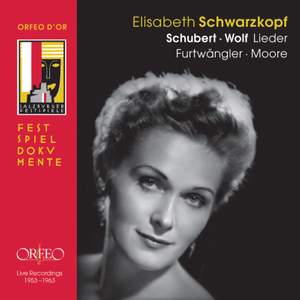
Orfeo's Salzburg series finds its culmination in a group of songs by Hugo Wolf and Franz Schubert that Elisabeth Schwarzkopf sang between 1953 and 1963, with accompanists Wilhelm Furtwängler and Gerald Moore.

Schwarzkopf’s diction and the manner in which she moulds the text in Wolf’s Spanish and Italian Songbooks have remained a benchmark to the present day, and brought them to attention properly for the first time. She also turned Schubert songs such as Gretchen am Spinnrade into self-contained mini-dramas.

Orfeo - Orfeo d'Or - Salzburger Festspieldokumente - C826103D

(CD - 3 discs)

$37.50

Usually despatched in 3 - 4 working days.

Elizabeth Schwarzkopf: The Radiant Soprano

Elizabeth Schwarzkopf: The Radiant Soprano


Bach, J S:

Cantata BWV51 'Jauchzet Gott in allen Landen'

Cantata BWV208 'Was mir behagt, ist nur die muntre Jagd!'

Cantata BWV68 'Also hat Gott die Welt geliebt: Mein glaubiges Herze

Cantata BWV199 'Mein Herze schwimmt im Blut'

Bist du bei mir, BWV508

Brahms:

Vergebliches Ständchen, Op. 84 No. 4

Immer leiser wird mein Schlummer, Op. 105 No. 2

Wie Melodien zieht es mir, Op. 105 No. 1

Der Jäger (No. 4 from Sieben Lieder, Op. 95)

Liebestreu, Op. 3 No. 1

Ständchen, Op. 106 No. 1

Dvorak:

Songs My Mother Taught Me, Op. 55 No. 4

Grieg:

Barnlige sange, Op. 61 No. 3 'Lok'

Ich liebe Dich, Op. 5 No. 3

Med en vandlije, Op. 25 No. 4

Våren, Op. 33 No. 2

Det første møde, Op. 21 No. 1

Zur Rosenzeit (No. 5 from Seks Sange, Op. 48)

Handel:

L'Allegro, Il Penseroso ed Il Moderato: Sweet Bird

Heuberger:

Gehen wir ins Chambre séparée) from The Opera Ball

Humperdinck:

Suse, liebe Suse... Brüderchen, komm tanz mit mir (from Hänsel und Gretel)

Der kleine Sandmann bin ich (from Hänsel und Gretel)

Irmgard Seefried (Hansel

Philharmonia Orchestra, Josef Krips

Jensen, A:

Murmelndes Lüftchen, Op. 21 No. 4

Lehár:

Bitte meine Herren (from Die Lustige Witwe)

Viljalied (from Die lustige Witwe)

Lippen schweigen (from Die Lustige Witwe)

Eberhard Wächter (baritone)

Philharmonia Orchestra & Chorus, Lovro von Matačić

Einer wird kommen (from Der Zarewitsch)

Heut’ noch werd' ich Ehefrau...Unbekannt, deshalb nicht minder interessant (from Der Graf von Luxemburg)

Ich danke...Soll ich? Soll ich nicht? (from Der Graf von Luxemburg)

Meine Lippen sie Kussen so heiss (from Giuditta)

Liszt:

Die drei Zigeuner, S.320

Mahler:

Lob des hohen Verstandes (Des Knaben Wunderhorn)

Medtner:

Selbstbetrug, Op. 15 No. 3

Aus 'Lila', Op. 15 No. 5

Mendelssohn:

Auf Flügeln des Gesanges, Op. 34 No. 2

Millöcker:

Ich habe Liebe schon genossen...Ich schenk' mein Herz (from Die Dubarry)

Was ich im Leben beginne...Ja so ist sie, die Dubarry (from Die Dubarry)

Mozart:

Exsultate, jubilate, K165

Ridente la calma, K152

Oiseaux, si tous les ans, K307

Dans un bois solitaire, K308

Die kleine Spinnerin, K531

Als Luise die Briefe, K520

Abendempfindung an Laura, K523

Das Kinderspiel, K598

Die Alte K517

Das Traumbild, K.530

Das Veilchen, K476

Im Frühlingsanfang, K597

Die Zufriedenheit,K.349

Das Lied der Trennung, K519

An Chloë, K524

Sehnsucht nach dem Frühlinge, K596

Ch'io mi scordi di te?... Non temer, amato bene, K505

Vado, ma dove? oh Dei!, K583

Alma grande e nobil core K578

Nehmt meinen Dank, ihr holden Gönner!, concert aria K383

L'amerò, sarò costante (from Il re pastore)

Zeffiretti lusinghieri (from Idomeneo)

Welche Kummer herrscht in meiner Seele (from Die Entführung aus dem Serail)

Traurigkeit (from Die Entführung aus dem Serail)

Martern aller Arten (from Die Entführung aus dem Serail)

Non so più cosa son, cosa faccio (from Le nozze di Figaro)

Porgi amor (from Le nozze di Figaro)

Voi che sapete (from Le nozze di Figaro)

Dove sono i bei momenti (from Le nozze di Figaro)

Giunse alfin il momento... Deh, vieni, non tardar… (from Le nozze di Figaro)

Batti, batti, o bel Masetto (from Don Giovanni)

Vedrai, carino (from Don Giovanni)

In quali eccessi ... Mi tradì quell'alma ingrate (from Don Giovanni)

Crudele? Ah no, mio bene! ... Non mi dir, bell'idol mio (from Don Giovanni)

Ach, ich fühl's (from Die Zauberflöte, K620)

Come scoglio (from Così fan tutte)

Philharmonia Orchestra, Karl Böhm

Mussorgsky:

In der Pilzen

Puccini:

Tu che di gel sei cinta (from Turandot)

Wiener Philharmoniker, Karl Böhm

O mio babbino caro (from Gianni Schicchi)

Wiener Phlharmoniker, Herbert von Karajan

Rossini:

La regata veneziana (C. Pepoli)

Victoria de los Angeles (soprano)

Duetto buffo di due gatti (Comic Duet for Two Cats)

Victoria de los Angeles (soprano)

Schubert:

Die Vogel D691

Liebhaber in allen Gestalten, D558

An die Musik D547

Im Frühling, D882

Wehmut, D772 (Collin)

Ganymed, D544 (Goethe)

Das Lied im Grünen, D917

Gretchen am Spinnrade, D118

Nähe des Geliebten, D162

Die junge Nonne, D828

An Sylvia, D891

Auf dem Wasser zu singen, D774

Nachtviolen D752 (Mayrhofer)

Der Musensohn, D764 (Goethe)

Litanei auf das Fest Allerseelen, D343

Ungeduld (No. 7 from Die schöne Müllerin, D795)

Heidenröslein, D257

Der Jüngling an der Quelle, D300 (Salis-Seewis)

Der Einsame, D800

Die Forelle, D550

Liebe schwarmt auf allen Wegen, D239 No. 6 (Goethe)

Seligkeit D433 (Holty)

An mein Klavier D342 (Schubart)

Erlkönig, D328

Schumann:

Liederkreis, Op. 39

Aufträge, Op. 77 No. 5

Widmung, Op. 25 No. 1

Tanzlied

Dietrich Fischer-Dieskau (baritone)

Siecynski:

Wien, Wien nur du Allein (Vienna, City of My Dreams)

Strauss, J, II:

Dieser Anstand, so manierlich (from Die Fledermaus)

Nicolai Gedda (tenor)

Klänge der Heimat (from Die Fledermaus)

Philharmonia Orchestra, Herbert von Karajan

So elend und so true…O habet acht (from Der Zigeunerbaron)

Nicolai Gedda (tenor)

Wer uns getraut? (from Der Zigeunerbaron)

Willy Ferenz (bass)

Philharmonia Orchestra & Chorus, Otto Ackermann

Nun's Chorus & Laura's Song from Casanova

Strauss, R:

Four Last Songs

Morgen mittag um elf! (from Capriccio)

Ich danke, Fraulein (from Arabella)

Anny Felbermayer (Zdenka)

Mein Elemer! Das hat so einen sonderbaren (from Arabella)

Anny Felbermayer (Zdenka), Murray Dickie (Elemer)

Sie woll'n mich heiraten, sagt mein Vater (from Arabella)

Josef Metternich (Mandryka)

Und jetzt sag ich Adieu, mein lieber Dominik (from Arabella)

Harald Pröglhöf (Dominik), Walter Berry (Lamoral)

Das war sehr gut, Mandryka (from Arabella)

Josef Metternich (Mandryka)

Philharmonia Orchestra, Lovro von Matačić

Der Rosenkavalier: excerpts

Christa Ludwig (Octavian), Teresa Stich-Randall (Sophie)

Philharmonia Orchestra, Herbert von Karajan

Muttertändelei, Op. 43 No. 2

Waldseligkeit, Op. 49 No. 1

Zueignung, Op. 10 No. 1

Freundliche Vision, Op. 48 No. 1

Die heiligen drei Könige aus Morgenland Op. 56 No. 6

Radio-Symphonie-Orchester Berlin, George Szell

Ruhe, meine Seele!, Op. 27 No. 1

Meinem Kinde, Op. 37 No. 3

Wiegenlied, Op. 41 No. 1

Morgen, Op. 27 No. 4

Edith Peinemann (violin)

Das Bächlein, Op. 88 No. 1

Das Rosenband, Op. 36 No. 1

Winterweihe, Op. 48 No. 4

London Symphony Orchestra, George Szell

Herr Gott in Himmel! (from Der Rosenkavalier)

Irmgard Seefried (Octavian)

Wiener Philharmoniker, Herbert von Karajan

Suppe:

Hab' ich nur deine Liebe (from Boccaccio)

Tchaikovsky:

None but the lonely heart, Op. 6 No. 6

Verdi:

Libera me (from Requiem)

Philharmonia Chorus and Orchestra, Carlo Maria Giulini

Wagner:

Dich, teure Halle (from Tannhauser)

Philharmonia Orchestra, Walter Susskind

Einsam in trüben Tagen (from Lohengrin)

Philharmonia Orchestra, Walter Susskind

Weber:

Wie nahte mir der Schlummer … Leise, leise, fromme Weise (from Der Freischütz)

Philharmonia Orchestra, Walter Susskind

Wolf, H:

Im Frühling (No. 13 from Mörike-Lieder)

Elfenlied (No. 16 from Mörike-Lieder)

Lebe wohl (No. 36 from Mörike-Lieder)

Schlafendes Jesuskind (No. 25 from Mörike-Lieder)

Phänomen (No. 32 from Goethe-Lieder)

Die Spröde (No. 26 from Goethe-Lieder)

Die Bekehrte (No. 27 from Goethe-Lieder)

Anakreons Grab (No. 29 from Goethe-Lieder)

Blumengruss (No. 24 from Goethe-Lieder)

Epiphanias (No. 19 from Goethe-Lieder)

Wie lange schon war immer mein Verlangen (No. 11 from Italienisches Liederbuch)

Was soll der Zorn, mein Schatz, der dich erhitzt? (No. 32 from Italienisches Liederbuch)

Nein, junger Herr, so treibt man’s nicht, fürwahr (No. 12 from Italienisches Liederbuch)

Mein Liebster hat zu Tische mich geladen (No. 25 from Italienisches Liederbuch)

Bedeckt mich mit Blumen (No. 26 from Spanisches Liederbuch: Weltliche Lieder)

Herr, was trägt der Boden hier (from Spanisches Liederbuch)

In dem Schatten meiner Locken (No. 2 from Spanisches Liederbuch: Weltliche Lieder)

Mögen alle bösen Zungen (No. 13 from Spanisches Liederbuch: Weltliche Lieder)

Wie Glanzet der Helle Mond

Wiegenlied im Sommer (from Sechs Lieder für eine Frauenstimme)

Nachtzauber (No. 8 from Eichendorff-Lieder)

Die Zigeunerin (No. 7 from Eichendorff-Lieder)

Mignon IV 'Kennst du das Land' (No. 9 from Goethe-Lieder)

Zeller:

Ich bin die Christel von der Post (from Der Vogelhändler)

Schenkt man sich Rosen in Tirol (from Der Vogelhändler)

Wo sie war die Müllerin...Sei nicht bös' (from Der Obersteiger)


Elizabeth Schwarzkopf (soprano)

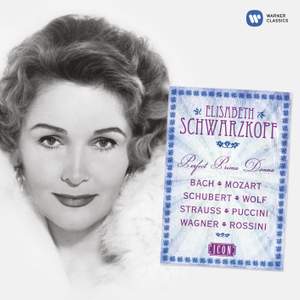
Elisabeth Schwarzkopf (1915–2006) is universally acknowledged to be one of the greatest singers of the 20th century. Blessed with a voice of exquisite beauty, as well as a striking physical presence, she shone brightly in opera, excelled in the concert hall and brought a unique artistry to the recital platform. She was signed exclusively to EMI in 1946 by the recording producer Walter Legge, with whom she formed a dedicated artistic and personal relationship, and together they produced a stream of magnificent recordings over almost 30 years. In addition to the tonal qualities of her voice, Schwarzkopf was renowned for her unrivalled communicative ability, which the vocal critic John Steane described as 'almost making the voice visible'. Thus she could translate her charismatic stage presence into purely vocal terms through the medium of recording, and still convey all the dramatic meaning of her songs and operatic characters to listeners who could hear but not see her. This rare quality is evident in all the recordings in this unique collection, which covers a lifetime of work and reveals the development of her art.

The first CD begins with recordings of works by Bach, Handel and Mozart that are among the earliest that Schwarzkopf made for EMI. They show her voice at its freshest and also exhibit her fine legato and appreciable technique in Baroque music.

CD 2 begins with the famous collaboration between Schwarzkopf and the eminent pianist Walter Gieseking in a collection of simple but refined songs by Mozart that reveal great beauty of tone, evenness of line and sincerity of expression in the singing, as well as sensitive accompaniment from Gieseking. These are followed by four of Mozart’s concert arias with orchestra, in which the conductor is the highly regarded George Szell.

At the beginning of her career, Schwarzkopf sang mainly lighter roles and in CD 3 we have a collection of Mozart arias that demonstrate this part of her repertoire in the arias of Susanna (Le nozze di Figaro) and Pamina (Die Zauberflöte), but also a number of lyric roles that she never sang on stage, including Zerlina (Don Giovanni) and Cherubino (Le nozze di Figaro). This disc also gives us the chance to compare Schwarzkopf’s totally different characterisation of the three principal female roles in Don Giovanni (Elvira, Anna and Zerlina) and Le nozze di Figaro (Susanna, Cherubino and the Countess).

CD 4 brings us back to the field of Lieder and includes another collaboration with a famous pianist, this time Edwin Fischer, in a highly acclaimed recital of Schubert Lieder, as well as more Schubert songs with her two regular accompanists, Gerald Moore and Geoffrey Parsons.

In CD 5 we encounter the widely varied programmes of songs by a wide-ranging selection of composers – from Mendelssohn and Schumann, through Liszt and Brahms, to Mahler and Medtner and many more in between – that would often be a feature of Schwarzkopf’s recitals. To each of these songs she brings her own individuality and stamps them with her personal qualities of beautiful singing and vivid interpretation.

The next disc is devoted entirely to the songs of Hugo Wolf, a composer whom Legge had championed since the beginning of the 1930s. Guided by Legge, Schwarzkopf became a peerless interpreter of Wolf's compositions. This live recording is of a legendary concert in Salzburg on 12 August 1953 marking the 50th anniversary of Hugo Wolf’s death. The piano accompanist is the great conductor Wilhelm Furtwängler.

CD 7 brings us to Richard Strauss, a composer of whose works Schwarzkopf was a matchless performer. It begins with Schwarzkopf’s 1953 recording of Strauss’s valedictory Vier letzte Lieder, followed by the closing scene from Capriccio, an opera that Schwarzkopf performed a number of times on stage, and ends with scenes from Arabella, which Schwarzkopf sang only in the recording studio.

CD 8 stays with Richard Strauss. It starts with a long extract from the first act of Der Rosenkavalier beginning with the aging Marschallin contemplating the passing of the years in a famous monologue and then going to the end of the act in an extended duet with her young lover, the handsome Octavian. This is followed by the glorious trio from the end of the third act, one of Strauss’s most beautiful compositions for the female voice. Then come 12 of Strauss’s wonderful songs for soprano with orchestra, all conducted in supreme Straussian style by George Szell.

In CD 9 we turn to the lighter side of Schwarzkopf’s repertoire with extracts from a whole range of delightful Viennese operettas, beginning with two of Johann Strauss II’s favourite works: Die Fledermaus and Der Zigeunerbaron. Then come several extracts from Schwarzkopf’s second complete recording of Die lustige Witwe by Franz Lehár, and finally the complete recital of operetta arias that was always one of Schwarzkopf’s must popular albums.

The final CD in the set starts with some of Schwarzkopf’s earliest operatic recordings, when she was singing Sophie in Der Rosenkavalier rather than the Marschallin, and a very youthful-sounding Gretel in Hänsel und Gretel. Then come a varied assortment of operatic arias that recall some of the roles that Schwarzkopf sang in the early part of her career, and the disc concludes with four items from the memorable concert at the Royal Festival Hall, London, in February 1967, when Schwarzkopf joined with her two distinguished colleagues Dietrich Fischer- Dieskau and Victoria de los Angeles to pay homage to that doyen of accompanists, Gerald Moore.

EMI Icons - 9184592

(CD - 10 discs)

$37.75

In stock - usually despatched within 1 working day.

Copyright © 2002-13 Presto Classical Limited, all rights reserved.