Prices shown exclude VAT. (UK tax is not payable for deliveries to United States.) See Terms & Conditions for p&p rates. | |  | Mozart: Five Divertimenti
Recording location: Sofiensaal, Vienna, Austria, April 1961 (KV 136, KV 334); September 1962 (KV 287); October 1963 (KV 247); October 1964 (KV 205, KV 290) This recording forms part of a series of 10 reissues celebrating the glorious Decca recordings from the 1950s-1970s of the Wiener Oktett (Vienna Octet), made up of key principals from the Wiener Philharmoniker and the Vienna Symphony Orchestra. Those who campaign against background music in shops, restaurants, hotel lobbies and lifts do not have history on their side. A whole corpus of marvellous music, including the delightful Mozart Divertimenti on these discs, is not intended for serious listening. Its original performances were certainly given against a hum of conversation and probably in the open air. These glorious Wiener Oktett performances represent the Wiener Oktett’s stereo recordings of these pieces, with the ensemble led by Anton Fietz (1926-2010). (The ensemble’s earlier recordings of selected Mozart Divertimenti, led by Willi Boskovsky will be released in December 2010 under the title “Mozart from a Golden Age”.) The recordings of the Divertimenti KV 136 and No. 15 in B flat make their first international appearance on Decca CD and the release is accompanied by extensive and probing notes on the music and the performers by renowned commentator Tully Potter. | | | In stock - usually despatched within 1 working day. |
|
|
| |  | Mozart From A Golden Age: Four Divertimenti
Recording locations: Grosser Saal, Musikverein, Vienna, Austria, June 1950 (KV 334), September 1952 (KV 247); Brahmssaal, Musikverein, Vienna, Austria, April 1955 (KV 287); Sofiensaal, Vienna, Austria, October 1957 (KV 113) This recording forms part of a series of 10 reissues celebrating the glorious Decca recordings from the 1950s-1970s of the Wiener Oktett (Vienna Octet), made up of key principals from the Wiener Philharmoniker and the Vienna Symphony Orchestra. Five titles were released in September and the remaining five are released this month. This release forms a companion to the 2CD set of stereo recordings of the Mozart Divertimenti performed by the Vienna Octet (Decca Eloquence 4802394). The personnel for the earlier recordings of Nos. 10, 15 and 17 differs, led by Willi Boskovsky (witness his superb solo violin playing in No. 15) in these recordings and Anton Fietz in the later versions. They are time-honoured performances, from a truly golden era of Mozart performance, here receiving their first international release on Decca CD. The 1959 stereo recording of Mozart’s first Divertimento in E flat, KV 113, representing Mozart’s first use of clarinets, receives its first release on CD; even in its LP lifetime it was only issued once, on a 45rpm EP record, in both mono and stereo formats. Review publications were in raptures about the release of No. 15, Malcolm McDonald writing in Gramophone (August 1956) concluding his review with the words: ‘If there is a much better Mozart record in the catalogues than this, I would like to hear it.’ The engaging notes to this release, as for all those in this Decca Eloquence Wiener Oktett series, are provided by Tully Potter. “Chamber music at its most orchestral...The musicians play these riches with enchanting naturalness.” BBC Music Magazine, January 2011 ***** “Half century on, the golden age of Viennese music-making flares gloriously into life again [KV 334] … I would say that this classic, out of the catalogues now for more than 30 years, is still the version to have … [Boskovsky’s] playing, and the playing of the ensemble as a whole, is always burnished, idiomatic, intensely alive” Gramophone Magazine “Where to begin singing the praises of this most enchanting record I do not know” Gramophone Magazine (K287) “this is a delightful little record, and highly recommended” Gramophone Magazine K113 | | | In stock - usually despatched within 1 working day. |
|
|
| |  | Herbert von Karajan conducts Mozart & StravinskyBBC broadcast: 15 May 1972, Royal Festival Hall, London
These performances, given in London and Paris in May 1972, can best be described as ‘work in progress’. In the months that followed, Karajan switched the orchestra’s modernist repertoire away from Stravinsky to the music of Schoenberg, Berg and Webern. The Stravinsky ensemble, he concluded, needed better horns and better support in the subsidiary wind sections. Not that the orchestra had disappointed in London. “Perhaps no passage showed more remarkably the near-perfection of the playing than the exchanges between muted trumpets and divided strings in the Introduction to Part 2,” noted Martin Cooper, the exacting chief music critic of the Daily Telegraph. “The overwhelming experience was of a precision, a range of colour and of dynamics, wholly suited to the music. Karajan was able to give even the thickest textures a vibrant clarity, and the split-second timing and sureness of attack in the ‘Dance of the Earth’ and the ‘Glorification of the Chosen One’ showed not only the players’ skill but their extraordinarily intimate knowledge of the work.” Reviewing the 1977 recording in The Gramophone, Arnold Whittall echoed Glenn Gould’s thinking about the importance of alternative views of Le Sacre by noting that what Karajan brought to the piece was a “riveting realisation of the monolithic formal principles which give this score its coherence and its enduring radicalism”. This live London performance may have been work in progress. What is fascinating, however, is the uninterrupted view it provides of the blueprint to which Karajan was working. From the booklet note Richard Osborne, 2009 | | | Usually despatched in 4 - 5 working days. |
|
|
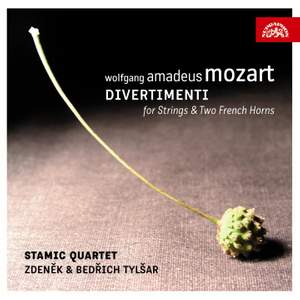
| |  | Mozart: Divertimenti for String Quartet and Two Horns
Zdenek Tylšar, Bedrich Tylšar (horn) Stamic Quartet The period in which the divertimenti for string quartet and winds originated was replete with revolutionary events for Mozart (the struggle of the twenty-year-old “child prodigy” to be accepted as a respected musician, the death of his mother, unreciprocated ardour).The divertimenti, however, as it were remained aloof from these life dramas, rather reflecting memories of the warm Italian sun on his recent travels. Italianate musical style and grace also had a big influence on Mozart’s chamber instrumental works. The Stamic Quartet combines within itself the strong tradition of the Czech quartet school and a long-term interest in the classicist repertoire. This ensemble’s conjunction with the phenomenal horn-playing brothers Zdenek and Bedrich Tylšar has resulted in a model recording of Mozart’s divertimenti; a recording that (just like these compositions themselves) should serve primarily as a celebration of the joyous side of life. | | | Usually despatched in 4 - 5 working days. |
|
|
| |  | Mozart: Eine Kleine Nachtmusik, Serenata Notturna & Divertimento
| |
|
| |  | Mozart: Nachtmusik…
| | | Usually despatched in 4 - 5 working days. |
|
|
| |  | Mozart: Divertimenti
| | | (Sorry, download not available in your country) | Usually despatched in 8 - 10 working days. |
|
|
| |  | Toscanini: All Mozart
Plus rehearsal footage of the Magic Flute Overture and the Haffner Symphony from 2nd November 1946 Concert recorded on 3rd November 1946 | | | Usually despatched in 8 - 10 working days. |
|
|
| |  | Mozart: Divertimenti K. 205 and 287
| |
|
| |  |
| | | Usually despatched in 8 - 10 working days. |
|
|
| |
|