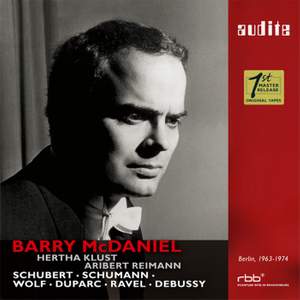
Prices shown exclude VAT. (UK tax is not payable for deliveries to United States.) See Terms & Conditions for p&p rates. | |  | Barry McDaniel sings Schubert, Schumann, Wolf, Duparc, Ravel & Debussy
Debussy: | Le promenoir des deux amants | Duparc: | Chanson triste Lamento Le Manoir de Rosemonde Extase Soupir Phidylé | Ravel: | Trois chansons madécasses Eberhard Finke (cello) & Karlheinz Zoeller (flute) | Schubert: | Der Winterabend (Es ist so still), D938 Herbst, D945 Dass sie hier gewesen! D775 (Rückert) Der Einsame, D800 Fahrt zum Hades, D526 (Mayrhofer) Der Jungling und der Tod, D545 (Spaun) Sprache der Liebe D410 (A W von Schlegel) Fischerweise, D881 (Schlechta) Über Wildemann D884 (Ernst Schulze) Auflösung, D807 | Schumann: | Gedichte (6) und Requiem, Op. 90 Nachtlied, Op. 96 No. 1 Der Spielmann, Op. 40, No. 4 Zigeunerliedchen I & II Verratene Liebe, Op. 40, No. 5 Provencalisches Lied, Op. 139 No. 4 Mein Schöner Stern! Op. 101 No. 4 Aus den hebräischen Gesängen, Op. 25 No. 15 Ihre Stimme Op. 96 No. 3 (August von Platen) | Wolf, H: | An eine Æolsharfe (No. 11 from Mörike-Lieder) Heimweh (No. 37 from Mörike-Lieder) Lebe wohl (No. 36 from Mörike-Lieder) Nimmersatte Liebe (No. 9 from Mörike-Lieder) Der Tambour (No. 5 from Mörike-Lieder) Abschied (No. 53 from Mörike-Lieder) |
Barry McDaniel (baritone), Hertha Klust (piano) & Aribert Reimann (piano) The American baritone Barry McDaniel was one of the outstanding singers of the post-war era. As a successful opera singer and Lieder interpreter, he enjoyed a long and eventful career, both in Germany and abroad. Despite numerous performances and many recordings for radio and television, he nonetheless remained largely unnoticed by the media, partly because his name almost vanished in the shadow of Dietrich Fischer-Dieskau, who was five years his senior. Unjustly so, since the two singers were equals as artists, albeit with different characters. Today, Barry McDaniel is hardly mentioned in specialist literature and one searches in vain for CDs since, until now, recordings from radio archives have not been phonographically processed. However, Audite now presents a première double CD of Lieder sung by Barry McDaniel. These studio recordings from the archives of Radio Berlin-Brandenburg (formally Sender Freies Berlin) were made between 1963 and 1974 with Hertha Klust and Aribert Reimann as accompanists. This selection of songs by Schubert, Schumann, Wolf, Duparc, Ravel and Debussy reveals diverse facets of McDaniel’s artistic personality. His interpretations are characterised by an interleaving of knowledge and naivety, feeling and craftsmanship, expression and impeccable singing. Apart from his immaculate technique, his accent-free German is particularly remarkable. Barry McDaniel moved from the USA to Germany in 1953 in order to further his studies. He then gave his first song recitals, together with Hermann Reutter, and later began a career as an opera singer. In 1961 he was engaged at the newly re-opened Deutsche Oper Berlin, where he remained for thirty-seven years. At the same time, he gave guest performances at the Vienna Staatsoper, the Metropolitan Opera New York, the Frankfurt Opera and the Munich Opera Festival, as well as broadcasting for radio and television. In addition, Barry McDaniel gave numerous song recitals, for example in Stuttgart, Karlsruhe, Hanover, Brunswick and Berlin, including, in the latter city, the first ever song recital at the newly built Philharmonie in 1963. Today, the 81-year-old baritone declares: “Whatever I sing, I have to believe in it.” That is exactly how these recordings sound. “The American Barry McDaniel inevitably sang in the shadow of Fischer-Dieskau; but this double CD reveals his deeply thoughtful baritone, in superbly accompanied Lieder and melodie.” BBC Music Magazine, June 2012 **** | | | (also available to download from $21.00) | Usually despatched in 3 - 4 working days. (Available now to download.) |
|
|
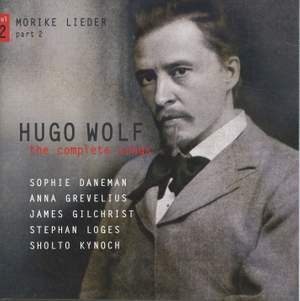
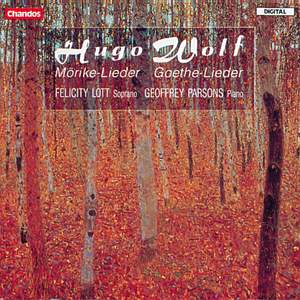
| |  | Hugo Wolf: The Complete Songs Volume 2Mörike-Lieder Nos. 27-53
This is the second volume of the first complete recording of the songs of Hugo Wolf. All the works are performed by internationally renowned lieder singers and were recorded live at the Oxford Lieder Festival. Sholto Kynoch is the founder and director of the festival and is in demand as a chamber musician and song accompanist. “The four excellent singers...show a vivid understanding of the texts (translated in helpful CD notes by Richard Stokes). Sholto Kynoch steers the performances with secure, expressive playing, especially in dark moods – "Der Jäger" (Gilchrist) – or in the sardonic wit of the last song, "Abschied" (Loges).” The Observer, 9th October 2011 “As the palette of voices is varied, Kynoch is able to group the Lieder thematically without risking tedium...Gilchrist alert to [the songs'] volatility and drama; Daneman capturing every elusive and sensuous breeze of emotion and tale-telling; Grevelius discovering the inner angst darkening the songs; and Loges the Sehnsucht of late-Romantic yearning.” BBC Music Magazine, December 2011 **** “[Kynoch] is among the finest accompanists around. Sophie Daneman’s bright soprano is always a pleasure to hear but here she is not always ideally steady and her vibrato is at times too prominent. Her floated pianissimos sometimes make me forgive some of the unsteadiness...Best of all, to my mind, is Anna Grevelius. Her voice is a flexible instrument, beautiful and even from top to bottom, and with a wide range of nuance and expressivity.” MusicWeb International, June 2012 | | | (also available to download from $10.50) | Usually despatched in 2 - 3 working days. (Available now to download.) |
|
|
| |  | Le Lied Romantique
| | | Usually despatched in 4 - 5 working days. |
|
|
| |  | Wolf: Lieder
| | | (also available to download from $10.50) | Usually despatched in 2 - 3 working days. (Available now to download.) |
|
|
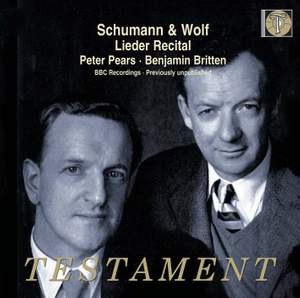
| |  | Elisabeth Schwarzkopf: Farewell Recital in Amsterdam, 1977
Liszt: | Die drei Zigeuner, S.320 | Mahler: | Ich atmet' einen linden Duft (Rückert-Lieder) | Schubert: | Der Einsame, D800 Gretchen am Spinnrade, D118 Seligkeit D433 (Holty) Der Lindenbaum (No. 5 from Winterreise, D911) | Schumann: | Der Nussbaum, Op. 25 No. 3 | Strauss, R: | Ruhe, meine Seele!, Op. 27 No. 1 Ach, was Kummer, Qual und Schmerzen, Op. 49 No. 8 | Wolf-Ferrari: | Vado di notte, come fa la luna | Wolf, H: | Mignon IV 'Kennst du das Land' (No. 9 from Goethe-Lieder) Die Zigeunerin (No. 7 from Eichendorff-Lieder) Ich esse nun mein Brot nicht trocken mehr Ich hab in Penna einen Liebsten (No. 46 from Italienisches Liederbuch) Trau nicht der Liebe (No. 67 from Spanisches Liederbuch: Weltliche Lieder) O wär dein Haus durchsichtig wie ein Glas Wie lange schon war immer mein Verlangen (No. 11 from Italienisches Liederbuch) An den Schlaf (No. 29 from Mörike-Lieder) Heimweh (No. 37 from Mörike-Lieder) Denk es, o Seele! (No. 39 from Mörike-Lieder) Das verlassene Mägdlein (No. 7 from Mörike-Lieder) |
| | | Usually despatched in 2 - 3 working days. |
|
|
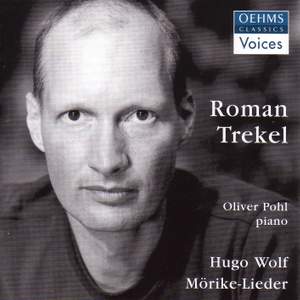
| |  | Wolf: Mörike-Lieder (selections)
“There can be no better advocate of Hugo Wolf than Roman Trekel, now at the peak of his career as a Lieder interpreter, who presents this deeply satisfying recital of the best of the Mörike Lieder. These inspired songs need, above all, the kind of intense expression and intimate, detailed treatment that Trekel brings them. Performed as convincingly as they are here, they offer a particular frisson of individual accent that no other composer in the genre, whatever their other merits, quite equals: words and music seem as though they were written at one and the same time Trekel achieves an ideal fusion of tonal security, sense of line and word-painting. In a comparatively long and complex Lied such as 'Im Frühling', he and the admirable Oliver Pohl traverse all the points of the expressive compass, and all the nuances of dynamics that belong to them. In that surpassingly sincere and beautiful love-song 'An die Geliebte' they build to the climax from 'Von Tiefe dann zu Tiefen' with a confidence that bespeaks long familiarity with the piece. Even better is the heartache they bring to 'Peregrina II' and 'Lebe wohl', where Wolf seems to enter into all the poet's suffering at the hands of a beloved. They also find the inner spirituality of the religion-inspired settings, such as 'Auf ein altes Bild' and 'Denk' es o Seele', the latter so compelling for saying so much in such a short time. In a quite different vein, they rise marvellously to the frenzied melodrama of 'Der Feuerreiter', always a challenge to singer and pianist and one that's surely met here. A truthful recording adds to the disc's merits. Not so the notes, which omit any exposition of the songs and also English translations. Even so, this is a recital that ought to convert even Wolf heretics to the cause.” Gramophone Classical Music Guide, 2010 “Still too little known outside Germany, Roman Trekel brings to his selection of 22 Mörike Lieder a voice of burnt umber, a scrupulous sense of style (including a true legato) and a probing imagination, whether in an eager wondering "Auf einer Wanderung" or a musing unmawkish "Verborgenheit".” Gramophone Magazine, October 2008 | | | (also available to download from $10.50) | Usually despatched in 2 - 3 working days. (Available now to download.) |
|
|
| |
|