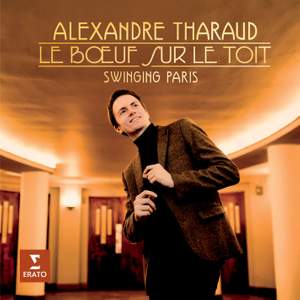
Prices shown exclude VAT. (UK tax is not payable for deliveries to United States.) See Terms & Conditions for p&p rates. | |  | Alexandre Tharaud: Le Boeuf sur le toit
In a startling new departure for the French pianist Alexandre Tharaud, he invites a diverse group of musical friends to join him in celebrating Le Boeuf sur le toit, the legendary Paris cabaret that became a hotspot of Parisian and international culture in the heady 1920s. A confluence of jazzy musical currents brings together French composers like Ravel, Milhaud, Wiener and Doucet and American songwriters like Gershwin, Kern and Porter. “This CD, ‘Le Boeuf sur le toit’, is completely different from anything I have recorded up till now,” says Alexandre Tharaud. While each of his previous Virgin Classics albums has focused on a single composer – Bach, Scarlatti, Chopin – here the French pianist presents more than 20 items by a kaleidoscope of musical talent from both classical and popular milieux: Ravel, Milhaud, Gershwin, Kern, Porter, Kalman, W.C. Handy (the so-called Father of the Blues), the French piano duo Wiener and Doucet and more. Their point of convergence is the legendary Paris cabaret, Le Boeuf sur le toit, a hotspot and melting pot of Parisian and international culture in the heady 1920s. Its name – meaning ‘the ox on the roof’ – was appropriated by the cabaret’s owner, Louis Moysès, from the composer Darius Mihaud, who had used it for a celebrated orchestral score, written after a visit to Brazil and filled with syncopated dance rhythms. Jean Cocteau, the Renaissance man of French artistic life in the mid-20th century, brokered the deal. As Tharaud explains: “Cocteau – who was there almost every evening and sometimes used to play drums with the marvellous pianist and composer, Jean Wiener – embodied the spirit of Le Boeuf sur le toit. The pianist Clément Doucet also used to play there regularly. And, in the restaurant every evening, you would come across composers like Maurice Ravel, Erik Satie and the members of Les Six, like Francis Poulenc, Darius Milhaud, Germaine Tailleferre. ... or perhaps Stravinsky. There were French popular singers like Maurice Chevalier, Yvonne Georges, Mistinguett, Kiki de Montparnasse and then, among the throng, lots of artists, such as Man Ray, Picabia, Diaghilev, Coco Chanel, Georges Simenon, André Gide ... Though they came from different worlds, everybody on the Paris scene came to Le Boeuf sur le toit for jazz and new music amidst the excitement of the Roaring Twenties.” The cabaret’s importance in the history of jazz can be gauged by its immortalisation in the French term for having a jam session, ’faire le boeuf’. “I really think that French music would not have been the same without Le Bœuf sur le toit,” continues Tharaud. “The programme for this CD includes piano pieces that were played there on a regular basis, written by Jean Wiener, Clément Doucet and Darius Milhaud, but also by American composers who probably never set foot there, such as George Gershwin and Jerome Kern.” Tharaud is joined on this disc by a hand-picked group of colleagues. From the world of classical music come: the pianist Frank Braley (“He is crazy about Gershwin,” explains Tharaud); the percussionist Florent Jodelet; the tenor Jean Delescluse and, singing (or doing the vocal trumpet more precisely) a blues by Jean Wiener, the soprano Natalie Dessay, one of Virgin Classics’ highest-flying artists. Joining Tharaud from the world of jazz and popular music are the guitarist David Chevallier (here on banjo) and three singer-songwriters: Madeleine Peyroux (an American of French extraction) and two French artists very much in the idiosyncratic tradition of the French chansonnier, Juliette and Bénabar. The actor Guillaume Galliene, an resident of France’s most prestigious theatre, the Comédie-Française, takes on a cheeky comic song. Touchingly, Tharaud also sees this disc as a tribute to his grandfather, Charles Auvergne, a classical violinist who in the 1920s used to play in cinema orchestras, dance bands and brasseries and in the recording studio for singers. “He was an all-round musician,” says Tharaud, “and I like the idea of being a musician who interprets music in a broad sense, who can experience music to the full, whether it’s a little popular song or a grand concerto by Rachmaninov ... from the opera house to a little café.” “Tharaud sheds his customary cool to "faire le boeuf" (or "jam") with Frank Braley, Natalie Dessay, Madeleine Peyroux and assorted stars of the Parisian theatre” The Independent on Sunday, 21st October 2012 **** “67 minutes of pure musical sunshine. Much of the delight comes from the unexpectedness of the programming...Any caveats? Short of the addition of an audience to add some ambient sound, no...A disc to charm, to delight and to chase away the winter blues.” Gramophone Magazine, December 2012 “This is fun...Tharaud's varied programme captures the frenetic, vibrantly eclectic melting pot of 1920s Paris...The charms of this beautifully packaged disc are hard to resist.” BBC Music Magazine, February 2013 **** | | | Usually despatched in 4 - 5 working days. |
|
|
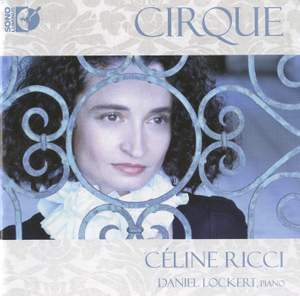
| |  | Céline Ricci: Cirque
Céline Ricci (soprano) & Daniel Lockert (piano) The magic and ambience of a 1920 French street circus comes alive in Cirque, a spectacular collection of works brought to life by soprano Céline Ricci and her pianist and collaborator, Daniel Lockert and presented by Sono Luminus. In this collection of songs by Georges Auric, Darius Milhaud, Henri Sauguet and Francis Poulenc, the listener is drawn into the world of circus as depicted by the words of Cocteau, Copperie, Pitoëff, Supervielle, Lenormand, Dréjac and even Nostradamus. Through colorful language and clever sounds depicting a carnival-like atmosphere, we hear the words of the fortune-teller, see the girl riding bareback, watch the trapeze artist, hear the horses hooves pounding in the dirt, see into the future. The references go beyond street life in Huit Poèmes de Jean Cocteau by Georges Auric exploring many new inventions of the 1920s, citing the “bi-plane combing the clouds”, the clouds circling the Eiffel Tower, the dirigible in the air, along with homage being paid to Erik Satie, the initiator of the new movement of surrealism in music, and the final line in the last poem about “Long live the republic” referring, of course, to the end of the 1st World War. Two of the cycles on this album are not directly related to the early 20s, but have a strong connection because of who wrote them. Written considerably later, Six Chansons de Théâtre by Darius Milhaud are wonderful musical illustrations of fragments of theater pieces by three different playwrights. Le Chemin des Forains by Henri Sauguet is actually a song made famous by Edith Piaf, arranged on this album by Daniel Lockert. These two works are representative of the relationship both composers had to their early beginnings. The musical and poetic illustrations of common, everyday life were the driving force behind much of the composers’ output during this period of time, which extended from the early 20s into the early 50s. It was a commentary on things ordinary described musically and textually in an extraordinary way. Many of these songs also served as a metaphor for a much larger picture by pushing the boundaries of thought, perception and the relevancy of man in relation to the world following the devastation of the Great War. Born in Florence of Italian and French parents, soprano Céline Ricci studied in Paris with Ana Maria Miranda continuing her post-graduate studies at the prestigious Guildhall School of Music and Drama in London. Renowned conductor William Christie selected this gifted artist for his first elite academy, Les Jardin des Voix. She was named one of opera’s promising new talents by Opernwelt. She has subsequently made many appearances under the baton of this conductor and his prestigious Les Arts Florissants and continues to have engagements with them well into the future. Céline Ricci already has an impressive discography including a number of audio recordings and three DVDs. The recent release of Terradellas’ opera Artaserse, in which she sang the role of Arbace, garnered a great deal of critical acclaim. In her character’s 8-minute aria, Opernwelt singled out Ms Ricci’s exciting performance as being a “tour de force” and she was also described as having “faultless breath control, total security and perfect round tone.” This is Céline Ricci’s first solo recording, which also marks her partnership with pianist/collaborator Daniel Lockert. Daniel Lockert is a multi-talented pianist/collaborator. He was honored as the only American finalist at the first International Accompanying Competition held in Den Hague, the Netherlands. In his role as pianist/collaborator, his wide-ranging career has taken him around the globe, playing throughout the United States, Europe, Japan, Australia and New Zealand. He has been praised for exhibiting a strong sense of rhythm, lovely variety of touches, and a convincing sense of historical style. In the words of Ms Ricci, “the CD will be very alive and animated in order to give to the listener the possibility of traveling back in time and to have the impression of what it was like on the streets of Paris or at a fair or a play in the 20’s.” | | | (also available to download from $10.50) | Usually despatched in 2 - 3 working days. (Available now to download.) |
|
|
| |
|