Wagner: Schlafst du, Gast? Ich bin's! (from Die Walküre) (Sieglinde's monologue)

This page lists all recordings of Schlafst du, Gast? Ich bin's! (from Die Walküre) (Sieglinde's monologue), by Richard Wagner (1813-83) on CD. Generally, more recent releases are listed first, but with priority given to those that are in stock.

Prices shown exclude VAT. (UK tax is not payable for deliveries to United States.)
See Terms & Conditions for p&p rates.

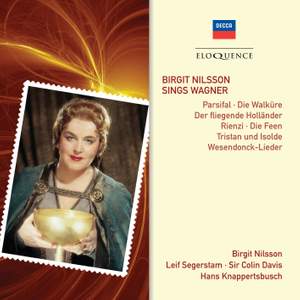
Birgit Nilsson sings Wagner

Birgit Nilsson sings Wagner


Wagner:

Schlafst du, Gast? Ich bin's! (from Die Walküre)

Helge Brilioth (Siegmund)

Orchestra of the Royal Opera House, Covent Garden, Leif Segerstam

Dies alles – hab’ ich nun geträumt? (from Parsifal)

Helge Brilioth (Parsifal), Norman Bailey (Amfortas)

Orchestra of the Royal Opera House, Covent Garden, Leif Segerstam

Gerechter Gott! (from Rienzi)

London Symphony Orchestra, Sir Colin Davis

Johohoe! Traft ihr das Schiff im Meere an 'Senta's Ballad' (from Der fliegende Holländer)

The John Alldis Choir & London Symphony Orchestra, Sir Colin Davis

Weh mir, so nah (from Die Feen)

London Symphony Orchestra, Sir Colin Davis

Wesendonck-Lieder (5)

London Symphony Orchestra, Sir Colin Davis

Tristan und Isolde: Prelude to Act 1

Wiener Philharmoniker, Hans Knappertsbusch

Wie lachend sie mir Lieder singen (from Tristan und Isolde)

Grace Hoffmann (Brangäne)

Wiener Philharmoniker, Hans Knappertsbusch

Tristan und Isolde: Prelude & Liebestod

Wiener Philharmoniker, Hans Knappertsbusch


Birgit Nilsson (soprano)

Birgit Nilsson. Richard Wagner. It was an operatic marriage made in heaven that lasted for over twenty years and, thanks to recordings, continues to thrill music lovers around the world. She sang her first Wagnerian part in Stockholm. It was Senta in Der fliegende Holländer. It was greeted rapturously and throughout her long career it was for her Wagner and Strauss roles that she was most noted. Many of the greatest recordings of music dramas and operas by these composers have featured her, and many appear on Decca. However, she also made two Wagner records for Philips – one with Leif Segerstam in 1974 of extended scenes from Walküre and Parsifal, another, in 1972, with Colin Davis of the Wesendonck-Lieder and extracts from Der fliegende Holländer, Rienzi and the little-known early Wagner opera, Die Feen (The Fairies). Also included are scenes from Tristan und Isolde, one of her great calling cards and of which she made at least two live recordings, one studio recording with Georg Solti, and another of scenes (with Grace Hoffman as Brangäne) with Hans Knappertsbusch.

Nilsson’s voice had the clear, silvery sound that seems to be characteristic of Scandinavian singers. It was rock solid, encompassed over two octaves, and was perfectly even, top to bottom. It was also enormous. Especially in the upper part of the voice it could take on a laser-like quality that simply sliced through the densest orchestral sound and speared listeners to the backs of their seats. That meant the great moments of a Wagnerian opera were truly monumental – a surging orchestra and a soprano who dominated everything, combined into an overwhelming climax as Wagner must have heard in his dreams.

Here is a snapshot of some of those great moments, captured on record, and bringing together three complete LPs – two made for Philips (Segerstam, Davis) and one for Decca (Knappertsbusch).

“Her Kundry, in the most crucial scene of the opera, is lulling, sensuous, the menace more sinister because it is not revealed in any hardness of tone or phrasing … It is an immensely subtle performance, a proper reconciliation of great vocal gifts with an intelligent understanding of the most difficult moment of the most difficult of all operas. […] a showpiece for Miss Nilsson's great powers” Gramophone Magazine (Parsifal, Walküre)

“Even allowing for the fact that these were demonstration records when they first appeared, the sound on this CD is astonishing in its lifelike presence and its warmth. As nobody has surpassed Knappertsbusch to this day as a Wagner conductor in the inevitable sweep and grandeur of his direction […] What glorious singing Nilsson gives us; full throated in the great passage, “O blinde Augen!”, which she ends with an electrifying top B natural, producing another (no mere glancing at the note) on "lacht" just before her thrilling singing of the curse.” Gramophone Magazine (Tristan und Isolde)

Australian Eloquence Vocal Recitals - 4803550

(CD - 2 discs)

$14.25

In stock - usually despatched within 1 working day.

Wagner Duets

Wagner Duets


Wagner:

Wie aus der Ferne längst (from Der Fliegende Holländer)

Das susse Lied verhallt (from Lohengrin)

Gruss Gott, mein Junker (from Die Meistersinger von Nürnberg)

Grüß Gott, mein Evchen! (from Die Meistersinger von Nürnberg)

Geliebter, sag’, wo weilt dein Sinn? (from Tannhäuser)

Dir töne Lob (from Tannhäuser)

Ach! Ach! Tiefe Nacht! Wahnsinn!...Furchtbare Not! (from Parsifal)

Du siehst, das ist nicht so (from Parsifal)

Wotan! Gemahl! Erwache (from Das Rheingold)

Schlafst du, Gast? Ich bin's! (from Die Walküre)

Winterstürme wichen dem Wonnemond (from Die Walküre)

Du bist der Lenz (from Die Walküre)

Siegmund heiß ich und Siegmund bin ich! (from Die Walküre)

So tatest du, was so gern zu tun ich begehrt (from Die Walküre)

Nicht streb’, o Maid, den Mut mir zu stören (from Die Walküre)

Leb wohl, du kühnes, herrliches Kind! (from Die Walküre)

Zu neuen Taten, teurer Helde (from Götterdämmerung)

Mehr gabst du, Wunderfrau, als ich zu wahren weiß (from Götterdämmerung)

Schläfst du, Hagen, mein Sohn? (from Götterdämmerung)

O sink hernieder, Nacht der Liebe (from Tristan und Isolde)

Tatest du's wirklich? (from Tristan and Isolde)


Looking back at Tristan und Isolde twenty years after its composition, Wagner told his wife Cosima: ‘My model was Romeo and Juliet – nothing but duets!’ He was invoking Bellini’s opera I Capuleti e i Montecchi, which he had conducted many times as a young man. Indeed, there had been much in the Italian master’s legacy that had impressed the young Wagner, including the ‘long, long, long melodies’ that Verdi described, and the technique of melodic sequence in which a phrase is repeated with rising pitch and heightened effect. The erotic potential of such procedures is famously exploited in the ‘night of love’ in Act II of Tristan und Isolde. And while this might well claim to be Wagner’s best-known duet, this innovative 2CD set, compiled by Australia’s Wagner expert Peter Bassett (who also contributes the notes) brings together a collection of dialogues, musical conversations and duets from the major Wagner operas.

The recordings are among the finest ever made. The singers are a Who’s Who of great names from the sixties, seventies and eighties – Fischer-Dieskau, Janowitz, Vickers, Thomas, Price, Kollo… with conductors like Karajan, Kleiber and Jochum directing these revelatory performances. The breadth and diversity of the emotion on this double album is matched by the generous playing times: more than two hours and forty minutes of music on a 2CD set.

“a performance with the blast of the winds and whiff of the sea” Gramophone Magazine (Fliegende Holländer)

“the chivalrous James King will impress you as being one of the purest, most unidiosyncratic Lohengrins you’ll have heard” Gramophone Magazine (Lohengrin)

“Fischer-Dieskau’s interpretation is as musical, as richly varied, as intelligent as one could hope for […] The great and unexpected revelation is Domingo’s Walther … he provides the most lyrically ardent Walther in any of the sets to date, seconding his conductor in his long-breathed, eloquent phrasing.” Gramophone Magazine (Die Meistersinger von Nürnberg)

“Nilsson rises to great heights … is predictably glorious in her pleading for mercy to be shown to her lover and Windgassen is equally good in his defiance and contrition” Gramophone Magazine (Tannhäuser)

“Fischer-Dieskau and Veasey establish their characters with amazing clarity and speed” Gramophone Magazine (Rheingold)

“Vickers is a passionate Siegmund … his performance is superb … and as he is in splendid voice the heroic moments are most exciting.” Gramophone Magazine (Die Walküre)

“Kollo matches Price’s beauty of line with his own, so that for lyrical refinement their love duet is in a class of its own” Gramophone Magazine (Tristan und Isolde)

“Helge Dernesch is at her very peak” Penguin Guide ***

Released or re-released in last 6 months

Australian Eloquence - 4807308

(CD - 2 discs)

$14.25

Scheduled for release on 17 June 2013. Order it now and we will deliver it as soon as it is available.

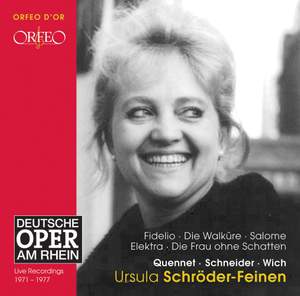
In Memoriam - Ursula Schröder-Feinen

In Memoriam - Ursula Schröder-Feinen


Beethoven:

Abscheulicher! Wo eilst du hin? (from Fidelio)

Er sterbe!...Es schlägt der Rache Stunde (from Fidelio)

Peter Wimberger (Pizarro), Peter Meven (Rocco), Wold Appel (Jaquino)

O namenlose Freude! (from Fidelio)

Ernst Kozub (Florestan)

Strauss, R:

Die Frau ohne Schatten (highlights)

Hildegard Behrens (Empress), Linda Karén (Nurse), Matti Kastu (Emperor) & Gerd Feldhoff (Barak)

Orest! Orest! (from Elektra)

Siegmund Nimsgern (Orest)

Läßt du den Bruder nicht nach Hause, Mutter? (from Elektra)

Astrid Varnay (Klytamnestra)

Ah! Du wolltest mich nicht deinen Mund küssen lassen (from Salome)

Astrid Varnay (Herodias), Wilhelm Ernest (Herodes)

Wagner:

Schlafst du, Gast? Ich bin's! (from Die Walküre)

Gerd Brenneis (Siegmund)


Ursula Schröder-Feinen (soprano)

Chorus & Orchestra of the Deutschen Oper am Rhein/Arnold Quennet, Peter Schneider & Günther Wich

Live Recordings 1971-1977

Orfeo - Orfeo d'Or - C599061B

(CD)

$13.50

Usually despatched in 3 - 4 working days.

Birgit Nilsson sings Richard Wagner and Richard Strauss

Birgit Nilsson sings Richard Wagner and Richard Strauss


Strauss, R:

Es gibt ein Reich (from Ariadne auf Naxos)

Es ist kein Laut zu vernehmen (from Salome)

Ah! Du wolltest mich nicht deinen Mund küssen lassen (from Salome)

Was willst du, fremder Mensch? (from Elektra)

Es dunkelt, dass ich nicht sehe zur Arbeit (from Die Frau ohne Schatten)

Es gibt derer, Die bleiben immer gelassen (from Die Frau ohne Schatten)

Das Weib ist irre...Barak, ich hab' es nicht getan! (from Die Frau ohne Schatten)

Wagner:

Dich, teure Halle (from Tannhauser)

Euch Lüften, die mein Klagen (from Lohengrin)

Schlafst du, Gast? Ich bin's! (from Die Walküre)

Winterstürme wichen dem Wonnemond (from Die Walküre)

Du bist der Lenz (from Die Walküre)

Siegmund heiß ich und Siegmund bin ich! (from Die Walküre)

Ewig war ich (from Siegfried)

Schweigt eures Jammers jauchzenden Schwall (from Götterdämmerung)

Starke Scheite schichtet mir dort 'Brünnhilde's Immolation Scene' (from Götterdämmerung)


Birgit Nilsson (soprano)

Gala - GL100535

(CD - 2 discs)

$12.75

Usually despatched in 2 - 3 working days.

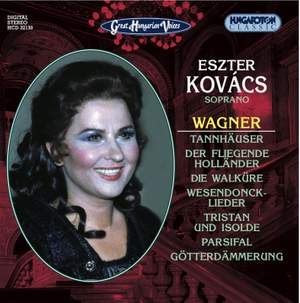
Great Hungarian Voices: Eszter Kovács

Great Hungarian Voices: Eszter Kovács


Wagner:

Dich, teure Halle (from Tannhauser)

Johohoe! Traft ihr das Schiff im Meere an 'Senta's Ballad' (from Der fliegende Holländer)

Schlafst du, Gast? Ich bin's! (from Die Walküre)

Wesendonck-Lieder (5)

Mild und leise 'Isolde's Liebestod' (from Tristan und Isolde)

Ich sah das Kind an seiner Mutter Brust (from Parsifal)

Starke Scheite schichtet mir dort 'Brünnhilde's Immolation Scene' (from Götterdämmerung)


Eszter Kovács (soprano), with András Molnár (tenor), András Faragó (baritone)

Hungarian State Opera Chorus and Orchestra, Zagreb Philharmonic Orchestra, Budapest Symphony Orchestra, Lovro Von, Matacic, András Mihály

Hungaroton Great Hungarian Voices - HCD32130

(CD)

$15.75

Usually despatched in 4 - 5 working days.

Copyright © 2002-13 Presto Classical Limited, all rights reserved.