All recordingsPrices shown exclude VAT. (UK tax is not payable for deliveries to United States.) See Terms & Conditions for p&p rates. | |  | Schumann/Heine Lieder
Schumann: | Liederkreis, Op. 24 Der arme Peter, Op. 53 No. 3 Die beiden Grenadiere, Op. 49 No. 1 Abends am Strand, Op. 45 No. 3 Die feindlichen Brüder, Op. 49 No. 2 Belsazar, Op. 57 Du bist wie eine Blume, Op. 25 No. 24 Was will die einsame Träne, Op. 25 No. 21 Die Lotosblume, Op. 25 No. 7 Tragödie Op. 64 No. 3 Es leuchtet meine Liebe, Op. 127 No. 3 Lehn deine Wang' Op. 142 No. 2 Dein Angesicht, Op. 127 No. 2 Mein Wagen rollet langsam, Op. 142 No. 4 |
Florian Boesch (baritone) & Malcolm Martineau (piano) ONYX is proud to present an exceptional Schumann recital by the outstanding Austrian baritone Florian Boesch. The recital consists of the greatest Heine settings, the op24 Liederkreis, plus many of the great Romances and Ballads including Belshazzar (Belsatzar). Boesch is rapidly becoming known as one of the most truthfully dramatic lieder interpreters of our day, and made a sensational debut at the Edinburgh Festival in 2005 with Martineau. Florian Boesch studied in Vienna with Robert Holl. In 2003 he made his operatic debut with Opernhaus Zürich as Papageno, and is now working with many of the world’s greatest conductors including Gergiev, Bychkov, Harnoncourt, Herreweghe, Viotti and Adam Fischer. Despite his opera work he is perhaps unusual in devoting much of his time to lieder with performances at London’s Wigmore Hall, Concertgebouw Amsterdam, Edinburgh Festival, Mozarteum Salzburg, Wiener Konzerthaus, Palais des Beaux-Arts Brussels, the Schubertiade Festival Schwarzenberg. “The Austrian baritone opens with an exquisitely gauged Liederkreis, Op 24, full of subtle emotional twists and turns. The rest is a carefully varied selection of settings of words by Heine.” Sunday Times, 3rd May 2009 **** “Having an accompanist as perceptive and exquisitely musical as Malcolm Martineau is a big asset, these are lieder performances of very high quality indeed.” The Guardian, 1st May 2009 **** “There is much to enjoy in Boesch's dramatic, intensely "lived" performances, and in the imaginative playing of Malcolm Martineau (ultra-sensitive in Schumann's secretive piano postludes).” Gramophone , Awards 2009 | | | In stock - usually despatched within 1 working day. |
|
|
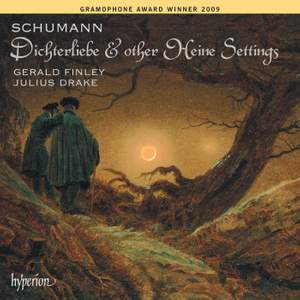
| |  | Schumann - Dichterliebe & other Heine settings
Schumann: | Tragödie Op. 64 No. 3 Die beiden Grenadiere, Op. 49 No. 1 Abends am Strand, Op. 45 No. 3 Die feindlichen Brüder, Op. 49 No. 2 Der arme Peter, Op. 53 No. 3 Belsazar, Op. 57 Die Lotosblume, Op. 25 No. 7 Was will die einsame Träne, Op. 25 No. 21 Du bist wie eine Blume, Op. 25 No. 24 Lehn deine Wang' Op. 142 No. 2 song originally conceived for Dichterliebe Es leuchtet meine Liebe, Op. 127 No. 3 song originally conceived for Dichterliebe Dein Angesicht, Op. 127 No. 2 song originally conceived for Dichterliebe Mein Wagen rollet langsam, Op. 142 No. 4 song originally conceived for Dichterliebe Dichterliebe, Op. 48 |
Gerald Finley (baritone) & Julius Drake (piano) Why another Dichterliebe recording? Because Gerald Finley has simply one of the greatest voices of his generation, and is an artist at the peak of his powers. He brings to this noble song cycle the supreme technical ability and penetrating musical understanding that characterize all his performances, whether on the concert platform, in the recording studio or on the great opera stages of the world. This is his fourth disc with collaborator Julius Drake, and the partnership has proved to be a uniquely rewarding one. This fine recital also includes many of Schumann’s other Heine settings. The extremes of elation and despair in Heine’s poetry stimulated Schumann to write some of his most poignant and unforgettable songs. This is truly a disc to treasure. “[Finley] brings eloquence to the text and maturity to his interpretations, but with a still youthful-sounding voice. Darker and more “bassy” of tone than Dieskau, he is especially impressive in the sardonic and bitter songs...Finley is a gripping narrator, too, in the tale of Belshazzar’s feast, and can refine his voice to the most arresting of internalised confidences in the love songs to Clare Wieck.” Sunday Times, 14th September 2008 **** “Finley is a much less knowing, more direct performer than Fischer-Dieskau, concentrating less on precise verbal nuance (though his German diction is wonderfully clear) than on more generalised expressive contours, but the effect is still overwhelmingly powerful.” Andrew Clements, The Guardian, 5th September 2008 ***** “Doubts as to whether the world needs yet another Dichterliebe are allayed by a performance that probes the extremes of Schumann's evocation of remembered, blighted love. Gerald Finley's burnished baritone is one of the most beautiful voices to have recorded the cycle.” The Telegraph, 6th September 2008 “Finley's performance gives huge pleasure and insight…” BBC Music Magazine, September 2008 **** “In close collusion with the ever-sentient Julius Drake, Gerald Finley gives one of the most beautifully sung an intensely experience performances on dic of Schumann's cycle of rapture, disillusion and tender regret. This is a Dichterliebe firmly in the past tense, the poet-lover achingly resigned from the outset. Singer and pianist are just as compelling in the other Heine settings here.” Gramophone Magazine, November 2008 | | | In stock - usually despatched within 1 working day. |
|
|
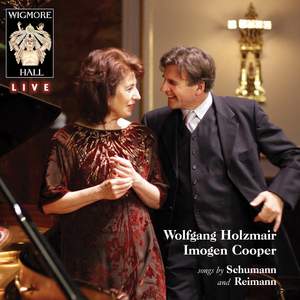
| |  | Schumann: | Dichterliebe, Op. 48 Liederkreis, Op. 24 Liederkreis, Op. 39 Liederreihe Op. 35 Der Himmel hat eine Träne geweint, Op. 37 No. 1 Ich hab' in mich gesogen, Op. 37 No. 5 Rose, Meer und Sonne , Op. 37 No. 9 Mein Wagen rollet langsam, Op. 142 No. 4 Der arme Peter, Op. 53 No. 3 Tragödie Op. 64 No. 3 Lehn deine Wang' Op. 142 No. 2 Du bist wie eine Blume, Op. 25 No. 24 Was will die einsame Träne, Op. 25 No. 21 Die Lotosblume, Op. 25 No. 7 Widmung, Op. 25 No. 1 Freisinn, Op. 25 No. 2 Zwei Venetianische Lieder, Op. 25 Nos. 17 & 18 Der Nussbaum, Op. 25 No. 3 Aus dem Schenkenbuch im Divan I, Op. 25 No. 5 Aus dem Schenkenbuch im Divan II, Op. 25 No. 6 Aus den östlichen Rosen, Op. 25 No. 25 Zum Schluß, Op. 25 No. 26 |
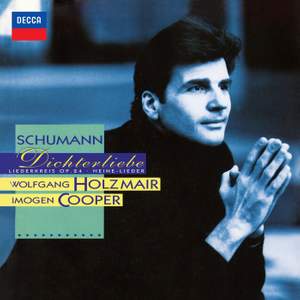
Wolfgang Holzmair (baritone), Imogen Cooper (piano) Wolfgang Holzmair and Imogen Cooper's lieder partnership is the stuff of dreams and their traversal of the Schumann repertoire has won them international plaudits both, for performance as well as the sound engineering on these Philips recordings. Here, brought together for the first time as a collection, is their complete traversal of a vast selection of Robert Schumann's lieder, including all the cycles - the two sets of Liederkreis, the 'Kerner Lieder' and Dichterliebe. Included too are individual songs to poems by Heine and Ruckert, as well as a selection of Myrthen. Two songs Rose, Meer und Sonne, Op. 37 No. 9 and Aus den ostlichen Rosen, Op. 25 No. 25, only appeared previously as part of an Imogen Cooper anthology and are here included to well and truly complete the duo's Schumann survey. “I was transfixed by the sheer artistry... Rarely have I heard so sensitive, intelligent and gloriously musical a partnership... no one could have asked for more attentive, detailed expressions nor more complete harmony of feeling between singer and pianist” The Independent “Singer and pianist work together almost by instinct in thinking themselves into the very heart of these songs... Holzmair's plangent, very Viennese voice bespeaks the vulnerability that lies at the soul of Robert's Eusebius side, heard to mesmeric effect in the great, slower songs of Op 35, but he is just as capable of tramping the ways with Schumann when he is in his Florestan mood.... [Imogen Cooper's] playing throughout the programme is at once supportive of her partner and individual in itself. The recording is faultless” Gramophone Magazine | | | In stock - usually despatched within 1 working day. |
|
|
| |  | Schumann - Lieder
Schumann: | Widmung, Op. 25 No. 1 Mein Schöner Stern! Op. 101 No. 4 Zwei Lieder der Braut Die Soldatenbraut Op. 64 No. 1 Das verlassene Mägdlein, Op. 64 No. 2 Er ist's! Op. 79 No. 23 (Eduard Mörike) Mignon (Kennst du das Land?) Op. 98a No. 1 (Johann Wolfgang von Goethe) Nur wer die Sehnsucht kennt Op. 98a No. 3 (Johann Wolfgang von Goethe) Heiss' mich nicht reden Op. 98a No. 5 (Johann Wolfgang von Goethe) Singet nicht In Trauertönen Op. 98a No. 7 (Johann Wolfgang von Goethe) So lasst mich scheinen Op. 98a No. 9 (Johann Wolfgang von Goethe) Du bist wie eine Blume, Op. 25 No. 24 Der arme Peter, Op. 53 No. 3 Die Lotosblume, Op. 25 No. 7 Was will die einsame Träne, Op. 25 No. 21 Erstes Grün, Op. 35 No. 4 Frauenliebe und Leben, Op. 42 Mondnacht (No. 5 from Liederkreis, Op. 39) Der Nussbaum, Op. 25 No. 3 |
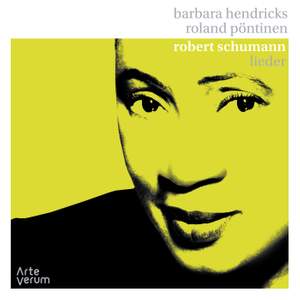
Barbara Hendricks (soprano) & Roland Pöntinen (piano) "Hendricks' slender, sweet-toned soprano, with its distinctive quick vibrato, is still in fine shape." Gramophone | | | Usually despatched in 3 - 4 working days. |
|
|
| |  | Schumann/Dvorak/Brahms - Lieder
Brahms: | Sag mir O schonste Schaf rin mein Schwesterlein Feinsliebchen, du sollst mir nicht barfuß gehen, WoO 33 No. 12 Wie komm ich denn zur Tur herein | Dvorak: | Lieder im Volkston Liebesleider (8), Op. 83 | Schumann: | Tragödie Op. 64 No. 3 Die beiden Grenadiere, Op. 49 No. 1 Die Lotosblume, Op. 25 No. 7 Die feindlichen Brüder, Op. 49 No. 2 Der Soldat, Op. 40, No. 3 Lehn deine Wang' Op. 142 No. 2 Rätsel, Op. 25 No. 16 Romanzen und Balladen Vol. 3, Op. 53 Der arme Peter, Op. 53 No. 3 Belsazar, Op. 57 Schon ist das Fest des Lenzes Wiegenlied |
Edita Gruberova, Ivan Paley & Friedrich Haider Dedicated and sold in aid of Cleft Children International (CCI) Foundation | | | Usually despatched in 2 - 3 working days. |
|
|
| |  | Schumann - Lieder Edition Volume 1
Thomas Bauer (baritone) & Uta Hielscher (piano) “In these songs and the others on this CD, the couple demonstrates a masterful approach to Schumann’s Lieder, and they should offer some excellent interpretations in the remainder of his repertoire in subsequent volumes of the series.” MusicWeb | | | Usually despatched in 2 - 3 working days. |
|
|
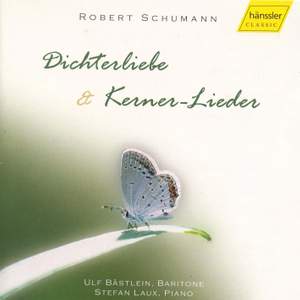
| |  | Dichterliebe & Kerner-Lieder
Ulf Bastlein (bass-baritone), Stefan Laux (piano) Drawing upon the greatest poets of his generation, Schumann’s Lieder are among the most perfect works of German art – capturing the most intimate feelings with honesty and self-realization. Bass-Baritone Ulf Bästlein has devoted much of his time to (re-) discovering and studying the German Lied repertoire from the eighteenth century to today and to making it known through his recitals to a wider public. The Lieder Festival he has established (in Husum), his masterclasses in Germany and abroad as well as his numerous CD recordings demonstrate his fascination with this very intimate musical form. This is his debut recording on Hänssler classic. | | | Usually despatched in 2 - 3 working days. |
|
|
| |  | Gérard Souzay - Schumann Lieder Recital
Gérard Souzay (baritone), Dalton Baldwin (piano) Recorded 1975 & 1971 | | | Usually despatched in 4 - 5 working days. |
|
|
| |  | Andreas Schmidt sings Schumann
Andreas Schmidt (baritone), Rudolf Jansen (piano) | | | Usually despatched in 2 - 3 working days. |
|
|
| |  | Dietrich Fischer-Dieskau: The Great EMI Recordings
Brahms: | Die schöne Magelone, Op. 33 Sviatoslav Richter (piano) Feldeinsamkeit, Op. 86 No. 2 Daniel Barenboim (piano) Vier ernste Gesänge, Op. 121 Wolfgang Sawallisch (piano) | Cornelius: | Weihnachtslieder (6), Op. 8 Hermann Reutter (piano) | Grieg: | Seks Sange, Op. 48 No. 5 'Zur Rosenzeit' Hartmut Holl (piano) | Liszt: | Es rauschen die Winde, S294 Ständchen, S301 Über allen Gipfeln ist Ruh, S306 Wieder mocht’ ich dir begegnen Aribert Reimann (piano) | Loewe, C: | Der Erlkönig, Op. 1 No. 3 (Goethe) Herr Oluf "Herr Oluf reitet spät und weit", Op. 2/2 Der Schatzgräber, Op. 59 No. 30 Archibald Douglas, Op. 128 Tom der Reimer "Der Reimer Thomas lag am Bach", Op. 135a Gerald Moore (piano) | Mahler: | Lieder eines fahrenden Gesellen (4 songs, complete) Daniel Barenboim (piano) Rückert-Lieder (5 songs, complete) Daniel Barenboim (piano) Der Schildwache Nachtlied (Des Knaben Wunderhorn) Verlorne Müh' (Des Knaben Wunderhorn) Das irdische Leben (Des Knaben Wunderhorn) Des Antonius von Padua Fischpredigt (Des Knaben Wunderhorn) Rheinlegendchen (Des Knaben Wunderhorn) Wo die schönen Trompeten blasen (Des Knaben Wunderhorn) Lob des hohen Verstandes (Des Knaben Wunderhorn) Revelge (Des Knaben Wunderhorn) Der Tambourg'sell (Des Knaben Wunderhorn) Daniel Barenboim (piano) Revelge (Des Knaben Wunderhorn) London Symphony Orchestra, George Szell | Mendelssohn: | Neue Liebe, Op. 19a No. 4 Gruß, Op. 19a No. 5 Auf Flügeln des Gesanges, Op. 34 No. 2 Morgengruss (Heine) Op. 47 No. 2 Venetianisches Gondellied, Op. 57 No. 5 'Wenn durch die Piazetta' Nachtlied, Op. 71 No. 6 Der Mond, Op. 86 No. 5 Wolfgang Sawallisch (piano) | Schubert: | Die schöne Müllerin, D795 Gerald Moore (piano) Winterreise D911 Gerald Moore (piano) Schwanengesang, D957 Gerald Moore (piano) Du bist die Ruh D776 (Rückert) Nacht und Träume, D827 Rastlose Liebe, D138 Nachtviolen D752 (Mayrhofer) Der Einsame, D800 Auflösung, D807 Der Wanderer an den Mond D870 (Seidl) Der Wanderer, D489 An die Musik D547 Auf der Bruck, D853 Im Frühling, D882 An Sylvia, D891 Erlkönig, D328 Nachtstück, D672 (Mayrhofer) Gruppe aus dem Tartarus, second version, D583 (Schiller) Abendstern, D806 Sei mir gegrüsst! D741 (Rückert) Lachen und Weinen, D777 Heidenröslein, D257 Der Jüngling an der Quelle, D300 (Salis-Seewis) Litanei auf das Fest Allerseelen, D343 Seligkeit D433 (Holty) Der Tod und das Mädchen, D531 An die Laute D905 Im Abendrot, D799 Digitally remastered in 2003 Die Forelle, D550 Auf dem Wasser zu singen, D774 Fischerweise, D881 (Schlechta) Des Fischers Liebesgluck, D933 (Leitner) Der Schiffer, D536 (Mayrhofer) Der Winterabend (Es ist so still), D938 Einsamkeit, D620 Das Lied im Grünen, D917 Ständchen 'Horch! Horch! die Lerch!', D889 Wohin? (No. 2 from Die schöne Müllerin, D795) Gerald Moore (piano) Gute Nacht (No. 1 from Winterreise, D911) Gerald Moore (piano) | Schumann: | Liederkreis, Op. 39 Digitally remastered in 2004 Gerald Moore (piano) Romanzen und Balladen Op. 45 Digitally remastered in 2004 Liederkreis, Op. 24 Digitally remastered in 2005 Hertha Klunst (piano) Die beiden Grenadiere, Op. 49 No. 1 Gerald Moore (piano) Die feindlichen Brüder, Op. 49 No. 2 Hertha Klunst (piano) Der arme Peter, Op. 53 No. 3 Hertha Klunst (piano) Tragödie Op. 64 No. 3 Hertha Klunst (piano) | Strauss, R: | Zueignung, Op. 10 No. 1 Die Nacht, Op. 10 No. 3 Allerseelen, Op. 10 No. 8 Heimkehr, Op. 15 No. 5 Ständchen, Op. 17 No. 2 All mein Gedanken ... Op. 21 No. 1 Ruhe, meine Seele!, Op. 27 No. 1 Cäcilie, Op. 27 No. 2 Heimliche Aufforderung, Op. 27 No. 3 Morgen, Op. 27 No. 4 Traum durch die Dämmerung, Op. 29 No. 1 Nachtgang Op. 29 No. 3 Blauer Sommer, Op. 31 No. 1 Ich trage meine Minne, Op. 32 No. 1 Sehnsucht Op. 32 No. 2 Liebeshymnus, Op. 32 No. 3 Das Rosenband, Op. 36 No. 1 Meinem Kinde, Op. 37 No. 3 Befreit, Op. 39 No. 4 Freundliche Vision, Op. 48 No. 1 Winterliebe Op. 48 No. 5 Winterweihe, Op. 48 No. 4 Waldseligkeit, Op. 49 No. 1 Gefunden Op. 56 No. 1 Die heliegen drei Könige aus Morgenland Op. 56 No. 6 Einerlei, Op. 69 No. 3 Schlechtes Wetter, Op. 69 No. 5 Das Bächlein, Op. 88 No. 1 Gerald Moore (piano) | Verdi: | Vanne, la tua meta gia vedo…Credo in un Dio crudel (from Otello) New Philharmonic Orchestra, Sir John Barbirolli | Wagner: | Der Tannenbaum Aribert Reimann (piano) | Wolf, H: | Der Freund (No. 1 from Eichendorff-Lieder) Der Musikant (No. 2 from Eichendorff-Lieder) Verschwiegene Liebe (No. 3 from Eichendorff-Lieder) Das Ständchen (No. 4 from Eichendorff-Lieder) Heimweh (No. 12 from Eichendorff-Lieder) Der Genesene an die Hoffnung (No. 1 from Mörike-Lieder) Jägerlied (No. 4 from Mörike-Lieder) Der Tambour (No. 5 from Mörike-Lieder) Begegnung (No. 8 from Mörike-Lieder) Fussreise (No. 10 from Mörike-Lieder) Verborgenheit (No. 12 from Mörike-Lieder) Im Frühling (No. 13 from Mörike-Lieder) Auf ein altes Bild (No. 23 from Mörike-Lieder) In der Frühe (No. 24 from Mörike-Lieder) Gebet (No. 28 from Mörike-Lieder) An die Geliebte (No. 32 from Mörike-Lieder) Der Feuerreiter (No. 44 from Mörike-Lieder) Gesang Weylas (No. 46 from Mörike-Lieder) Storchenbotschaft (No. 48 from Mörike-Lieder) Abschied (No. 53 from Mörike-Lieder) Harfenspieler I (No. 1 from Goethe-Lieder) Harfenspieler II (No. 2 from Goethe-Lieder) Harfenspieler III (No. 3 from Goethe-Lieder) Anakreons Grab (No. 29 from Goethe-Lieder) Der Rattenfänger (No. 11 from Goethe-Lieder) Verborgenheit (No. 12 from Mörike-Lieder) Gerald Moore (piano) |
Plus extracts from two interviews recorded in 2000 and 2005: some parts of the interviews have previously been aired by the WFMT Radio Network and published by VAI and Gramophone, and those organisations have kindly agreed to their reissue here. However, much of this documentary has never been heard or published before. Sung texts with translations can be found on CD11 in pdf form, which can be accessed from any computer equipped with CD-ROM drive and Adobe Acrobat 6.0.
Dietrich Fischer-Dieskau (baritone) | 
| | | In stock - usually despatched within 1 working day. |
|
|
| |
|