Liszt: Ce qu'on entend sur la montagne, symphonic poem No. 1, S95 (Bergsymphonie)

This page lists all recordings of Ce qu'on entend sur la montagne, symphonic poem No. 1, S95 (Bergsymphonie), by Ferencz Liszt (1811-86) on CD & download (MP3 & FLAC). Generally, more recent releases are listed first, but with priority given to those that are in stock.

Recommendations

Editor's Choice
October 2005

All recordings

Prices shown exclude VAT. (UK tax is not payable for deliveries to United States.)
See Terms & Conditions for p&p rates.

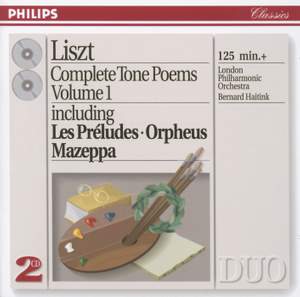
Liszt: Les Préludes, Orpheus & Mountain Symphony

Liszt: Les Préludes, Orpheus & Mountain Symphony


Liszt:

Les Préludes, symphonic poem No. 3, S97

Orpheus, symphonic poem No. 4, S98

Ce qu'on entend sur la montagne, symphonic poem No. 1, S95


Orchester Wiener Akadamie, Martin Haselböck

This is the second CD in the series “Liszt: The Sound of Weimar” being performed by the Vienna Academy Orchestra under the Austrian conductor Martin Haselböck and released by NCA as part of the celebrations to mark the 200th anniversary of the composer’s birth. Liszt wrote 13 symphonic poems in all, and those featured here are No. 3 - “Les Preludes”, No. 4 - “Orpheus”, and No. 1 - “Berg-Symphonie”. As with the previous disc the music on this volume is performed on original instruments of the 19th century.

The orchestral project “The Sound of Weimar” will include all the orchestral works of Franz Liszt in the original orchestration of the live premieres in Weimar. The recordings are taking place at the Austrian Liszt Raiding Centre, and will all be made at performances in seven concerts during 2011 and 2012 by the Vienna Academy Orchestra under the direction of the renowned Austrian conductor Martin Haselböck. He is the musical director of Musica Angelica in Santa Monica, California, and the director and founder of the Vienna Academy Orchestra. He is also a professor at the University of Vienna, where he teaches organ.

“The second installment of Martin Haselböck's Liszt series moves the cursor across three contrasting tone-poems, Les preludes in particularly emerging with sound perspectives that are quite unlike the norm...Haselböck's liberated textures open up new listening horizons that all lovers of this fine but still underrated music should investigate.” Gramophone Magazine, January 2012

New Classical Adventure - The Sound of Weimar - 60246

(CD)

$17.50

(also available to download from $10.50)

Usually despatched in 4 - 5 working days. (Available now to download.)

Liszt: Les Préludes

Liszt: Les Préludes


Liszt:

Les Préludes, symphonic poem No. 3, S97

Fantasy on Hungarian Folk-tunes, S123

Ce qu'on entend sur la montagne, symphonic poem No. 1, S95


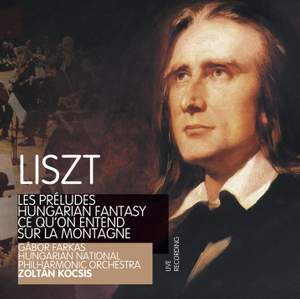
The second recording for Warner Classics by the critically acclaimed Hungarian pianist.

Farkas’ first recording, 2008’s ‘An Evening With Liszt’ was lauded throughout the European press, and won him the 2009 Franz Liszt International Grand Prix du Disque of the Hungarian Liszt Society.

“The opening minutes of Les Preludes are fuill of promise for an account that mixes grandeur, lyrical ardour and impetuousness well enough. The most dramatic passages are the most ear-catching...Kocsis really exaggerates some aspects of the orchestral writing; an earthy, rough-hewn approach to which Gabor Farkas responds in heroic and glittering style, the piano tone rather hard, not finding much subtlety.” International Record Review, February 2012

Warner Classics - 2564667226

(CD)

$17.00

Usually despatched in 4 - 5 working days.

Liszt - Symphonic Poems Volume 3

Liszt - Symphonic Poems Volume 3


Liszt:

Festklänge, symphonic poem No. 7, S101

Ce qu'on entend sur la montagne, symphonic poem No. 1, S95

Hunnenschlacht, symphonic poem No. 11, S105


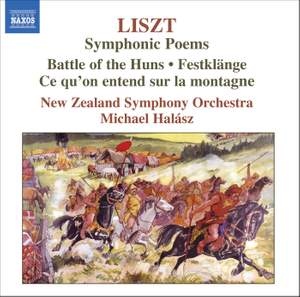
"Praise for previous volumes in the series: “Michael Halasz and the New Zealand Symphony offer real performances rather than unimaginative run-throughs.” BBC Music Magazine

“…while the three symphonic poems on this record… hardly show Liszt at his greatest, they are immensely exhilarating, their occasionally inflated grandeur compensated by genuine brilliance and poetry. …make heavy demands on their players. The New Zealand Symphony Orchestra under Michael Halász is more than equal to these, moving fluently from one ultra-romantic mood-swing to the next.” Gramophone Magazine, Awards 2006

20% off Naxos

Naxos - 8557846

(CD)

Normally: $8.25

Special: $6.60

(also available to download from $6.00)

Usually despatched in 2 - 3 working days. (Available now to download.)

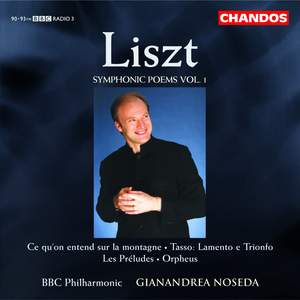
Liszt - Symphonic Poems Volume 1

Liszt - Symphonic Poems Volume 1


Liszt:

Ce qu'on entend sur la montagne, symphonic poem No. 1, S95

Tasso, Lamento e trionfo, symphonic poem No. 2, S96

Les Préludes, symphonic poem No. 3, S97

Orpheus, symphonic poem No. 4, S98


Such music makes huge demands and these are met by Noseda with unfaltering command and lucidity. It is presented with an enviable clarity and acuteness. (The Gramophone)

“Where vigour and energy matter, Gianandrea Noseda and the BBC Philharmonic sometimes achieve effective results - the concluding triumph of Tasso sounds genuinely grand under Noseda, painfully stilted under Haitink - and, thankfully, this performance of Les Préludes stresses flow over pomposity. ” BBC Music Magazine, October 2005

“Volume 1 of Liszt's complete symphonic poems augurs well for the releases. Gianandrea Noseda and the BBC Philharmonic remind you at every turn that the days of a lofty critical dismissal of this uneven but pioneering and romantically audacious music are surely over. Coldly objective complaints about Liszt's lack of craftsmanship or melodic distinction have been echoed in other more stylishly phrased complaints: for Clara Schumann there was 'too much of the tinsel and the drum' while Edward Sackville-West could see little beyond 'the expensive glare and theatricality'.
But Liszt was nothing if not ambitious and if there are elements of truth in such accusations, they fail to convey the wider picture. Better an attempt to scale the heights than a safe repose on the lower slopes.
Ce qu'on entend sur la montagne is, indeed, epic in design and intention, seizing on Victor Hugo's obsession with the eternal battle between the forces of good and evil, of light and dark. But if Hugo's poem leaves us with an uneasy resolution, Liszt, a devout Catholic, ends with a radiant state of holiness. Tasso, too, celebrates final acclaim after the artist's trials and tribulations, and Les préludes attempts to unite four disparate ideas. Orpheus also conveys the victory of civilising art over baser forces.
Such music makes huge demands and these are met by Noseda with unfaltering command and lucidity. What could so easily topple into bombast is presented with an enviable clarity and acuteness. Excellent sound and presentation.”
Gramophone Classical Music Guide, 2010

GGramophone Magazine

Editor's Choice - October 2005

Chandos - CHAN10341

(CD)

$16.75

(also available to download from $10.50)

Usually despatched in 2 - 3 working days. (Available now to download.)

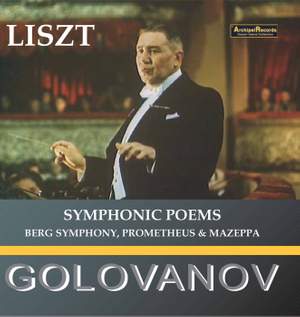
Liszt Symphonic Poems

Liszt Symphonic Poems


Liszt:

Ce qu'on entend sur la montagne, symphonic poem No. 1, S95

Prometheus, symphonic poem No. 5, S99

Mazeppa, symphonic poem No. 6, S100


UDSSR Large Radio Orchestra Moscow, Nikolai Golovanov

Recorded 1952-53

Archipel Records - ARPCD0279

(CD)

$7.75

Usually despatched in 2 - 3 working days.

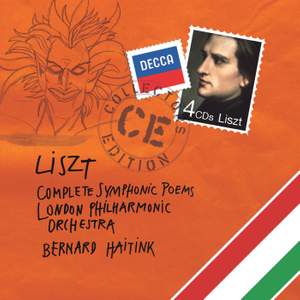
Liszt - Complete Tone Poems

Liszt - Complete Tone Poems


Liszt:

Symphonic Poems Nos. 1-13

Mephisto Waltz No. 1


Decca Collectors Edition - 4782309

(CD - 4 discs)

$25.00

Usually despatched in 2 - 3 working days.

Liszt: Symphonic Poems (Complete Edition)

Liszt: Symphonic Poems (Complete Edition)


Liszt:

Symphonic Poems Nos. 1-13

Le Triomphe funèbre du Tasse, S517

Dante Symphony, S. 109

À la chapelle Sixtine, for orchestra, S. 360


This 5-CD set comprises a series of live recordings made by the Orchester Wiener Akademie and its conductor Martin Haselböck of orchestral music by Franz Liszt. They were released to mark the 200th anniversary of the composer’s birth. It features all of the Symphonic Poems, the Dante Symphony and the beautiful Évocation à la Chapelle Sixtine. These critically-acclaimed performances from 2011 and 2012 are unique in that the orchestra performs on the original instruments or copies of the original instruments that were used at concerts conducted by the composer himself.

For “The Sound of Weimar” project, Liszt expert Martin Haselböck deployed the orchestra Wiener Akademie in exactly the size adopted for the original performances given by the Weimar Hofkapelle, and for the recordings made use of instruments that had either been played in concerts conducted by Franz Liszt himself or were faithful copies of such instruments. When the early CDs of the series appeared they were immediately described in such terms as “definitive recording”, “exemplary editions”, “a resounding success” or “a tonal phenomenon”. In addition to the symphonic poems this special edition also includes the Dante symphony, a work that was also composed at Weimar, and Évocation à la Chapelle Sixtine. Volumes 1 to 4 of the series won the International Franz Liszt Record Grand Prix in 2011 and 2012, and the series has received outstanding reviews in specialist magazines around the world.

Released or re-released in last 6 months

New Classical Adventure - The Sound of Weimar - 60260

(CD - 5 discs)

$60.75

(also available to download from $41.00)

Usually despatched in 4 - 5 working days. (Available now to download.)

Liszt: Symphonic Poems (complete)

Liszt: Symphonic Poems (complete)


Liszt:

Symphonic Poems Nos. 1-13

Episoden (2) aus Lenaus Faust S100

Mephisto Waltz No. 2

Szozat und Ungarischer Hymnus, for orchestra, S. 353


Hungaroton - HCD12677-81

(CD - 5 discs)

$70.25

Usually despatched in 4 - 5 working days.

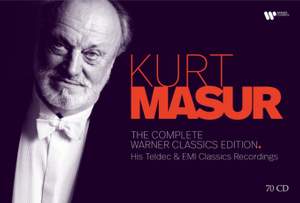
Liszt: Orchestral Works and Piano and Orchestra

Liszt: Orchestral Works and Piano and Orchestra


Liszt:

Symphonic Poems Nos. 1-13

A Faust Symphony, S108

Episoden (2) aus Lenaus Faust S100

Dante Symphony, S. 109

Piano Concerto No. 1 in E flat major, S124

Piano Concerto No. 2 in A major, S125

Wandererfantasie (Schubert), S366

Polonaise brillante, S367

Fantasy on Hungarian Folk-tunes, S123

Fantasia on a theme from Beethoven's 'Ruins of Athens', S122

Grande fantaisie symphonique on themes from Berlioz's ‘Lelio', S120

Malédiction, S121 Op. 452

Totentanz, S126 for piano & orchestra


Michel Béroff (piano)

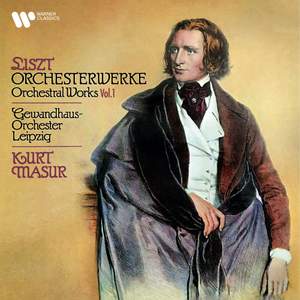
Leipzig Gewandhaus, Kurt Masur

Among the 25 orchestral works that Liszt wrote, the thirteen tone poems make up the biggest single category. He gave these works of ideas their final form during his years as kapellmeister at the Weimar court (1843–59), and dedicated them to his beloved, Princess Carolyne von Sayn-Wittgenstein. The numbering of the first editions doesn’t reflect the order of composition: the first tone poem that Liszt composed was Tasso (first performance: 28. August 1849); it was followed (in the order of the first performance) by Bergsinfonie and Prometheus (1850), Orpheus, Les Préludes, Mazeppa and Festklänge (1854), Hungaria (1856), Die Ideale, Héroide funèbre and Hunnenschlacht (1857), and finally Hamlet (1876). Nearly all the tone poems are based on literary sources or historic myths and reflect philosophical ideas, with the exception of Festklänge, which was intended to be the wedding march for Liszt’s planned wedding to Carolyne, and Hungaria, which extols the praises of the composer’s native country. Von der Wiege bis zum Grabe (1881/2) was not written during the Weimar years: this later addition can be seen as an epilogue penned in the wisdom of old age.

Liszt treated the character of Faust in his music in a variety of forms: in the two orchestral episodes after Nikolaus Lenau’s poem of the same name, and in the different Mephisto Waltzes. The Faust Symphony is a study of the three main characters in the Goethe drama, but it also represents a picture "of the nature of Man with his aspirations and flaws, with his fluctuation between guilt and redemption" (Hans Jürgen Meinerts), culminating in the challenge to find true love. Here Liszt introduces the closing chorus with a tenor solo: "Everything transient is but an allegory, the inadequate becomes reality, the indescribable is done; eternal femininity draws us upwards". The Dante Symphony, which is dedicated to Wagner, reflects the process of understanding described in the Divine Comedy, which Dante completed shortly before his death in 1321. In the ‘Inferno’ Liszt sends the Romantic idea of love to hell in the example of Francesca da Rimini qnd Paolo. The opening of ‘Purgatorio’ puts Dante’s words into music: "A gentle blue, poured like oriental sapphire on to the bright firmament"; later follows a fugue marked ‘Lamentoso’ that portrays the process of purification. Liszt originally wanted to add a final section corresponding to Dante’s ‘Paradiso’, but Wagner convinced him that this couldn’t be depicted in music. Thus Liszt left the piece in two movements; however, the ‘Magnificat’ essentially represents Paradise, for the Gregorian magnificat he quotes here with its ethereal female choir is in keeping with the central message of Man finding his fulfilment in the divine. Liszt subsequently added a closing apotheosis to the work. Nowadays, this later addition often falls victim to the tendency to favour the original version, but doing so actually distorts our view of the connections between the two symphonies: ‘Mephisto’ and ‘Inferno’ correspond inversely with one another, as do ‘Faust’ and ‘Purgatorio’. Admittedly, the Dante Symphony goes one step further: where Gretchen was still a real person in the Faust Symphony, Liszt makes Beatrice, whom Dante tries to find in hell, into a mere ideal that no longer appears.

Of Liszt’s ten original compositions for piano and orchestra, at least four can be described as piano concertos, among them Malédiction S. 121. But Liszt only number­ed two of them for publication. Listened to one after the other, they create an impression of extreme opposites. This much is apparent from the basic keys of E flat major and A major, which couldn’t be farther away from one another. The majestic Piano concerto no.1 is clearly structured in three movements, while the second concerto has a single movement with a six-part structure that superimposes variation and sonata form. Notwithstanding, the two works seem to refer to each other. As Liszt also appeared for many years as a concert pianist, he also left quite a number of arrangements for piano and orchestra of other composers’ works. In most such fantasias, he used well-known themes by composers like Berlioz and Beethoven for musical reflections that are formally independent. Schubert’s Wanderer Fantasy, on the other hand, he turned into a captivating piano concerto, even though it does stick for the most part to the form of the original.

The first complete German recording of Franz Liszt's 13 tone poems, his two symphonies and the big works for piano and orchestra. Recorded by the Leipzig Gewandhaus under Kurt Masur in 1980–81, this issue set international standards in the Liszt discography.

EMI - 0851602

(CD - 7 discs)

$27.00

In stock - usually despatched within 1 working day.

Carl Schuricht Collection Volume 2

Carl Schuricht Collection Volume 2


Beethoven:

Symphony No. 1 in C major, Op. 21

Symphony No. 3 in E flat major, Op. 55 'Eroica'

Symphony No. 4 in B flat major, Op. 60

Symphony No. 5 in C minor, Op. 67

Symphony No. 6 in F major, Op. 68 'Pastoral'

Blacher:

Concertante Musik, Op. 10

Brahms:

Symphony No. 1 in C minor, Op. 68

Symphony No. 3 in F major, Op. 90

Symphony No. 4 in E minor, Op. 98

Alto Rhapsody, Op. 53

Lucretia West (alto)

Tragic Overture, Op. 81

Symphony No. 2 in D major, Op. 73: Allegro con spirito

rehearsal excerpts

Debussy:

La Mer

Liszt:

Ce qu'on entend sur la montagne, symphonic poem No. 1, S95

Oboussier:

Violin Concerto

Roman Schimmer (violin)

Raphael, G:

Sinfonia breve, Op. 67

Reger:

Variations and Fugue on a theme of Johann Adam Hiller Op. 100

Reznicek:

Donna Diana Overture

Schubert:

Symphony No. 5 in B flat major, D485

Schumann:

Symphony No. 3 in E flat major, Op. 97 'Rhenish'

Strauss, R:

Sinfonia Domestica, Op. 53

Tchaikovsky:

Hamlet - Fantasy overture, Op. 67

Wagner:

Parsifal: Prelude to Act 1

rehearsal excerpts

Schluss from Parsifal

rehearsal excerpts

Parsifal: Good Friday Music

rehearsal excerpts

Weber:

Euryanthe Overture

Oberon Overture

Wolf, H:

Italian Serenade in G major

version for orchestra


Stuttgart Radio Symphony Orchestra , Stuttgart Southwest Radio Vocal Ensemble, Stuttgart Lehrergesangverein, Carl Schuricht

A very special boxed set documenting the artistry of one of the 20th century’s greatest conductors. Includes a special bonus disc including Schuricht in rehearsal.

Hänssler - Carl Schuricht Collection - HAEN93292

(CD - 10 discs)

$83.75

(also available to download from $59.50)

In stock - usually despatched within 1 working day.

Page: 

 1   2 

 Next >>

Copyright © 2002-13 Presto Classical Limited, all rights reserved.