Prices shown exclude VAT. (UK tax is not payable for deliveries to United States.) See Terms & Conditions for p&p rates. | |  | Debussy: Poèmes
Stella Doufexis has the ability to shape her lucid singing in accordance with the cadence of the language and, with the sensitive support of her accompanist Daniel Heife, to form poems in music that are rich in mysteries and small miracles. | 
| | | In stock - usually despatched within 1 working day. |
|
|
| |  | Debussy: Clair de lune
Two leading French performers – soprano Natalie Dessay and pianist Philippe Cassard – come together in vocal works from the early career of Claude Debussy, whose 150th anniversary falls in 2012. Their recital includes four unpublished songs reflecting the young composer’s love for the soprano wife of one of his patrons. In Cassard’s words, Dessay informs these works with “her charisma as an actress, her energy, her temperament and her virtuosity, with its joyous sense of fun”. Claude Debussy, whose 150th anniversary falls in 2012, signed his scores ‘musicien français’ in the final years of his life. Two leading French musicians of today collaborate on this disc of the composer’s songs – including a number of rarities – and his cantata, La damoiselle élue, based on the poetry of Dante Gabriel Rossetti. Philippe Cassard – whose impeccable Debussy credentials include performances of the composer’s complete piano works – wrote to Natalie Dessay after he had been deeply impressed by her interpretation of Mélisande, which can be seen on a Virgin Classics DVD of Pelléas et Mélisande (catalogue No 6961379). He suggested she would be perfect for a series of songs Debussy had composed around the age of 20. As Cassard recounts: “At the time, Debussy was very much in love with Marie Vasnier, an older woman married to a man who helped Debussy at the beginning of his career. She was a light soprano and he composed some 40 songs for her, to poems by Bourget, Banville, Bouchor and Verlaine. They all reflect his feelings for Madame Vasnier. “In 2010 I was shown a collection of Debussy manuscripts. Among them were four songs I had never heard of – and which the Debussy expert Denis Herlin confirmed were not officially documented. One of them, ‘Les Elfes’, to a poem by Leconte de Lisle, is, at 174 bars, the longest song Debussy ever wrote, and contains high vocalises, chord sequences taken from Wagner’s ‘Ride of the Valkyries’ and melodic motifs showing the influence of Massenet and Delibes. Another, ‘Le matelot qui tombe à l'eau’, to a poem by Bouchor, is the shortest of all his songs, a dreamy little bubble of wit.” Writing to Natalie Dessay after he had seen her Mélisande in Vienna, Cassard explained that “she would be the only person able to inhabit and embody these early Debussy songs … that her charisma as an actress, her energy, her temperament and her virtuosity, with its joyous sense of fun, would enable her to offer an interpretation that was different and really personal … something far away from a performing tradition that portrays preciosity, restrained intimacy and pseudo-Impressionism, which to me seems out of place in these works: they might be poetic, but they are also full of passion.” Dessay had in fact sung many of Debussy’s songs in the past, and she was delighted to return to them as she and Cassard made a selection from repertoire which, as the pianist says, “shows Debussy trying out all sorts of genres, testing his ammunition and his discoveries.” Describing the partnership with Dessay, Cassard says: “I’ve worked with many singers and this collaboration with Natalie Dessay gave me the privilege and joy of meeting an inspired, but humble artist with a perpetually questing spirit, always ready to question the text and the score. Her straightforwardness and integrity are rare in a professional world so obsessed with appearances. I am eternally grateful to her.” “[In 'Les elfes'] Dessay brilliantly handles the dialogue among the song's characters and delivers some of the best vocal shading of the disc when the elf princess admits that she is, in fact, dead. It's an extremely effective performance but would have been more so five years ago, when the voice had less mileage.” Gramophone Magazine, March 2012 “that silvery soprano voice [...] caresses these delicately perfumed offerings (some of them unpublished) with nonchalant French elegance, a winning soubrette sparkle, and loving regard for the meaning and poetry of every word.” The Times, 16th March 2012 **** | | | In stock - usually despatched within 1 working day. |
|
|
| |  | Opium (Mélodies Françaises)
Unsurprisingly, it is in the music of the Baroque era – the heyday of the castrato – that French countertenor Philippe Jaroussky has captured the attention of music-lovers lovers around the world. The ethereal, but sensuous beauty of his voice, his virtuosity and his sense of style have brought him critical praise, a number of major awards – including, in 2008, Germany’s prestigious Echo-Klassik prize for Male Singer of the Year, honouring his Virgin Classics album, Carestini: The Story of a Castrato – and impressive sales: more than 120,000 copies of his Vivaldi album Heroes and 90,000 of the Carestini release. Jaroussky enters new territory with this programme of French songs from the late 19th and early 20th centuries – well over a hundred years after the end of the Baroque era. Taking its name, Opium, from a song by Saint-Saëns, it evokes the voluptuous, sometimes decadent spirit of the Belle Époque, the era of transition between Romanticism and Modernism. The programme includes a number of rarities by composers such as Dukas, Caplet, and Chaminade, as well as better-known numbers by figures like Fauré, Chausson and Hahn. “Many people will probably wonder why a counter tenor should sing these songs,” says Jaroussky, “but if you think about it, the countertenor voice as such has no repertoire of its own, except the modern music written specifically for it. For the most part we sing music written for castratos who – as we know – had very different voices from ours. So why not venture into other musical worlds if we feel they are suited to our voices? … There has been David Daniels in Schubert, Max Emmanuel Cencic in Rossini, and even Andreas Scholl and Gérard Lesne in pop music. “I’ve always felt a special affinity for French song, which was an area of focus in the early days of my studies with my teacher, Nicole Fallien. It was Renaud Capuçon -- whom I want to thank, along with Gautier Capuçon and Emmanuel Pahud for his valuable contribution to this disc -- who first had the idea of inviting me to sing Hahn, Chausson, Fauré in a recital. It was then that I met the pianist Jérôme Ducros, and we decided to work further on this rich and well-stocked repertoire, which contains some real undiscovered treasures. There is no theme to this album, but I wanted to record songs which have captured my heart and which suit my voice. Perhaps I can show them in a new light too.” French song demands an acute sense of language and style, and today there are relatively few singers --- even native Francophones – who succeed in capturing its elusive magic. “I’ve decided to pronounce the texts in a way that is as close as possible to the spoken word – I don’t roll the ‘r’, for example,” continues Jaroussky. “The poetry should come to life without the imposition of too much interpretation or emotional contrivance. I’ve tried to approach it with humility.” "Philippe Jaroussky is one of the best countertenors around. His voice is mellow, evenly toned, wide-ranging and largely free from intrusive mannerism and vocal strain” BBC Music Magazine, February 2007 “Philippe Jaroussky has a wide pitch range and absolute control throughout, with no tenseness at the top of hooting at the bottom, and his floated high notes are ravishing. Jérôme Ducros's accompanying is some of the best I have heard.” BBC Music Magazine, April 2009 **** “His repertoire is fabulous, mixing gold star favourites with striking curios by non-song composers such as Dukas. The instrumental back-up from Jerome Ducros, the Capuçon brothers and Emmanuel Pahud is superb.” The Times, 28th March 2009 *** | | | In stock - usually despatched within 1 working day. |
|
|
| |  | Christopher Maltman & Julius DrakeSongs by Warlock, Debussy, Duparc, Schubert and Wolf
“It's Maltman's superb breath control which gives shape and sensuous beauty to Debussy and Dupare. And, thanks to Drake's restraining pace, Warlock's Captain Stratton's Fancy' has real swagger. Flanders and Swann's little masterpiece… about the Honeysuckle and the Bindweed, ends the recital in raptuous applause.” BBC Music Magazine, February 2008 **** “Christopher Maltman… is remarkably skilful in the management of his voice, dealing wonderfully well with Debussy's high tessitura and still plumbing the depths with ease as he does at the end of "Der Wanderer" and "La vague et la cloche". Julius Drake is his perfect counterpart...” Gramophone Magazine, Janurary 2008 | | | In stock - usually despatched within 1 working day. |
|
|
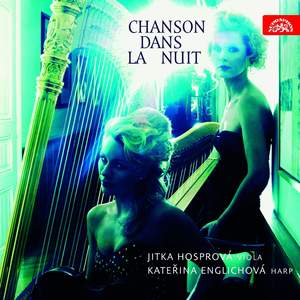
| |  | Chanson dans la nuitRecorded at the Suk Hall of the Rudolfinum, Prague, on November 17-19 and December 5, 2011
Jitka Hosprová (viola) & Kateřina Englichová (harp) The soft, silvery tone of the harp and the rich, dark timbres of the viola make these instruments the ideal combination for playing a gentle night song or lullaby. Chanson dans la nuit is a meditation amid the quiet of the night... Yet Jitka Hosprova and Kateřina Englichova are also able to make the night dance with their instruments. The listener can savour almost an hour’s worth of enchanting music for the viola and harp ranging from the Baroque masters to the French Impressionists. It is hard to believe that La fille aux cheveux de lin or Ravel’s Pavane were not originally created for these very instruments and that they can be played otherwise. The programme was compiled for the Czech Philharmonic Orchestra’s enormously popular “For Mothers-To-Be” concert cycle. It makes a refreshing change to hear the bright sound of the violin replaced by the deeper colours of the viola, the brilliancy of the piano by the lambent tones of the harp, especially when the two instruments are in the hands of two such charming ladies and superlative musicians. Their music finds its way directly to the heart. Chanson dans la nuit on the strings of the viola and harp – an hour of graceful music close to the heart. | | | Usually despatched in 4 - 5 working days. |
|
|
| |  | Debussy: Melodies de Jeunesse
This is a reissue of Donna Brown’s performances of beautiful songs by Debussy. They are settings of poems by Verlaine, Bourget, Banville, de Musset, Mallarmé and Peter. This soprano is known for the floating angelic quality of her voice and the intelligent musicality of her interpretations. | | | (also available to download from $10.50) | Usually despatched in 2 - 3 working days. (Available now to download.) |
|
|
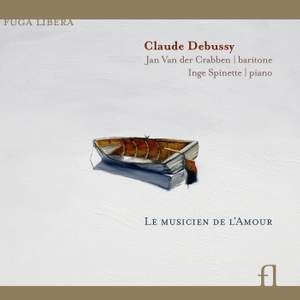
| |  | Debussy: Le Musicien de L’Amour (The Musician of Love)
Jan Van der Crabben (baritone) & Inge Spinette (piano) Jan Van der Crabben’s art has seduced the most demanding lovers of French melody. This is because, in the line of Bernard Kruysen or José Van Dam, he also has a rich experience as a soloist in baroque and classical music – namely with La Petite Bande and Sigiswald Kuijken – which nourished his musical thinking in a new and refined way. His previous CD with Fuga Libera (FUG510), devoted to Fauré, demanded a follow-up. It is Debussy, whom Van der Crabben serves today with his warm tone of voice, perfect style and pronunciation that we would have liked to submit to the ears and critical mind of Roland Barthes. In this recital, covering thirty years of creation, dominated by Verlaine and the wonderful Fêtes galantes, the Belgian baritone is ideally accompanied by Inge Spinette, whose delicate colors equal the intelligence of the conception. “Jan van der Crabben's relaxed baritone voice charms; and Inge Spinette gracefully captures the play of light.” BBC Music Magazine, December 2011 ***** | | | (also available to download from $10.50) | Usually despatched in 4 - 5 working days. (Available now to download.) |
|
|
| |  | Romantic Transcriptions for Viola and Piano
Brahms: | Sonatensatz (Scherzo from the F.A.E. sonata), WoO 2 Lerchengesang Op. 70 No. 2 arr. Ettore Causa Hungarian Dance No. 1 in G minor arr. Watson Forbes Hungarian Dance No. 3 in F major arr. Watson Forbes | Chopin: | Étude Op. 25 No. 7 in C sharp minor arr. Alexander Glazunov & Ettore Causa Étude Op. 10 No. 6 in E flat minor 'Lacrimosa' arr. Glazunov/Ettore Causa | Debussy: | Romance arr. Milton Katims | Fauré: | Les berceaux, Op. 23 No. 1 arr. Ettore Causa | Granados: | Danza española, Op. 37 No. 2 'Orientale' arr. Milton Katims | Mendelssohn: | Song without Words for Cello & Piano, Op. 109 arr. Milton Katims | Prokofiev: | Romeo and Juliet: Dance of the Knights arr. Wadim Borissovsky | Rachmaninov: | Daisies, Op. 38 No. 3 arr. Jasha Heifetz & Ettore Causa | Saint-Saëns: | Allegro Appassionato in B minor Op. 43 arr. Ettore Causa | Schumann: | Abendlied, Op. 85 No. 12 arr. Ettore Causa | Scriabin: | Prelude, Op. 9 No. 1 in C sharp minor for the left hand arr. Wadim Borissovsky | Tchaikovsky: | Valse sentimentale, Op. 51 No. 6 arr. Alan Arnold Chanson triste, Op. 40 No. 2 arr. Johann Palaschko | Ysaye: | Rêve d'enfant, Op. 14 arr. Ettore Causa |
Ettore Causa (viola) Ulrich Staerk (piano) | | | Usually despatched in 4 - 5 working days. |
|
|
| |  | L'Invitation au VoyageSongs from the 19th & 20th Centuries
Annette Celine (soprano), Christopher Gould (piano) | | | Usually despatched in 2 - 3 working days. |
|
|
| |  | Music from France & Spain
| | | Usually despatched in 2 - 3 working days. |
|
|
| |
|