Wagner: Weh mir, so nah (from Die Feen)

This page lists our only recording of Weh mir, so nah (from Die Feen), by Richard Wagner (1813-83) on CD.

Prices shown exclude VAT. (UK tax is not payable for deliveries to United States.)
See Terms & Conditions for p&p rates.
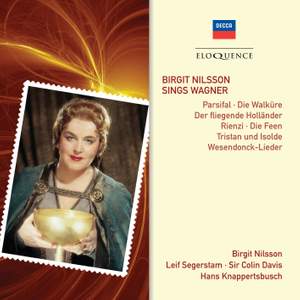
Birgit Nilsson sings Wagner

Catalogue No:

4803550

Discs:

2

Release date:

8th Aug 2011

Barcode:

0028948035502

Medium:

CD
| Share

Birgit Nilsson sings Wagner


Wagner:

Schlafst du, Gast? Ich bin's! (from Die Walküre)

Helge Brilioth (Siegmund)

Orchestra of the Royal Opera House, Covent Garden, Leif Segerstam

Dies alles – hab’ ich nun geträumt? (from Parsifal)

Helge Brilioth (Parsifal), Norman Bailey (Amfortas)

Orchestra of the Royal Opera House, Covent Garden, Leif Segerstam

Gerechter Gott! (from Rienzi)

London Symphony Orchestra, Sir Colin Davis

Johohoe! Traft ihr das Schiff im Meere an 'Senta's Ballad' (from Der fliegende Holländer)

The John Alldis Choir & London Symphony Orchestra, Sir Colin Davis

Weh mir, so nah (from Die Feen)

London Symphony Orchestra, Sir Colin Davis

Wesendonck-Lieder (5)

London Symphony Orchestra, Sir Colin Davis

Tristan und Isolde: Prelude to Act 1

Wiener Philharmoniker, Hans Knappertsbusch

Wie lachend sie mir Lieder singen (from Tristan und Isolde)

Grace Hoffmann (Brangäne)

Wiener Philharmoniker, Hans Knappertsbusch

Tristan und Isolde: Prelude & Liebestod

Wiener Philharmoniker, Hans Knappertsbusch


Birgit Nilsson (soprano)

CD - 2 discs

$14.25

In stock - usually despatched within 1 working day.

Birgit Nilsson. Richard Wagner. It was an operatic marriage made in heaven that lasted for over twenty years and, thanks to recordings, continues to thrill music lovers around the world. She sang her first Wagnerian part in Stockholm. It was Senta in Der fliegende Holländer. It was greeted rapturously and throughout her long career it was for her Wagner and Strauss roles that she was most noted. Many of the greatest recordings of music dramas and operas by these composers have featured her, and many appear on Decca. However, she also made two Wagner records for Philips – one with Leif Segerstam in 1974 of extended scenes from Walküre and Parsifal, another, in 1972, with Colin Davis of the Wesendonck-Lieder and extracts from Der fliegende Holländer, Rienzi and the little-known early Wagner opera, Die Feen (The Fairies). Also included are scenes from Tristan und Isolde, one of her great calling cards and of which she made at least two live recordings, one studio recording with Georg Solti, and another of scenes (with Grace Hoffman as Brangäne) with Hans Knappertsbusch.

Nilsson’s voice had the clear, silvery sound that seems to be characteristic of Scandinavian singers. It was rock solid, encompassed over two octaves, and was perfectly even, top to bottom. It was also enormous. Especially in the upper part of the voice it could take on a laser-like quality that simply sliced through the densest orchestral sound and speared listeners to the backs of their seats. That meant the great moments of a Wagnerian opera were truly monumental – a surging orchestra and a soprano who dominated everything, combined into an overwhelming climax as Wagner must have heard in his dreams.

Here is a snapshot of some of those great moments, captured on record, and bringing together three complete LPs – two made for Philips (Segerstam, Davis) and one for Decca (Knappertsbusch).

playWagner: Parsifal: ‘Dies alles hab’ ich nun’ – ‘Ich sah das Kind’ (scene from Act II)

playWagner: Die Walküre: ‘Schläfst du Gast’ (Act I – closing scene)

playWagner: Rienzi: ‘Gerechter Gott’

playWagner: Der fliegende Holländer: ‘Johohoe! Traft ihr das Schiff im Meere an’

playWagner: Die Feen: ‘Weh mir, so nah’

playWagner: Wesendonck Lieder - 1. Der Engel

playWagner: Wesendonck Lieder - 2. Stehe Still!

playWagner: Wesendonck Lieder - 3. Im Treibhaus

playWagner: Wesendonck Lieder - 4. Schmerzen

playWagner: Wesendonck Lieder - 5. Träume

playWagner: Tristan und Isolde: Prelude to Act I

playWagner: Tristan und Isolde: Isolde’s Narrative and Curse

playWagner: Tristan und Isolde: Liebestod

Gramophone Magazine

(Parsifal, Walküre)

“Her Kundry, in the most crucial scene of the opera, is lulling, sensuous, the menace more sinister because it is not revealed in any hardness of tone or phrasing … It is an immensely subtle performance, a proper reconciliation of great vocal gifts with an intelligent understanding of the most difficult moment of the most difficult of all operas. […] a showpiece for Miss Nilsson's great powers”

Gramophone Magazine

(Tristan und Isolde)

“Even allowing for the fact that these were demonstration records when they first appeared, the sound on this CD is astonishing in its lifelike presence and its warmth. As nobody has surpassed Knappertsbusch to this day as a Wagner conductor in the inevitable sweep and grandeur of his direction […] What glorious singing Nilsson gives us; full throated in the great passage, “O blinde Augen!”, which she ends with an electrifying top B natural, producing another (no mere glancing at the note) on "lacht" just before her thrilling singing of the curse.”

Click on any of the works listed above for alternative recordings.

Copyright © 2002-13 Presto Classical Limited, all rights reserved.