Prices shown exclude VAT. (UK tax is not payable for deliveries to United States.) See Terms & Conditions for p&p rates. | |  | JS Bach: Arias with piccolo cello
Bach, J S: | Cantata BWV68 'Also hat Gott die Welt geliebt' Chorale Prelude BWV645 'Wachet auf, ruft uns die Stimme' Cantata BWV41 'Jesu, nun sei gepreiset' Cantata BWV199 'Mein Herze schwimmt im Blut' Cantata BWV85 'Ich bin ein guter Hirt' Cantata BWV6 'Bleib bei uns, denn es will Abend werden' Cantata BWV49 'Ich geh und suche mit Verlangen' Cantata BWV175 'Er rufet seinen Schafen mit Namen' Chorale Prelude BWV650 'Kommst du nun, Jesu, vom Himmel herunter' Cantata BWV115 'Mache dich, mein Geist, bereit' Cantata BWV183 'Sie werden euch in den Bann tun' Cantata BWV159 'Sehet, wir gehn hinauf gen Jerusalem' Chorale Prelude BWV639 'Ich ruf' zu dir, Herr Jesu Christ' | Hoffmann, G M: | Schlage doch, gewünschte Stunde cantate BWV 53 |
Ophelie Gaillard has made recently a deep impression with the Suites for cello solo by Jean-Sebastian Bach. On this new recording, dedicated to the Cantor of Leipzig, she gathered her close team from the Pulcinella Ensemble and invited some of the most talented soloists: Sandrine Piau, Emiliano Gonzalez Toro, Christophe Dumaux. This programme gives a vision of the most beautiful cantatas written by Jean-Sebastian Bach in Leipzig from 1723 to 1750, interspersed with some of the masterpieces from the 'Schübler' Chorales and Orgelbüchlein. With a passion for Baroque music played on period instruments, Pulcinella is a group of virtuoso soloists, gathered in a chamber spirit around cellist Ophélie Gaillard. Highly experienced musicians, who attach great importance to sound and articulation, they explore some of the major works of the repertoire, while aiming to present little known or unknown pieces as well. Part of Pulcinella’s repertoire is devoted to important 17th- and 18th-century works for concerted cello, of which it is one of the foremost ambassadors. The ensemble’s first recording, devoted to Vivaldi’s complete Cello Sonatas (on Ambroisie) was highly acclaimed by the international press in 2006. The following year its tribute (with Sandrine Piau and Rolf Lislevand) to the cellist and composer Luigi Boccherini also received excellent reviews, including praise from The Times. Pulcinella works with singers including Nuria Rial, Salomé Haller, Sandrine Piau, Max Emmanuel Cencic, Xavier Sabata, Christophe Dumaux, Carlos Mena, Dietr ich Henschel, Emiliano Gonzalez Toro, who are among its guests at major festivals, such as those of Saint-Denis, Beaune, and Santiago de Compostela, and at venues such as the Cité de la Musique and the Théâtre du Châtelet in Paris. “Ophelie Galliard plays admirably: springy in fast passages...and soulful elsewhere...Good support and lovely obbligatos from Pulcinella.” Gramophone Magazine, April 2013 | 
| | | In stock - usually despatched within 1 working day. |
|
|
| |  | Bach Cantatas Volume 27Cantatas for Whit Tuesday & Cantata for Trinity Sunday
Bach, J S: | Brandenburg Concerto No. 3 in G Major, BWV1048 Recorded: Holy Trinity, Blythburgh Lisa Larsson, Nathalie Stutzmann, Christoph Genz, Stephen Loges Cantata BWV184 'Erwünschtes Freudenlicht Recorded: Holy Trinity, Blythburgh Lisa Larsson, Nathalie Stutzmann, Christoph Genz, Stephen Loges Cantata BWV175 'Er rufet seinen Schafen mit Namen' Recorded: Holy Trinity, Blythburgh Lisa Larsson, Nathalie Stutzmann, Christoph Genz, Stephen Loges Cantata BWV194 'Höchsterwünschtes Freudenfest' Recorded: St Magnus Cathedral, Kirkwall Ruth Holton, Daniel Taylor, Paul Agnew, Peter Harvey Cantata BWV176 'Es ist ein trotzig und verzagt Ding' Recorded: St Magnus Cathedral, Kirkwall Ruth Holton, Daniel Taylor, Paul Agnew, Peter Harvey Cantata BWV165 'O heiliges Geist- und Wasserbad' Recorded: St Magnus Cathedral, Kirkwall Ruth Holton, Daniel Taylor, Paul Agnew, Peter Harvey Cantata BWV129 'Gelobet sei der Herr, mein Gott' Recorded: St Magnus Cathedral, Kirkwall Ruth Holton, Daniel Taylor, Paul Agnew, Peter Harvey |
“Nothing better captures Bach's endless capacity for exuding inner succour than the luminous, gentle melodic contours of "Was des Höchsten" (from BWV194).” Gramophone Magazine, May 2008 “These performances do full justice to such genius” BBC Music Magazine “The spread of locations – from Mühlhausen to Kirkwall – complements and intensifies the extraordinary range of cantatas in these rich and varied offerings from Sir John Eliot Gardiner. Those who thought that, perhaps, the best fruits of the Pilgrimage had already been tasted, can think again with these two latest volumes. One is reminded here – in works mainly for the extended summer months of the Trinity season – that the experience of touring so many masterpieces in such a short space of time obviated all dangers of homogeneity, comfort zones or complacency. Some exhaustion and rough-edgedness, yes, and just occasionally there's not quite enough time for the performers to get under the skin of a particular work, yet such instances are impressively infrequent. Gardiner and his forces rise here to each challenge (as the Pilgrimage had now passed the halfway point) with, it seems, a creative regimen of Bachian proportions: just as Bach efficiently identified how to react with supreme concentration and speed according to the compositional demands of the week, so these 21st-century performers adapt robustly to the seasonal implications within this pattern of ever-changing locales. The proof is in the imagination and wide compass of these performances – objectively assessed after nearly eight years – where the intense archaic idioms of Aus der Tiefen (No 131) and the municipal bravura of Gott ist mein König (No 71), performed in the Mühlhausen church for which they were written, are accentuated in quiet, contemplative dignity and surface finery, respectively. For Gardiner the emotional stakes are high and this possible memorial cantata for a horrific town fire is especially moving. Bach's own engagement with a text or liturgical 'problem' depended largely on personal circumstances and this means that some cantatas make for challenging listening. Gardiner recognises this in his note for the austere Ein ungefärbtGemüte (No 24), where the Gospel paraphrase of 'ye would that men should do to you, do ye even so to them' is reflected in a fiddly chorus of contrapuntal finger-wagging, a caveat of hypocrisy which then implores us to constancy. Gardiner is a master of delivering these hard enigmatic pieces with renewed logic and understanding, aided in No 185 by the fine duet of Magdalena KoOená and Paul Agnew and, then, alto Nathalie Stutzmann in the delectable 'Sei bemüht in dieser Zeit' (where the successful sower reaps a splendid harvest). This is, in fact, far from enigmatic but one of those courtly Weimar arias whose inimitable generosity of spirit, not least in its ordered periodic phrasing, requires assiduous refinement in voicing, which is exactly what the beautiful oboe-and-strings blend provides. If the cantatas discussed this far are included in the unusually rich Vol 3, Vol 27 from Blythburgh and Kirkwall is only marginally less uniformly good. Both volumes are characterised by choral and instrumental contributions of the most imploring and thrilling extremes (for instance, the glowing chorus to No 177, Bach's provocative take on Marianne von Ziegler's text in No 176 and the ecstatic trumpetings of Gelobet, No 129). Many of the arias for Whit Tuesday and Trinity Sunday comprise reused material from secular cantatas at Cöthen and hence the bright-eyed and bushy-tailed gavottes, minuets and bourrées, which appear regularly. Nothing better captures Bach's endless capacity for exuding inner succour than the luminous, gentle melodic contours of 'Was des Höchsten' (from No 194), although it's only one example in another treasure chest of cantatas, whose jewels continue to glisten for the new pilgrim-collectors.” Gramophone Classical Music Guide, 2010 | | | (also available to download from $20.75) | In stock - usually despatched within 1 working day. |
|
|
| |  | J S Bach - Whitsun Cantatas
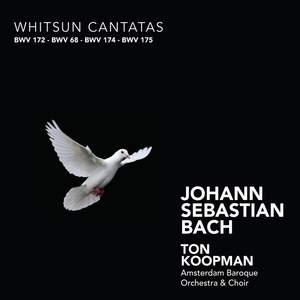
In Lutheran Germany of Bach’s time the Whitsun or Pentecost festival was celebrated like other high ecclesiastical feasts on three consecutive days, Sunday through to Tuesday. Music was performed in the services on all three feast days and Bach usually wrote cantatas for each of them. There were nine of these Whitsun cantatas altogether, and this collection presents a representative cross-section: BWV 172 for the Sunday and then BWV 68 and BWV 174, respectively, for the Second Day of Pentecost, and BWV 175 for the Third Day. As is typical for works to be performed on the high feasts, they invariably display a rich instrumental configuration: BWV 172 includes trumpets and timpani; BWV 68 makes use of 3 oboes, violoncello piccolo, and supporting cornetto and trombones; and BWV 174 features 2 horns, 3 oboes, along with an unusual complement of nine concertato strings. These recordings have been selected from the award-winning cycle of recordings of the complete cantatas of J. S. Bach by Ton Koopman and the Amsterdam Baroque Orchestra & Choir. The featured soloists are sopranos Barbara Schlick and Deborah York, altos Kai Wessel and Bogna Bartosz, tenor Christoph Pregardien, and bass Klauss Mertens | | | Usually despatched in 4 - 5 working days. |
|
|
| |  | Bach - Cantatas Volume 39
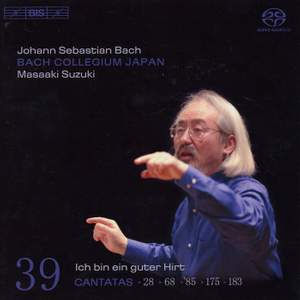
After two volumes concentrating on solo cantatas, the full forces of Bach Collegium Japan return in this programme of five cantatas dated 1725. The choir instantly makes its presence felt in the first movement of the opening work, BWV68. This is a large-scale hymn arrangement, where the choir is supported by an orchestra featuring horn and oboes. This is followed by one of the most charming and beautiful soprano arias in all of Bach’s cantatas, Mein gläubiges Herze’, in which Carolyn Sampson shines. The five works all include, to a certain extent, unusual instrumental combinations: from the three recorders which lend a pastoral character to Er rufet seinen Schafen mit Namen, BWV175, to the wind quartet (two oboi d’amore and two oboi da caccia) appearing in Sie werden euch in den Bann tun, BWV183. The variety of timbres is further aided by the appearance of the cornet and trombones of Concerto Palatino. Gerd Türk glows in the intensely melodic tenor aria ‘Seht, was die Liebe tut’ (from BWV 85), Peter Kooij, whose bass becomes the voice of Christ in Ich bin ein guter Hirt, (BWV85). All in all, another impressive installment in this highly acclaimed cycle. “None of these five cantatas extends beyond a quarter of an hour and yet the wealth of material is brilliantly compressed in a manner which followers of Bach's chorale cantata Jahrgang, his second cycle from Trinity 1724, would have come to expect. Before the following Easter, the composer had abandoned the cycle – at least partly, one imagines, as a result of some upset with the church authorities – and resumed with the conventional model where the music takes the gospel as catalyst for poetic inspiration. Vol 39 from Masaaki Suzuki introduces us initially to the outstanding Whit Monday cantata, No 68, Also hat Gott die Welt geliebt ('God so loved the world') in a performance of uncharacteristically ruddy complexion by Collegium Bach Japan. The siciliana rhythm is elegantly turned here but lacks intensity. Likewise, the bubbling radiance of 'Mein gläubiges Herze' ('My heart ever faithful', as early English arrangers have known it) is short of the genial joie devivre which Agnes Giebel famously brings to Fritz Werner's performance (Erato). If the texts of Marianne von Ziegler for Nos 68, 175 and 183 (sadly, she collaborated with Bach on only nine works) afford a special luminosity of imagery which Bach clearly found profoundly arresting, Suzuki is equally committed to Neumeister's effervescent representation of God's gifts of the past year in the Christmas Cantata Gottlob!, No 28. After Carolyn Sampson's authoritative opening aria, the great motet movement on the chorale, 'Nun lob, mein Seel, den Herren', finds a happy balance between textural refinement and declamatory zeal. These are, indeed, fine performances with notable contributions from all the soloists (and obbligato instruments – apart from some laboured violoncello piccolo playing in BWV183, albeit played on the shoulder, “da spalla”), though no single one falls into that special category where an association between work and performer is formed for instant recall.” Gramophone Classical Music Guide, 2010 “…fine performances with notable contributions from all the soloists…” Gramophone Magazine, September 2008 “The wonderfully trim and naturally expressive period band and choir, underpinned by an exceptional group of continuo players…. High-quality Bach singing and playing.” The Guardian | | | (also available to download from $10.50) | Usually despatched in 2 - 3 working days. (Available now to download.) |
|
|
| |  | Baroque Voices 3 - Bach: Cantatas
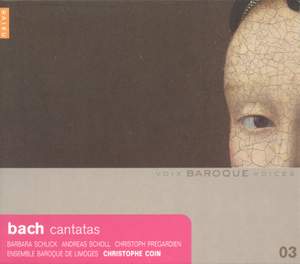
Here we have four masterpieces from J.S. Bach's vast output of cantatas – four works in which the violoncellopiccolo plays an important part. The violoncello piccolo is played by Christophe Coin; it vies with the beauty, clarity and purity of the voices, including that of Andreas Scholl. | | | (also available to download from $10.50) | Usually despatched in 3 - 4 working days. (Available now to download.) |
|
|
| | | |  | Bach - Cantatas Vol. 52
Aldo Baldin, Judith Beckmann, Eva Csapò, Julia Hamari, Philippe Huttenlocher, Adalbert Kraus, Peter Schreier, Wolfgang Schöne, Doris Soffel, Nikolaus Tüller, Carolyn Watkinson, Helen Watts Frankfurter Kantorei, Württembergisches Kammerorchester, Bach-Collegium Stuttgart, Gächinger Kantorei, Helmuth Rilling | | | (also available to download from $10.50) | Usually despatched in 2 - 3 working days. (Available now to download.) |
|
|
| |  | J S Bach - Complete Cantatas Volume 15
Deborah York, Sandrine Piau, Johannette Zomer, Sybylla Rubens (soprano), Bogna Bartosz (alto), Jörg Dürmüller, Christoph Prégardien, Paul Agnew, James Gilchrist (tenor), Klaus Mertens (bass) Amsterdam Baroque Orchestra, Ton Koopman | | | Usually despatched in 4 - 5 working days. |
|
|
| |  | J S Bach: Cantatas for Easter
| | | Usually despatched in 2 - 3 working days. |
|
|
| |  |
Holland Boys’ Choir & Netherlands Bach Collegium, Pieter Jan Leusink Upon popular demand available again: Bach’s complete Sacred Cantatas, newly compiled, on 50 CDs, an unbelievable bargain. These recordings, produced for the Bach‐year 2000, feature a superb boys choir, the Holland Boys Choir, a tradition going back to the time of the composer. The Netherlands Bach Collegium consists of Dutch early music specialists playing period instruments. Conductor Pieter Jan Leusink puts his entire soul in these recordings of what one might call “the greatest and most humanly moving corpus of sacred music ever written”. Reviewers around the world praised the set for its “characteristic performances, marked by a great sense of authencity, especially from the use of boy sopranos”. It sounds very much like it might have sounded in Bach’s time (Gramophone). Written to exalt the glory of God and to facilitate Lutheran worship, Johann Sebastian Bach’s sacred cantatas stand among the highest achievements of Western musical art. This acclaimed recording sees the works performed in their entirety by a stellar line‐up of musicians that includes the renowned Holland Boys’ Choir and period instrument ensemble Netherlands Bach Collegium. The cantatas are directed by Pieter van Leusink, one of Holland’s leading Bach experts. From the plaintive opening of Weinen, Kleinen, Sorgen, Sagen (‘Weeping, lamenting, worrying, fearing’) BWV12 to the triumphant D major chorus in Man singet mit Freuden vom Sieg BWV149, the works traverse a wide range of themes and moods, having been written for a variety of occasions throughout the liturgical year. | 
| | | In stock - usually despatched within 1 working day. |
|
|
| |
|