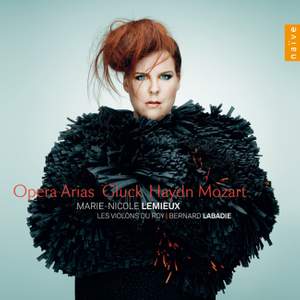
Prices shown exclude VAT. (UK tax is not payable for deliveries to United States.) See Terms & Conditions for p&p rates. | |  | Opera Arias: Gluck, Haydn, Mozart
Gluck: | Dieux puissants que j'atteste… Jupiter, lance la foudre (from Iphigénie en Aulide) Che faro' senza Euridice? (from Orfeo ed Euridice) | Graun, C H: | Del mio destin tiranno (from Montezuma) | Haydn: | Se non piange un infelice (from L'isola Disabitata) Sudò il guerriero (from Il ritorno di Tobia, HobXXI/1) | Mozart: | Venga pur, minacci e frema (from Mitridate, rè di Ponto) Mitridate, rè di Ponto, K87: Overture Ombra felice!...Io ti lascio, K255 Parto inerme e non pavento (from La Betulia liberata, K74c/K118) Voi che sapete (from Le nozze di Figaro) Deh, per questo istante solo (from La Clemenza di Tito) |
In the line of a rich and eclectic discography, Marie-Nicole Lemieux’s new recital, recorded with leading North American classical and baroque orchestra Les Violons du Roy, is devoted to the first decades of classical opera era. As always, Marie-Nicole Lemieux has combined hits of the repertoire (Mozart’s Le nozze di Figaro) with much less renowned pieces to which she gives new light, such as Graun’s 'Montezuma', Gluck’s 'Iphigénie en Aulide' or young Mozart’s 'Mitridate'. The warm and sensitive voice of Marie-Nicole Lemieux as well as the very precise and specific rhythm provided by Bernard Labadie’s orchestra perfectly combine to draw a complete range of musical colours. “You might think that a band called Les Violons du Roy would feature period instruments: it doesn't, but the playing is lean and muscular, with plenty of light and air...Lemieux's spine-tingling account of Clytemnestra's air in Iphigenie en Aulide is complemented by Bernard Labadie's attention to detail” Gramophone Magazine, January 2013 “The Canadian contralto's depth is genuine, even if there's a mezzo quality higher up. Hers may not be the richest or most rounded tone around, but she delivers everything assigned to her with a keen dramatic overview...Her ability to extract meaning from text and notes is impressive throughout.” BBC Music Magazine, January 2013 **** “her bottom range shows a strength worthy of Marilyn Horne...[in the Mitridate aria] Lemieux is a veritable spitfire as she spews out the young man's venom...Lemieux sings [Che faro?] with rich tone, clear focus and subtle hints in her colouring...This CD is another desirable addition to Lemieux's growing discography, with so much in which to revel.” International Record Review, February 2013 | | | (also available to download from $10.50) | In stock - usually despatched within 1 working day. |
|
|
| |  | Haydn: L'Infedelta costanteOperatic Arias and Overtures
| | | In stock - usually despatched within 1 working day. |
|
|
| |  | Haydn - L’infedeltà costanteOperatic Arias & Overtures
Sony Music is pleased to announce the release of the debut album by mezzo soprano Anna Bonitatibus on Deutsche Harmonia Mundi. L’Infedeltà costante is available worldwide and features arias and overtures by Joseph Haydn. Anna Bonitatibus is accompanied by Il Complesso Barocco, on period instruments, a release that celebrates the Haydn anniversary year in 2009. Anna Bonitatibus made her debut at Verona’s Teatro Filarmonico. In a short time she acquired a large repertoire in the field of Baroque opera. She then broadened her repertoire with works by Rossini, whose big mezzo roles (the title role in “La Cenerentola” and Rosina in “Il barbiere di Siviglia”) she has sung at many places all over Europe. Why the title, “L’Infedeltà costante”? Conductor Alan Curtis explains: “Since we do arias from “La fedeltà premiata”, “L’Infedeltà delusa” and “La vera costanza”, I think the perfect “modern” (i.e. ironic) title is “L'infedelta costante” which pretty much covers every situation in every opera we do.” “Haydn's operas have never attracted the attention they deserve. Alan Curtis's selection of overtures and arias makes an attractive sampler of their merits. Each of the overtures is well characterised by the players of Il Complesso Barocco, who are vivid as an ensemble and individually distinctive. Anna Bonitatibus's solos are appealingly done, with some successful attempts at characterisation...” BBC Music Magazine, February 2009 *** “A captivating, show-stealing Cherubino at Covent Garden, Italian mezzo Anna Bonitatibus quarries arias from Haydn's still rarely aired Eszterháza operas, ranging from a brace of buffo songs for the disguised Vespina in L'infedeltàdelusa, via numbers for the gentle shepherdess Celia and the upwardly mobile Amaranta from La fedeltà premiata, to the fisher-girl Rosina's magnificent, despairing outburst from La veracostanza. She also throws in two modestly charming 'insertion' arias Haydn composed for Eszterháza revivals of operas by Paisiello and Gazzaniga, and ends with the great keyboard-accompanied cantata Arianna a Naxos that quickly became a favourite in the salons of Vienna and London. On disc Bonitatibus's quick vibrato, characteristic of singers south of the Alps, may initially faze those accustomed to 'straighter' voices in 18th-century music. Sometimes – as in the opening of Arianna's final aria – she sacrifices a pure legato to intensity of expression. That said, Bonitatibus brings to each of these portraits a rich, flavoursome voice and a flair for characterisation, relishing the sound and sense of the words (an Italian always has a head start in this repertoire). She is splendidly imperious in Alcina's fiery entrance aria (Orlando paladino), amusingly over-the-top in Vespina's consumptive old woman act, and catches every shade of the distraught Rosina's fluctuating emotions. Alan Curtis is not the most poetic of fortepianists in Arianna, and as conductor sometimes lets rhythms plod in slower numbers. But in the main he encourages lively, characterful playing from his period band, whether in a rip-roaring account of the 'hunting' overture to La fedeltàpremiata (which Haydn recycled as the finale to Symphony No 73) or as eager colluders in Vespina's comic play-acting.” Gramophone Classical Music Guide, 2010 “Best of all is a gripping and moving account of Arianna a Naxos, which stands comparison with the young Cecilia Bartoli for dramatic delivery and passionate engagement with the music.” Sunday Times, 28th June 2009 “We get a strong sense of Haydn's psychological range, but are spared the lapses in pacing that make his operas dramatically awkward...There's some finely honed playing from Il Complesso Barocco under Alan Curtis, who is also the fortepianist in Arianna a Naxos.” The Guardian, 12th June 2009 **** “Anna Bonitatibus offers exemplary interpretations throughout, and even renders the apocalyptic prospect of Orlando paladino attractive; but it's the haughtiness of "Ho un tumore in un ginocchio" that is most entertaining, the heroine's bogus sickness suggested by the dainty tunefulness with which she feigns a coughing fit.” The Independent, 29th May 2009 **** | | | In stock - usually despatched within 1 working day. |
|
|
| |
|