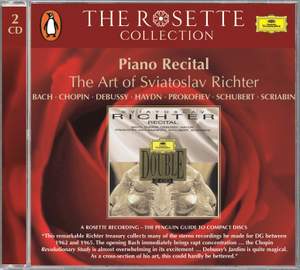
All recordingsPrices shown exclude VAT. (UK tax is not payable for deliveries to United States.) See Terms & Conditions for p&p rates. | |  | Sviatoslav Richter plays Chopin
As early as 1948 Richter recorded a Polonaise Op.25 No.1, and in 1950 the Ballade No.2 Op.38, few Studies… An avowed enemy of 'completism' the present programme is a fabulous example of his choices, excluding the famous Funeral Sonata, Walzes or First Piano Concerto…, leaving these to Gilels: ‘far better than me' in his opinion! “Here is Richter at his most godlike, taking the breath away with his astonishing tempos and also with his utterly original take on pieces that could be worn thin by over-familiarity, notably the Ballades.” BBC Music Magazine, February 2013 ***** | | | In stock - usually despatched within 1 working day. |
|
|
| |  | Chopin: 24 Preludes, Op. 28
| | | In stock - usually despatched within 1 working day. |
|
|
| |  | Chopin: Piano Works
Clarity of form and colour, the piano as a narrator and ballad-singer: Nelson Goerner has his own way of interpreting Chopin, and he shows it here in a varied recital programme ranging from major works like the famous B minor Sonata through the Nocturnes to the F minor Ballade. | | | In stock - usually despatched within 1 working day. |
|
|
| |  | Chopin: Preludes & Piano Sonatas Nos. 2 & 3
| | | (Sorry, download not available in your country) | In stock - usually despatched within 1 working day. |
|
|
| |  | Sviatoslav Richter in Moscow (Great Hall)
Beethoven: | Piano Sonata No. 1 in F minor, Op. 2 No. 1 Piano Sonata No. 7 in D major, Op. 10 No. 3 Piano Sonata No. 9 in E major, Op. 14 No. 1 Piano Sonata No. 12 in A flat major, Op. 26 'March Funebre' Bagatelles (6), Op. 126: No. 1 | Chopin: | Polonaise No. 7 in A flat major, Op. 61 'Polonaise-fantaisie' Waltz No. 4 in F major 'Grande Valse Brillante', Op. 34 No. 3 Waltz No. 13 in D flat major, Op. 70 No. 3 Mazurka No. 41 in C sharp minor, Op. 63 No. 3 Mazurka No. 44 in C major, Op. 67 No. 3 Mazurka No. 48 in F major, Op. 68 No. 3 Mazurka in A minor, Op..posth. Étude Op. 25 No. 7 in C sharp minor Scherzo No. 4 in E major, Op. 54 |
“Towering virtuosity that triumphs over the primitive Russian technology of the mid-1970s, sending out shockwaves of electrifying pianism, apparently without the slightest effort.” BBC Music Magazine, November 2012 ***** “prospective viewers should be aware that the tape is getting on for forty years old now. The sound quality is certainly pretty reasonable...The [Beethoven] playing is crisp, forthright accenting in the left hand setting up energy and dynamism. His Chopin recital is of lighter material, Waltzes and Mazurkas, all of which are played with commitment and energy.” MusicWeb International, January 2013 | | | In stock - usually despatched within 1 working day. |
|
|
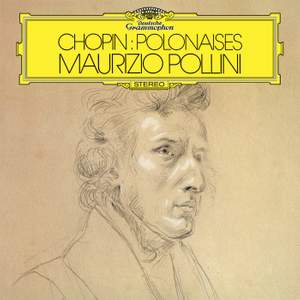
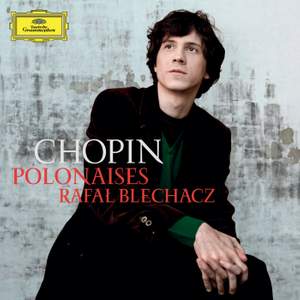
| |  | Chopin: Polonaises
Chopin: | Polonaise No. 7 in A flat major, Op. 61 'Polonaise-fantaisie' Polonaise No. 1 in C sharp minor, Op. 26 No. 1 Polonaise No. 2 in E flat minor, Op. 26 No. 2 Polonaise No. 3 in A major, Op. 40 No. 1 'Military' Polonaise No. 4 in C minor, Op. 40, No. 2 Polonaise No. 5 in F sharp minor, Op. 44 Polonaise No. 6 in A flat major, Op. 53 'Héroïque' Polonaise No. 8 in D minor, Op. 71 No. 1 Polonaise No. 9 in B flat major, Op. 71 No. 2 Polonaise No. 10 in F minor, Op. 71 No. 3 Andante spianato & Grande Polonaise, Op. 22 |
Polonaise: almost always, as soon as the word is uttered, it conjures up the name of Frédéric Chopin. And what could be more natural with a creative genius who was constantly attracted to the genre? His first work, published in Warsaw, was entitled ‘Polonaise for pianoforte dedicated to her Excellency the Countess Victoire Skarbek by Friderik Chopin, aged eight years’; and right up to the concluding Polonaise-Fantaisie, Op.61, fourteen other similar compositions had punctuated the all-too-brief career of the Polish maestro. Before Chopin, a number of musicians had devoted themselves to the polonaise since its appearance in the sixteenth century under the name of ‘Polish Dance’, before assuming that simply of ‘Polonaise’ (‘Polish’) in the following century. Gradually this dance in triple time had extended its influence to the whole of Europe. Undoubtedly some admirable polonaises had been written, but at the expense of the original essence of a proud, manly and noble dance. To Frédéric Chopin fell the honour of reviving that initial virility – of recreating the polonaise. Franz Liszt had not been mistaken when, shortly after the premature death of his friend, he wrote: ‘His Polonaises... are among his most inspired creations; in no way do they remind us of those over-ornate, pretty-pretty pieces à la Pompadour... Their vigorous rhythm sets us quivering; it rouses us from our usual torpid indifference. The noblest sentiments of the Poland of old come to life in them. A sense of firm determination allied to gravity is what strikes us from the start. For the most part soldierly in spirit, they express gallantry and valour on a note of simplicity which typifies these qualities in a warrior nation. They exude a calm and thoughtful strength, and we feel we are back with those Poles of earlier days depicted in their chronicles.’ There could be no better commentary to introduce the Polonaise in A flat Op.53 (1843), one of Chopin’s most celebrated achievements whose usual nickname, the ‘Heroic’, sums up manly determination and fervour and a distinctly narrative character which has led some to detect in it an underlying programme. The ‘Military’ Polonaise in A major, Op.40 No.1 (1838), again paints a portrait of a valiant and combative people, an image which owes much to a rising melodic pattern and a verticality of composition issuing from vast and powerful chords. In complete contrast, the Polonaise in C minor, Op.40 No.2 (1839), is notable for its mood of distress. Is this not the bitterness and despondency of defeat at the close of day, seemingly born of the bass notes underlying the sombre chords from the right hand? Four years before these two works of perfection Chopin had completed the two Polonaises Op.26. Created by a composer only twenty-five years old, they underline just how early in his career he had acquired a quite inimitable idiom. What vigour, indeed, in the first of these, in C sharp minor, which, if it does not make a clean break with the somewhat ornate manner of the polonaises of his even earlier youth (cf. Opus 71), already demonstrates an impressive authority. As for the second, the drama prefigured in the pianissimo of its opening bars is subsequently developed with an imagination expressed in sound which is astonishingly modern. The Polonaise in F sharp minor, Op.44 (1841) remains undoubtedly one of Chopin’s most enigmatic and disconcerting pieces. Its originality lies in its association of the polonaise with Chopin’s other favourite dance, the mazurka, and this association generates a strange atmosphere which Liszt, again, has wonderfully defined: ‘It is like the recounting of a dream in the first glimmering of a grey and misty winter dawn, a dream that follows a long, sleepless night, a dream-poem intermingling impression and reality which have no connection with one another, but which curiously coalesce.’ Published posthumously by Julien Fontana in 1871, the three Polonaises Op.71 – in D minor, B flat and F minor respectively – were written before their composer had finally left Poland. They are therefore the work of an adolescent who dazzled the aristocrats of Warsaw with his extraordinary talents. If here we are still far removed from the dramatic impact of the works which were to follow, we cannot fail to respond to the freshness and pianistic inventiveness of three compositions of great promise, made evident in a distinctive sense for contrast (No.1) or full-flavoured popular appeal (No.2). As the orchestra plays an extremely limited and secondary role the Andante spianato et grande polonaise brillante in E flat can be performed without detriment on the solo piano. This work, so rich in lyricism and sparkle, was written between 1830 and 1834 and crowns that period of stylistic brilliance begun before his departure from Poland. Imbued with all the insouciance of a young composer intent on winning over his public, this work derives its impact from the contrast between the peaceful atmosphere and half-toned cantabile of the Andante, and the triumphant high spirits of the polonaise which follows. With the Polonaise-Fantaisie in A flat, Op.61 (1846), Chopin made his last incursion into the world of the polonaise. The listener must not be put off by the evident multiformity of a masterpiece which is remarkable for the variety and complexity of the feelings and moods it expresses. The Polonaise-Fantaisie belongs among those works one gradually gets to grips with, constantly improving one’s appreciation of the inexhaustible wealth of poetry and the compositional audacities which, as with the fourth Ballade, place it among its author’s most visionary achievements. | | | In stock - usually despatched within 1 working day. |
|
|
| |  | Anastasia Voltchok plays Schumann, Chopin & Rachmaninov
Anastasia Voltchok (piano) "Anastasia Voltchok is a representative of the great Russian tradition of pianists. Her playing is powerful and fiery. There is no limit to her technical prowess. It is as though Richter's spirit were floating in the room." Le Temps, Geneva | | | (also available to download from $10.50) | In stock - usually despatched within 1 working day. |
|
|
| |  | Chopin: 4 Ballades, Barcarolle & Fantaisie
This 2-channel hybrid SACD features the much admired Ukrainean pianist Sergei Edelmann in a collection of pieces for solo piano by Frederick Chopin. The disc includes the Four Ballades, as well as the Barcarolle in F sharp minor, opus 60, the Fantasie in F minor, opus 49, and the Polonaise No. 7 in A flat major known as the “Polonaise Fantasie”. Born in Lvov, Ukraine in 1960, Sergei Edelmann comes from a long and outstanding musical heritage. He was taught to play by his father Alexander Edelmann, a renowned pianist and teacher who had links to Vladimir Horowitz and Sviatoslav Richter. In his native country Sergei’s first orchestral performance was at the age of 10 playing Beethoven’s Piano Concerto No. 1. He subsequently performed extensively in recitals and with orchestras throughout the old USSR. His BMG Classics/RCA Red Seal CDs with the Bamberg Symphony under the baton of Claus Peter Flor and the Stockholm Philharmonic Orchestra with Paavo Berglund include both Mendelssohn Concertos and the Strauss Burlesque, and his series of solo recordings of Beethoven, Schubert, Schumann, Chopin, and Prokofiev have garnered enthusiastic critical acclaim. Frederick Chopin’s Four Ballades represent some of the most challenging music in the solo piano repertoire. They were composed between 1835 and 1842, and were the first to use the word “Ballade” (a term which was previously associated with 19th century French poetry) in a musical context. Despite a shared lyrical quality, each piece is however highly distinctive in style and mood. | | | In stock - usually despatched within 1 working day. |
|
|
| |  | Chopin: Mazurkas
Chopin: | Mazurka No. 3 in E major, Op. 6 No. 3 Mazurka No. 5 in B flat major, Op. 7 No. 1 Mazurka No. 11 in E minor, Op. 17 No. 2 Mazurka No. 13 in A minor, Op. 17 No. 4 Mazurka No. 15 in C major, Op. 24 No. 2 Mazurka No. 17 in B flat minor, Op. 24 No. 4 Mazurka No. 33 in B major, Op. 56 No. 1 Mazurka No. 41 in C sharp minor, Op. 63 No. 3 Mazurka No. 47 in A minor, Op. 68 No. 2 Mazurka No. 49 in F minor, Op. 68 No. 4 Scherzo No. 1 in B minor, Op. 20 Nocturne No. 13 in C minor, Op. 48 No. 1 Polonaise No. 7 in A flat major, Op. 61 'Polonaise-fantaisie' |
Cédric Tiberghien offers us a panorama of Chopin’s output, with three of the composer’s key works framed by a selection of mazurkas. “I devised a recital programme for the 150th anniversary of Chopin’s death in 1999. The idea was to offer a panoramic survey of his output featuring several representative ‘large’ pieces, with the mazurkas providing a sort of chronological thread between them. So ten years later it was a natural process to narrow the focus down to three key pieces from different periods of Chopin’s life, surrounded by a generous selection of mazurkas… One of the very first Chopin pieces I discovered was on a record telling the story of the composer’s life: the Mazurka op.68 no.2, which illustrates the nostalgia for his homeland, the melancholy so often present in his music. I think the mazurkas show the most intimate side of Chopin’s personality, with their mixture of improvisation, evocation, and the ephemeral. These short pieces were a way for him to stay in touch with the roots of his country; he has nothing to prove, he submits to no rule except that of his inner music. I find it fascinating to see how varied Chopin’s inspiration is despite the common basis of all the mazurkas. As I explored the fifty-one pieces in the collection, I rediscovered masterpieces I thought I knew already, while others that were new to me have now become essential parts of my life. Chopin wrote mazurkas throughout his adult career, from 1830 to 1849. The first ones (opp.6 and 7) emphasise the popular element, while the later examples (op.59, op.68 no.4) show an unprecedented harmonic refinement that betrays his contact with French culture. The Scherzo has always struck me with its violence, which grips you right from the first chord and never lets up until the magnificent ‘Christmas carol’ which is transcendent in its simplicity. The Nocturne illustrates how important melody was for Chopin. He insisted that all his pupils should practise singing so that they would sense the phrasing, the direction of the lines, the moments of tension and relaxation. The Polonaise-Fantaisie is a very special work. It’s at the very opposite pole from the mazurkas, if only in its dimensions; and it achieves a mysterious balance between its improvisatory aspect and the strength of its architecture, between extreme complexity and a feeling of intimacy. The opening chords warn the listener: ‘Prepare for an extraordinary journey.’ If I were allowed to keep only one work by Chopin, it would be this Polonaise-Fantaisie in A flat – a key which was very dear to him, incidentally. For me it’s the perfect expression of his personality.” Cédric Tiberghien “When Tiberghien next plays in London, be there.” Geoff Brown, The Times Concert reviews: Chopin Mazurkas “The case for the innovatory nature of Chopin's mazurkas, penetrating the deepest of emotions often with the sparsest of musical gestures, was formidably made.” Tim Ashley, The Guardian, 26 January 2010 “This is very close to what we know about Chopin's own playing...How well Tiberghien caught the gentle, musing melancholy of the opening, and how the silence before the ensuing storm seemed to press on our eardrums!” The Daily Telegraph “Tiberghien says that if he was allowed to keep only one Chopin work, it would be the Polonaise-Fantasie, and he plays this once-neglected piece as if he treasures it: there's a sense of mystery in the way the dances are hinted at impressionistically.” BBC Music Magazine, December 2010 **** “Perhaps the C minor Nocturne, Op. 48 No. 1, adds up to this recital's best-realised interpretation, with its measured and sustained opening section and assiduous build into a shattering climax. Harmonia Mundi provides Tiberghien with attractively robust engineering.” Gramophone Magazine, November 2010 “Tiberghien seems to have the poise and poetry of Chopin in his blood. He makes the piano sing...This is an imaginative disc of shifting moods that are readily within Tiberghien’s expressive orbit and which he interprets with sublime inspiration.” The Telegraph, 8th October 2010 ***** | | | In stock - usually despatched within 1 working day. |
|
|
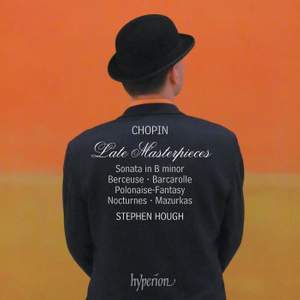
| |  | Chopin - Late Masterpieces
Chopin: | Barcarolle in F sharp major, Op. 60 Mazurka No. 40 in F minor, Op. 63 No. 2 Mazurka No. 45 in A minor, Op. 67 No. 4 Mazurka No. 41 in C sharp minor, Op. 63 No. 3 Mazurka No. 49 in F minor, Op. 68 No. 4 Polonaise No. 7 in A flat major, Op. 61 'Polonaise-fantaisie' Nocturne No. 17 in B major, Op. 62 No. 1 Nocturne No. 18 in E major, Op. 62 No. 2 Piano Sonata No. 3 in B minor, Op. 58 Berceuse in D flat major, Op. 57 |
Stephen Hough joins the celebrations for Chopin’s 200th birthday with a disc containing much of the composer’s most extraordinary music, written in the last years of his life where the expressive possibilites of his art were constantly unfolding as he imbued his favoured forms with previously unknown levels of complexity and emotional depth. This disc includes the intoxicatingly ornamented Berceuse Op 57 and the sublime Barcarolle in F sharp major as well as the Polonaise-Fantasy in A flat major and the towering Piano Sonata No 3 in B minor. Also included are two late Nocturnes which demonstrate how Chopin’s art had evolved since he first composed in that genre in his youth. The programme is completed by a selection of Mazurkas, each a tiny jewel, containing no less mastery than their larger counterparts, and providing moving sonic evidence of the contemplative profundity of Chopin’s late style. Stephen Hough’s extraordinarily sensitive playing is informed by his limitless technique and engaging musical imagination. This is the Chopin of a true Romantic. “A new Hough disc is one of life's pleasures…A masterclass in pianistic command and stylistic poise with the most heartfelt playing of any of his recent recordings. There are few who can elucidate the question-and-answer phrasing of Chopin's music with Hough's transparency and unaffected simplicity.” Gramophone Magazine, May 2010 “...in every case Hough's command of the music's expressive world is totally convincing...Hough's distinctive voicing of each strand in the musical texture [of Op. 61] is mesmerising. His playing is directly communicative, seductively decorative and, in the sonata, aristocratically controlled.” The Guardian, 15th April 2010 ***** “I was won over by the lovely tone and touch, the seductive warmth and clarity of the inner parts and the beautifully judged rubato. This is unusually forceful Chopin playing — the sonata is like Chopin played by Liszt — but it carries ringing conviction.” Sunday Times, 18th April 2010 **** “Hough’s fingers probe and caress; textures and colours dance and blend with cleansing clarity. Probably the Sonata’s best feature is Hough’s firm grasp of architecture.” The Times, 17th April 2010 **** “Hough stresses the Classical outlook of Chopin's Romanticism, even in a programme encompassing some of his most harmonically advanced music. The opening Barcarolle has rare clarity, and the Berceuse rounds things off clearly.” BBC Music Magazine, June 2010 **** | | | In stock - usually despatched within 1 working day. |
|
|
| |
|