All recordingsPrices shown exclude VAT. (UK tax is not payable for deliveries to United States.) See Terms & Conditions for p&p rates. | |  | Bach: Mass in B minor
For long out of the catalogue, Marriner’s (Philips) recording of Bach’s B Minor Mass, with an array of splendid soloists, returns to circulation. Its coupling is the first release on CD of this recording of the deeply moving Cantata BWV 56 ‘Ich will den Kreuzstab gerne tragen’. It was one of two (extant) Bach cantatas for bass voice alone (the other being BWV 82 ‘Ich habe genug’: Shirley-Quirk’s recording with Marriner appears on Decca Eloquence 476 2684). The two items were recorded thirteen years apart, the Cantata in April 1964 and the Mass in June-July 1977. The partnership of Neville Marriner and the Academy of St. Martin in the Fields is possibly the most recorded of all partnerships in recorded classical music. This pioneering 2CD set is issued in celebration of the Academy’s 50th anniversary this year and these recordings form part of a series of Marriner reissues on Eloquence. Marriner’s glorious recording of Bach’s Mass in B minor returns to the catalogue – at budget price for the first time. The Cantata BWV 56 receives its first release on CD. Forms part of a series of recordings with Marriner and the Academy. “This disc is, I would say, the one to have; and, more than any of his previous recordings, it makes apparent beyond doubt John Shirley-Quirk’s high standing as an artist” Gramophone Magazine (Cantata) “I found the solo singing rewarding and in particular Dame Janet Baker’s account of the Agnus Dei very moving … the sound is rich with plenty of bloom ... Cum Sancto Spiritu is a real choral tour de force” Gramophone Magazine (Mass) | | | In stock - usually despatched within 1 working day. |
|
|
| |  | Bach Cantatas Volume 10Cantatas for the Nineteenth Sunday after Trinity and for the Feast of the Reformation
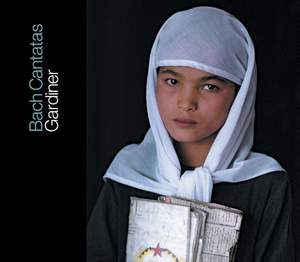
Alongside some magnificent, less well-known cantatas, this set contains two of Bach’s most famous works: the “Kreuzstab” Cantata BWV 56 for solo bass, expressing the desire to relieve Christ of the burden of the Cross, is an intimate yet intensely dramatic work, poignantly sung by Peter Harvey; BWV 80 “Ein feste Burg” is, by contrast, a monumental choral cantata celebrating the most intrinsically Lutheran festivity, the Feast of the Reformation - from the colossal, initial choral fugue to the final chorale it is a veritable rollercoaster! “There is unpredictable excitement in the random way the fruits of John Eliot Gardiner's Bach Pilgrimage are being released, as the next steps of that memorable year are retraced with autumn cantatas from Leipzig (19th Sunday after Trinity) and three Reformation pieces. Volume 10 represents another compelling reminder of what Gardiner can achieve in Bach when he has the wind behind him – 'living' these works appears to have fired the imagination. The largest work here is Ein feste Burg (No 80) whose gothic arches of sound find rasping advocacy in the Schlosskirche on the site where Luther preached. His famous hymn is most effectively fortified with a rousing bass sackbut in the first chorus. Here and in the outstanding sister-piece Gott, der Herr (No 79), the performances are distinguished by a palpable immediacy. The cathartic duet 'Wie selig' (No 80) from William Towers and James Gilchrist is a treasure. The quality of music never lets up in Potsdam. Wo soll ich fliehen hin (No 5) is one of the finest of Bach's chorale cantatas, its hymn nurtured by an arresting concerto style which conveys the gnawing presence of sin and the yearning to escape its insidious influence. The contrast between its opening fantasia and the radiant tenor aria 'Ergiesse' is skilfully negotiated: James Gilchrist relishes the transformation of the chorus's 'flight' motif into one of tactile pleasure as the divine spring washes away all man's blemishes. Mention must be made of Peter Harvey's cultivated and flexible bass. Joanne Lunn is perhaps not ideal but the chorus and orchestra are in stirring form and the recorded sound is captivating.” Gramophone Classical Music Guide, 2010 “…Gardiner's lively and articulate responses to Bach's dance rhythms… refresh and enliven the music, often in a quite distinctive way. The mighty fugal chorus of Ein Feste Burg (BWV 80) comes off splendidly, with Bach's quotation of the hymn melody in the uppermost and lowest strands of the score emerging from the full textures with forceful energy.” BBC Music Magazine, September 2005 **** | | | (also available to download from $21.00) | In stock - usually despatched within 1 working day. |
|
|
| |  | J S Bach: Bass Cantatas
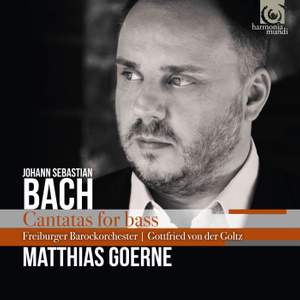
| | | In stock - usually despatched within 1 working day. |
|
|
| |  | JS Bach: Cantatas 21, 34, 46, 56 & 104
| | | Usually despatched in 8 - 10 working days. |
|
|
| |  | Hermann Prey – Arias & Songs
Hermann Prey has delighted opera audiences with his humour and the way he is able to bring characters to life. His lyric baritone voice is both noble and mellow. This CD presents him in some of his classic roles, including Figaro and Papageno. | | | Usually despatched in 4 - 5 working days. |
|
|
| |  | Bach - Favourite Arias and Choruses
Johann Sebastian Bach was an absolute master of all the musical forms of his time except opera, which he never had the opportunity to compose. Yet in his sacred vocal and choral music he fully assimilated the expressive potential of secular Baroque vocal music with his abiding respect for the music, both sacred and profane, of his predecessors. This disc, a representative selection of his sacred music, will appeal both to the experienced music lover and to those just beginning to discover Bach’s immortal music. | | | (also available to download from $6.00) | Usually despatched in 2 - 3 working days. (Available now to download.) |
|
|
| |  | Bach - Cantatas Volume 41solo cantatas
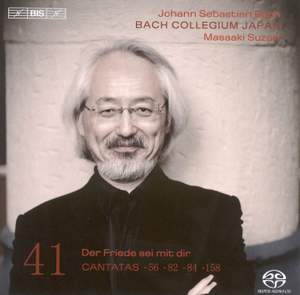
As on two other recent instalments (Vols 37 & 38) in his Cantata cycle, Masaaki Suzuki here concentrates on the so-called solo cantatas, providing an opportunity for two of the highly acclaimed soloists of this series, Carolyn Sampson and Peter Kooij, to shine even more brightly. Of the two cantatas for soprano, Ich habe genung (BWV82) is among the best-known of all of Bach’s cantatas, and was evidently held in high regard from an early stage. It was originally set for bass (and appears as such on Volume 38), and source materials show that Bach performed it at least four times. Bach’s wife Anna Magdalena must also have been especially fond of it: a partial arrangement for soprano and harpsichord was included in her second Klavierbüchlein. Ich bin vergnügt (BWV84) is a slighter work in which the oboe plays an important soloistic part. Ich will den Kreuzstab gerne tragen, the weightier of the bass cantatas, is a meditation on the cross of Jesus, but also on the suffering and need that mankind must bear. The texts, by an unknown librettist, inspired Bach to produce music of sublime earnestness, great expressive depth and full of rich, immediate imagery. Whereas these three cantatas were all composed during the winter of 1726-27, Der Friede sei mit dir has a less certain place in the chronology. It is in fact probable that it was assembled from movements from various sources, perhaps by an arranger rather than by Bach himself. “With singers on the top of their form, this disc is utterly absorbing from start to finish. 'Ich habe Genug', BWV82… is here in Bach's alternative for soprano, with flute replacing oboe. What is lost in balance is gained in pathos for this heartfelt Song of Simeon. Carolyn Sampson's floating line in dialogue with flute, portraying calm acceptance of death in the almost time-less opening movement, is deeply moving, as is her unaffected simplicity in the following lullaby...” BBC Music Magazine, February 2009 ***** “Carolyn Sampson is radiant in her two cantatas. Ich habe genug rarely seems to me as incrementally effective in E minor as in the earlier bass version but Sampson brings a resigned pathos as persuasive as anything you'll hear. …"Schlummert ein" offers a delicate blend of flute and strings to underpin a beautifully judged innocence of expression, reaching its apogee in an exquisite pianissimo da capo.” Gramophone Magazine, May 2009 | | | (also available to download from $10.50) | Usually despatched in 2 - 3 working days. (Available now to download.) |
|
|
| |  | Bach - Cantatas
Recorded during live performances in Munich October 1957. | | | Usually despatched in 2 - 3 working days. |
|
|
| |  | J S Bach - Solo Cantatas for Bass
The cantatas in this selection, which have been taken from Ton Koopman’s award-winning series of Bach recordings, feature a single bass voice alongside the choral ensemble. The solo cantata “Ich will den Kreuzstab gerne tragen” BWV 56 was first performed on 27 October 1726, the 19th Sunday after Trinity. The author of the text is unknown, but he was apparently inspired by Erdmann Neumeister‘s “Ich will den Kreuzweg gerne gehen” from the latter’s cantata text collection of 1711. “Ich habe genung” BWV 82 was composed for the Feast of the Purification of the Virgin Mary on 2 February 1727. The author of the text is also onknown. The cantata “Der Friede sei mit dir” BWV 158 survives with designations for two liturgical occasions (Purification/Third Day of Easter) in a manuscript copied by a reliable scribe shortly after Bach‘s death. The origins of the work are therefore uncertain, but most likely it represents an expansion of a solo cantata originally written (like BWV 82) for the Marian Feast of Purification on 2 February. “Amore traditore” BWV 203, in the typical format (aria-recitative- aria) of the Italian secular solo cantata, is based on an anonymous text that was also set by the Neapolitan composer Nicola Fago. | | | Usually despatched in 4 - 5 working days. |
|
|
| |  | Bach - Cantatas
| | | (also available to download from $10.50) | Usually despatched in 2 - 3 working days. (Available now to download.) |
|
|
| |
|