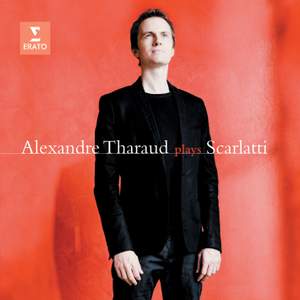
All recordingsPrices shown exclude VAT. (UK tax is not payable for deliveries to United States.) See Terms & Conditions for p&p rates. | |  | Alexandre Tharaud plays Scarlatti
“I love the extravagance, the sunny glow, the light touch of Scarlatti,” says French pianist Alexandre Tharaud, whose second Virgin Classics release is a collection of the composer’s captivating and adventurous keyboard sonatas. His first release, the Chopin recital Journal intime was described by The Guardian as “altogether breathtakingly beautiful”. “Listening to Mr. Tharaud's crisply articulated and vividly etched playing, a listener might guess that he is a Baroque specialist who, for some reason, prefers the modern piano to the harpsichord. But … Baroque music is only one of his interests,” wrote the New York Times in 2005. In typically imaginative fashion, Tharaud combined early Romanticism with the Baroque over the 2009-10 season when he toured a recital programme of works by Chopin – the subject of Virgin Classics release, Journal intime – and selections from Domenico Scarlatti’s canon of 555 keyboard sonatas. “I love the extravagance, the sunny glow, the light touch of Scarlatti, who shares with Chopin a precise sense for ornamentation, a culture of beauty in sound and an intimate rapport with the audience,” he says. Tharaud’s previous exploration of the Baroque repertoire has focused on composers such as Couperin and Rameau, whose music is rarely heard on the modern piano. The tradition of Scarlatti on the piano is much more firmly established – Vladimir Horowitz, for instance, would often include his music in recitals – but Tharaud draws inspiration from developments in historically informed performance over the past 30 years. As he told the French magazine Télérama: “I am not sure that authenticity is conferred by a specific instrument, but rather in the way new life is imbued into this music … Baroque musicians have taught us to approach tempi and ornamentation with a sense of freedom, even audacity.” Scarlatti, born in Naples, spent more than 30 years of his life serving the royal families of Portugal and Spain and died in Madrid. His sonatas are concise, captivating one-movement works in binary form, often adventurous in their use of harmony and modulation, and frequently inhabited by the exotic spirit of Iberian folk music. “Whether on a broad canvas or on a miniature one, Tharaud’s feel for tonal colouring and his eloquence of expression are a perfect match for this inspiring, kaleidoscopic music.” That praise from the Daily Telegraph could almost apply to works by Scarlatti, but in fact came from a review of Tharaud’s Chopin album, Journal intime. More specific in its frame of reference was The Guardian’s comment on the Chopin disc: “Alexandre Tharaud explores a huge emotional range in his Journal intime, including the most thrilling and propulsive first ballade since Michelangeli's version, with a deeply intense C sharp minor nocturne at the heart. Tharaud lifts the music across the bar-lines with deft rubato, his sound clear, shining and sensuous; altogether breathtakingly beautiful.” “Tharaud's attention to musical detail is, as ever, combined with total spontaneity. The recorded sound adds warmth and this is a wonderfully original reimagining of repertory and instrument.” The Observer, 30th January 2011 “The biggest surprise on this wonderfully exuberant and exhilarating disc comes with the very first notes: the piano tone is rich and full...There's never a dull moment, and Tharaud's range of touch and colour, and his sheer enthusiasm, shine through every jewel-like piece.” The Guardian, 3rd February 2011 ***** “The fact that Scarlatti used the same two-part structural template for all his sonatas is camouflaged by his vast imaginative range, a fertile mind that Tharaud taps and illuminates absorbingly in this recital...The diversity is captivating and Tharaud is a consummate master of it.” The Telegraph, 11th February 2011 ***** “if Tharaud is evidently aware of the stylistic insights afforded by the scholarly diggings of the past few decades, he's unrepentantly pianistic in his approach...Tharaud's is playing with personality, revelling in Scarlatti's playful inventiveness and pungent harmonic daring.” BBC Music Magazine, March 2011 ***** “The range is extraordinary, from the almost casual, plaintive charm of the K132, with its elegant trills and thoughtful progressions, to the dashing Iberian brilliance of the K420, and the more virtuosic manner of the K72 - three wildly differing explorations of the key of C major, handled with a deft, easy grace and an appropriate dash of wit.” The Independent, 18th February 2011 **** “Tharaud’s choices make for an exhilarating rollercoaster ride between dizzying feats of heady bravura and more gentle moments where introspection and quasi-operatic cantabile playing are required...The playing and musicianship of this young Frenchman are dazzling throughout.” Sunday Times, 27th February 2011 ***** “Tharaud commands an impressive range of timbres and articulations with a crisp technique which enables him to express melodic tenderness as tellingly as hard-edged brilliance and clarity.” Gramophone Magazine, April 2011 “The tipsy downward flourishes which interrupt the singing line of K132 suggest Tharaud improvising dreamily in a tapas bar. Best of all is the tiny two-minute aria which forms K32, a gorgeous moment of calm which hints at what Bach’s keyboard music might have sounded like had he lived in warmer climes. The close-up recording adds to the fun.” Graham Rickson, The Arts Desk, 7th May 2011 BBC Music Magazine
Instrumental Choice - March 2011 |
| | | In stock - usually despatched within 1 working day. |
|
|
| |  | Horowitz plays Scarlatti
| | | In stock - usually despatched within 1 working day. |
|
|
| |  | Domenico Scarlatti - 11 Sonatas
| | | (also available to download from $10.75) | In stock - usually despatched within 1 working day. |
|
|
| |  | D. Scarlatti: Sonatas
Scarlatti wrote no less than 555 keyboard sonatas, all of them true gems thanks to their melodic and rhythmic inventiveness. They use many of the harpsichord’s subtleties and appeal to the whole of the agility and imagination of those who endeavour to play it. Racha Arodaky simultaneously displays her great virtuosity, her artful eloquence and her intimate knowledge of baroque music throughout this disc. | | | Usually despatched in 4 - 5 working days. |
|
|
| |  | Reinventing Guitar IIAll works arranged by Gregoriadou for double-course pedal guitar & single-stringed scalloped pedal guitar (soprano/alto version)
Smaro Gregoriadou (guitar) Smaro’s extensive research has revealed significant differences between the modern classical guitar and those of the Renaissance and Baroque periods – encompassing instrumental design and construction, string materials used, number of string courses, wide-ranging tuning schemes, etc. Such extensive variants make for a broad array of tonal qualities and colors as well as different technical and interpretive approaches. Playing modern replicas of period instruments built by luthier Yorgos Kertsopoulos, Smaro performs transcriptions of well-known music by Bach, Handel and Scarlatti with exceptional skill and panache. Such “reinvented” guitars enable her to demonstrate many different tonal and interpretive possibilities of the period that – until now – have gone unheard. This release – as Classical Sentinel said of her first album – is certain to become “A fascinating CD for any classical music enthusiasts; a definite must-have for any serious classical guitar fans.” Reference Track Analytical presentation of all tunings; samples of program pieces performed on the standard classical guitar in nylon trebles and ordinary tuning | | | (also available to download from $10.75) | Usually despatched in 2 - 3 working days. (Available now to download.) |
|
|
| |  | Italian Harpsichord Music of the 18th Century
This CD gives us a tour of 18th Century Italian harpsichord music, both historically and geographically. It includes works by Durante and Cimarosa, both from Naples, Martini from Bologna and Galuppi from Venice. Roberto Giordano performs throughout the world and a film-portrait of him has been broadcast in many countries including the UK. | | | Usually despatched in 2 - 3 working days. |
|
|
| |  | D. Scarlatti: Keyboard Sonatas
| | | Usually despatched in 4 - 5 working days. |
|
|
| |  | Domenico Scarlatti: 12 Sonatas for Guitar
Recording made in 1998. Luigi Attademo is responsible for the premieres of rediscovered works for guitar by Tansman, Cyril Scott (Sonatina, Alesandria, 2001), Lennox Berkeley and Mompou. The 600 or so sonatas for harpsichord by Domenico Scarlatti contain some of the most remarkable music for keyboard from the Barock era. The influence of these works can be detected in the sonatas of Haydn, Clementi, and Beethoven. The fact that these composers, who developed the piano sonata form to new levels virtuosity, and at a time when the piano was a ‘new’ instrument, developing constantly, were influenced by his examples, has lead to many performers re-appraising Scarlatti’s sonatas. How would they sound on other instruments? The modern concert grand is, today, no stranger to Scarlatti’s sonatas, but the guitar? The great Andres Segovia was one of the first to recognise that many of these sonatas would work for the guitar. His idea was not to imitate the harpsichord (‘a guitar with a cold’ as he famously said, much to the annoyance of the great harpsichordist Wanda Landowska), but to bring out hitherto unexplored textures and colours contained in the music that only the guitar could realise. There wasn’t much in the way of period interpretation or slavish imitation of keyboard practice in Segovia’s approach. It was a marvellously ‘gut feel’ instinctive interpretation that divided opinion. In 1994 Claudio Giuliani attempted (successfully) to navigate a path for guitarists through the purists and Segovia’s opposing positions and published a collection of Scarlatti’s sonatas that lie within the compass of the guitar. On this CD Attademo skilfully demonstrates that the two schools of thought can be brought together – Scarlatti’s genius as keyboard virtuoso, and the genius and instinctiveness of Segovia. | | | Usually despatched in 4 - 5 working days. |
|
|
| |  | Scarlatti, Nebra & Lidon - Organ Music
Andres Cea plays on the organ of the Palacio Real in Madrid, built in 1756 by the famous organ builder Leonardo Fernandez Davila. This is a beautifully recorded CD allowing us to hear in breathtaking clarity the glorious sound of this historical and magnificent instrument. | | | Usually despatched in 2 - 3 working days. |
|
|
| |  | Scarlatti - DuendeHarpsichord Sonatas
“…this is a disc fired with an all-embracing Mediterranean volatility, a smouldering sense of danger, and dusted with the pungent Hispanic kick of smoked paprika. If you buy just one Scarlatti disc this anniversary year, make it this one.” BBC Music Magazine, August 2007 ***** | | | Usually despatched in 3 - 4 working days. |
|
|
| |
|