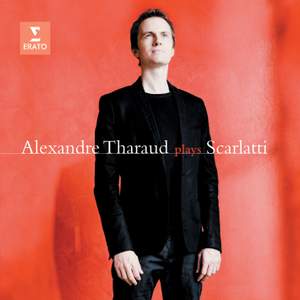
All recordingsPrices shown exclude VAT. (UK tax is not payable for deliveries to United States.) See Terms & Conditions for p&p rates. | |  | Alexandre Tharaud plays Scarlatti
“I love the extravagance, the sunny glow, the light touch of Scarlatti,” says French pianist Alexandre Tharaud, whose second Virgin Classics release is a collection of the composer’s captivating and adventurous keyboard sonatas. His first release, the Chopin recital Journal intime was described by The Guardian as “altogether breathtakingly beautiful”. “Listening to Mr. Tharaud's crisply articulated and vividly etched playing, a listener might guess that he is a Baroque specialist who, for some reason, prefers the modern piano to the harpsichord. But … Baroque music is only one of his interests,” wrote the New York Times in 2005. In typically imaginative fashion, Tharaud combined early Romanticism with the Baroque over the 2009-10 season when he toured a recital programme of works by Chopin – the subject of Virgin Classics release, Journal intime – and selections from Domenico Scarlatti’s canon of 555 keyboard sonatas. “I love the extravagance, the sunny glow, the light touch of Scarlatti, who shares with Chopin a precise sense for ornamentation, a culture of beauty in sound and an intimate rapport with the audience,” he says. Tharaud’s previous exploration of the Baroque repertoire has focused on composers such as Couperin and Rameau, whose music is rarely heard on the modern piano. The tradition of Scarlatti on the piano is much more firmly established – Vladimir Horowitz, for instance, would often include his music in recitals – but Tharaud draws inspiration from developments in historically informed performance over the past 30 years. As he told the French magazine Télérama: “I am not sure that authenticity is conferred by a specific instrument, but rather in the way new life is imbued into this music … Baroque musicians have taught us to approach tempi and ornamentation with a sense of freedom, even audacity.” Scarlatti, born in Naples, spent more than 30 years of his life serving the royal families of Portugal and Spain and died in Madrid. His sonatas are concise, captivating one-movement works in binary form, often adventurous in their use of harmony and modulation, and frequently inhabited by the exotic spirit of Iberian folk music. “Whether on a broad canvas or on a miniature one, Tharaud’s feel for tonal colouring and his eloquence of expression are a perfect match for this inspiring, kaleidoscopic music.” That praise from the Daily Telegraph could almost apply to works by Scarlatti, but in fact came from a review of Tharaud’s Chopin album, Journal intime. More specific in its frame of reference was The Guardian’s comment on the Chopin disc: “Alexandre Tharaud explores a huge emotional range in his Journal intime, including the most thrilling and propulsive first ballade since Michelangeli's version, with a deeply intense C sharp minor nocturne at the heart. Tharaud lifts the music across the bar-lines with deft rubato, his sound clear, shining and sensuous; altogether breathtakingly beautiful.” “Tharaud's attention to musical detail is, as ever, combined with total spontaneity. The recorded sound adds warmth and this is a wonderfully original reimagining of repertory and instrument.” The Observer, 30th January 2011 “The biggest surprise on this wonderfully exuberant and exhilarating disc comes with the very first notes: the piano tone is rich and full...There's never a dull moment, and Tharaud's range of touch and colour, and his sheer enthusiasm, shine through every jewel-like piece.” The Guardian, 3rd February 2011 ***** “The fact that Scarlatti used the same two-part structural template for all his sonatas is camouflaged by his vast imaginative range, a fertile mind that Tharaud taps and illuminates absorbingly in this recital...The diversity is captivating and Tharaud is a consummate master of it.” The Telegraph, 11th February 2011 ***** “if Tharaud is evidently aware of the stylistic insights afforded by the scholarly diggings of the past few decades, he's unrepentantly pianistic in his approach...Tharaud's is playing with personality, revelling in Scarlatti's playful inventiveness and pungent harmonic daring.” BBC Music Magazine, March 2011 ***** “The range is extraordinary, from the almost casual, plaintive charm of the K132, with its elegant trills and thoughtful progressions, to the dashing Iberian brilliance of the K420, and the more virtuosic manner of the K72 - three wildly differing explorations of the key of C major, handled with a deft, easy grace and an appropriate dash of wit.” The Independent, 18th February 2011 **** “Tharaud’s choices make for an exhilarating rollercoaster ride between dizzying feats of heady bravura and more gentle moments where introspection and quasi-operatic cantabile playing are required...The playing and musicianship of this young Frenchman are dazzling throughout.” Sunday Times, 27th February 2011 ***** “Tharaud commands an impressive range of timbres and articulations with a crisp technique which enables him to express melodic tenderness as tellingly as hard-edged brilliance and clarity.” Gramophone Magazine, April 2011 “The tipsy downward flourishes which interrupt the singing line of K132 suggest Tharaud improvising dreamily in a tapas bar. Best of all is the tiny two-minute aria which forms K32, a gorgeous moment of calm which hints at what Bach’s keyboard music might have sounded like had he lived in warmer climes. The close-up recording adds to the fun.” Graham Rickson, The Arts Desk, 7th May 2011 BBC Music Magazine
Instrumental Choice - March 2011 |
| | | In stock - usually despatched within 1 working day. |
|
|
| |  | Volumes 70 & 71 of the Glenn Gould Complete Jacket CollectionThe Glenn Gould Silver Jubilee Album
| | A Glenn Gould Fantasy | Bach, C P E: | Keyboard Sonata Wq 49/1 (H30) in A minor 'Württemberg Sonata No. 1' | Gould, G: | So You Want to Write a Fugue
Juilliard String Quartet | Scarlatti, D: | Keyboard Sonata K430 in D major Keyboard Sonata K9 in D minor Keyboard Sonata K13 in G major | Scriabin: | Two Pieces, Op. 57 | Strauss, R: | Wie erkenn' ich mein Treulich vor andern nun?, Op. 67, No. 1 Guten Morgen 's ist Sankt Valentinstag, Op. 67, No. 2 Sie trugen ihn auf der Bahre bloss, Op. 67, No. 3 |
The Canadian musician Glenn Gould was undoubtedly one of the greatest pianists of all time. To mark the 75th anniversary of his birth, and the 25th anniversary of his death, Sony BMG Masterworks presents this seminal artist’s vinyl recordings as re-mastered CDs, designed to replicate the exact artwork of the original gramophone records in miniaturised form. Already issued as part of an 80-CD box set (88697130942), these albums are now being made available individually. | | | In stock - usually despatched within 1 working day. |
|
|
| |  | Glenn Gould plays Renaissance & Baroque Music
| | | This item is currently out of stock at the UK distributor. You may order it now but please be aware that it may be six weeks or more before it can be despatched. |
|
|
| |  | Conversazioni I: Cantatas from a Cardinal’s Court
Andrew Radley (countertenor) & Julian Perkins (harpsichord / director) Sounds Baroque Rising star countertenor Andrew Radley with harpsichord virtuoso Julian Perkins and his period instrument ensemble Sounds Baroque, mirror the conversazione, or musical gatherings, of 17th and 18th century Italy with a programme of dramatic cantatas and magical instrumental works. In the late 17th century, all roads really did lead to Rome for the aspiring musician. There, wealthy aristocrats-turned-priests and Catholic nobility from across Europe vied for cultural status through artistic patronage. In particular, the young Pietro Ottoboni (1667–1740) reigned supreme among patrons of music, supporting among others Caldara and Albinoni, Alessandro Scarlatti and his son Domenico, and Handel, all of whom inspired and were inspired by one another. Musical gatherings of the time – called conversazione – often featured dramatic cantatas as well as virtuoso instrumental showpieces such as the works featured on this album. Recalling this fertile musical era, rising star countertenor Andrew Radley with Julian Perkins and his London-based period instrument ensemble Sounds Baroque, dispatch these entertaining vocal works with aplomb, interspersed with virtuosic harpsichord works performed to perfection by Perkins. With this, the first in a series of conversazione recordings, Sounds Baroque celebrates the passion, theatricality and sheer variety of music from the 17th and 18th centuries. “This debut disc from Sounds Baroque draws up a ringside seat and delves into the lovelorn world of the secular dramatic cantata with compelling specimens by Caldara and Alessandro Scarlatti...With delightfully expressive woodwind 'conversations' topping and tailing the disc, classy continuo, and deftly imaginative programming, Sounds Baroque proves a stylish ornament to the most discerning Cardinal's Court. Roll on Conversazioni Vol. 2!” BBC Music Magazine, November 2011 **** “There's a seductive tonal warmth (sometimes too seductive) to his voice. The countertenor does let loose the cutting edge of Handel's Mi palpita il cor...It's hearting to discover yet another group of young musicians, fuelled by intellectual curiosity and a corporate commitment to excellence, with enterprise and genuine flair. Roll on Conversazione II.” Classic FM Magazine, September 2011 **** “Andrew Radley demonstrates tender story-telling skills during the soft "Camminando lei pian piano"...In gentle arias [his] singing has affectionate intimacy and delicacy (such as Caldara's lovely last aria, "Parto mio ben costante"). I look forward to Volume 2.” Gramophone Magazine, October 2011 “Countertenor Andrew Radley is both swoonsome and stately, depending on the material: the somewhat melancholy progress of Albinoni's "Senza il core del mio bene", for instance, befitting a love plaint of such wretched torment, while a more playful involvement suits Handel's "Vedendo Amor", with its tortuous tale of mythic enslavement by Cupid.” The Independent, 15th July 2011 *** | | | Usually despatched in 4 - 5 working days. |
|
|
| |  | D. Scarlatti: Piano Sonatas
Son of Alessandro Scarlatti, Domenico was born in 1685, coincidentally the same year as J.S.Bach and G.F.Handel. He soon made a name for himself as a composer, his works included operas, oratorios, cantatas, masses, fugues and concertos. Perhaps his defining glory was composing 555 sonatas, all being miniature compositions for the keyboard. Marek Drewnowski brings flair and a total understanding of Scarlatti’s music to this fine recording. | | | Usually despatched in 4 - 5 working days. |
|
|
| |  | D. Scarlatti: Keyboard Sonatas
| | | Usually despatched in 4 - 5 working days. |
|
|
| |  | Scarlatti - Highlights from the 'Complete Sonatas'48 Favourite Sonatas
| | | Usually despatched in 4 - 5 working days. |
|
|
| |  | Volume 1 - Scarlatti & Bartók
At first sight, they appear to have nothing in common - but disregarding the stylistic elements and a difference of two centuries, you soon recognize that both Scarlatti and Bartók, are in a sense, musical architects, who as piano virtuosos were equally interested in miniature forms and inspired by folk music. Inspired by an 18th century performance practice, where two different character pieces were executed opposite each other in pairs in contrast with each other, I experimented in both the concert hall and the recording studio with the series of pieces on this CD. I found out quickly that I heard, experienced and played both Scarlatti and Bartók’s work ‘differently’ when they were executed alternately - as if discovering hidden secrets in familiar works! This realization led to a new and fresh perspective on the style and rubato and reconsideration of rhythmic, melodic and dynamic elements. (Dejan Lazic, liner notes) “An exciting idea this…and it works! After all, Bartók greatly admired Scarlatti: he even recorded a couple of his sonatas. Both composers were innovators and combined a strong feeling for rhythm with an audacious sense of harmony. Dejan Lazic wastes no time in establishing his credentials as a Scarlatti player. He opens the programme with a somewhat militaristic-sounding C major piece, K420, and already it's all there – the light, resilient touch, the crisp (and often free) approach to rhythm, nimble passage- Bartók Orchestral 113 work and an obvious appreciation of subsidiary material. The last of that particular Scarlatti trio, a filigree piece in F, segues beautifully with the first of Bartók's Three Rondos on Slovak Folktunes (in C), the principal common denominator here, as so often elsewhere, the dance element. Lazic has a very individual Bartók style; he's no literalist, as illustrated by his emphatic handling of the syncopated main motif of the last Rondo. Again the segue from Bartók (third Rondo) to Scarlatti (the processional D major Sonata, K491) is imaginative, though the switch from the gaily skipping D major Sonata (K159) to the first of Bartók's haunting Seven Sketches is more surprising. Lazic personalises the sequence in a most compelling way. He then gently breaks their spell with Scarlatti's D minor ('Pastoral') and interestingly sandwiches a dramatic piano version (Bartók's own) of the Kossuth Funeral March between lively sonatas in F major and A minor. Perhaps the most effective segue finds the flamenco strumming of Scarlatti's K135 (E major) acting as a prelude to the first of six Dances in Bulgarian Rhythm which conclude Bartók's Mikrokosmos. Here Lazic underlines the individual character of each dance, tenderising the fourth (a tribute to Gershwin) with expressive arpeggios, and focusing the fifth's dizzying rhythmic ambiguities. You reach the journey's end eager to start all over again – or maybe work out another Scarlatti- Bartók sequence. The potential is limitless and let's hope that that this first volume of a series called 'Liaisons' doesn't preclude a second Scarlatti-Bartók sequence.” Gramophone Classical Music Guide, 2010 “Imaginative fantasy, whole-hearted expressiveness, compelling, dramatic performance, playing of real individuality.” Gramophone Magazine “An exciting idea this… and it works! After all, Bartók greatly admired Scarlatti: he even recorded a couple of his sonatas. Both composers were innovators and combined a strong feeling for rhythm with an audacious sense of harmony.” Gramophone Magazine, April 2008 | | | Usually despatched in 4 - 5 working days. |
|
|
| |  | Scarlatti - Complete Keyboard Sonatas Volume 1
Eteri Andjaparidze (piano) | | | (also available to download from $6.00) | Usually despatched in 2 - 3 working days. (Available now to download.) |
|
|
| |
|