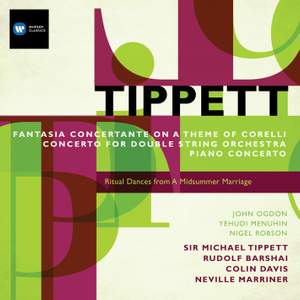
All recordingsPrices shown exclude VAT. (UK tax is not payable for deliveries to United States.) See Terms & Conditions for p&p rates. | |  | Tippett: Fantasia Concertante on a Theme of Corelli
Sir Michael Tippett (1905-1998) is regarded, along with Benjamin Britten, as one of the most important British composers of the 20th century. He was well-known for his atheist, humanitarian and pacifist beliefs which, during the Second World War, caused him to serve a term in prison as a conscientious objector. He was also one of the first openly gay composers and quite politically active: all qualities of his personality that are reflected in his work. The earliest work in this set is the Concerto for double string orchestra which was one of Tippett's first successes and one of his most popular works. The years 1945-59, from which most of the works in this set come, might be regarded as the composer's middle-period, a time of great success and critical denigration: the opera The Midsummer Marriage attracted particular criticism, more for its obscure libretto (written by Tippett himself) than the music itself, which is among some of his finest. John Odgon's performance of the 1955 Piano Concerto is, arguably, the definitive performance of this work and is a fine tribute to a great pianist. | | | In stock - usually despatched within 1 working day. |
|
|
| |  | Tippett - Orchestra Works
“Three memorable classics: Yehudi Menuhin leads the Fantasia concertante, and in the Piano Concerto, Ogdon is both powerful and reflective. Clear, rather bass-light recorded sound.” BBC Music Magazine, June 2009 **** | | | In stock - usually despatched within 1 working day. |
|
|
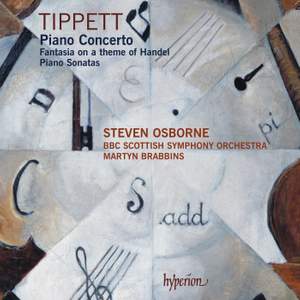
| |  | Tippett - The complete music for piano
“Osborne is superb at delineating the characters of the four sonatas and underlining how, in their very different ways, they relate to the piano tradition … under his fingers the Second Sonata emerges as a gritty and uncompromising masterpiece … his account of the Piano Concerto with Martyn Brabbins and the BBC Scottish Symphony is similarly charged” The Guardian “This double album is a monumental achievement. Tippett’s writing for piano is as demanding as it is cliché-resistant. No body of music for the instrument since Messiaen’s is as distinctive as his and it is wonderful to have the oeuvre together on disc. The concerto is realised with a precision and vigour, both soloistic and orchestral, that leave one marvelling anew at its inventiveness. The account of the brief, early, concerted Fantasia on a theme of Handel makes me revise my opinion of the work sharply upwards. In Osborne’s account of the four sonatas, each a big statement, radiance and virtuosity go hand in hand” Sunday Times “This splendid double album… assembles all Tippett's music for piano whether solo of with orchestra, in performances that impressively set new standards in these often challenging works.” BBC Music Magazine, January 2008 ***** “Most powerful of all is the mighty Concerto… the eloquence and fantasy of what is undoubtedly one of the major works of the 1950s is superbly projected in a performance which need fear no comparison with the best earlier recordings… As for the sonatas, Steven Osborne is at least the equal of Paul Crossley... in interpretative empathy, and has the advantage of superlative modern recording.” Gramophone Magazine, December 2007 “The young Tippett – magpie and maverick – sought maximum intensity of feeling while shunning what he felt to be the sentimental fervour of Elgar, Bax and Walton. Equally abhorrent were the pastoral pieties of Vaughan Williams. Tippett took his stand with Blake and Yeats rather than Bunyan, and a Blake whose 'bow of burning gold' required something altogether less complacent than Parry's well upholstered jingoism. The results are plain to hear in Tippett's earliest works for piano, the First Sonata and the Handel Fantasia. The slow movement of the sonata may flirt briefly with Hindemith-style counterpoint but the predominant spirit is fiery and spontaneous, with a reinvigorated romanticism embracing those aspects of popular music which Tippett believed to have 'classical' potential. The road ahead was bumpy and he occasionally lost his way, as in the very long slow movement of the Third Sonata, aspiring to Beethovenian depth but bogged down in overly dense textures. There are also several repetitions too many in the Fourth Sonata, though the final movement's gently poetic sense of resignation more than compensates. Most powerful of all is the mighty Concerto, starkly and confidently poised between Tippett's still richly potent earlier style and the brave new possibilities explored in its visionary central movement. This recording blends the piano in with the orchestra, acknowledging the work's symphonic attributes, and there is a certain recessed quality to the sound of the piece throughout. Nevertheless, the eloquence and fantasy of what is undoubtedly one of the major works of the 1950s is superbly projected in a performance which need fear no comparison with the best earlier recordings. As for the sonatas, Steven Osborne is at least the equal of Paul Crossley (CRD) in interpretative empathy, and has the advantage of superlative modern recording. There's a further advantage: perceptive and lucid booklet-notes by Ian Kemp, Tippett's friend and biographer, and one of Osborne's mentors. The set is dedicated to him.” Gramophone Classical Music Guide, 2010 “This is full-blooded, dramatic, joyful music. Steven Osborne makes the works his own, dealing with their considerable technical difficulties with ease and aplomb...Under his fingers, the piano glitters and glides through the multi-faceted concerto with luminosity and depth, and his playing is perfectly matched by the BBC Scottish Symphony Orchestra under Martyn Brabbins.” Charlotte Gardner, bbc.co.uk, 8th January 2008 CD Review
Critics Disc of the Year - December 2007 |
BBC Music Magazine
Instrumental Choice - January 2008 |
| | | In stock - usually despatched within 1 working day. |
|
|
| |  |
| | | (also available to download from $10.75) | In stock - usually despatched within 1 working day. |
|
|
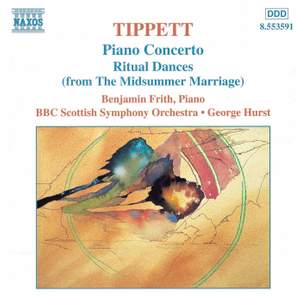
| |  |
“This is a highly desirable budget-priced Naxos release of two of the late Sir Michael Tippett's most well-loved works. The Ritual Dances adds up to a sizeable chunk of his first opera, the Midsummer Marriage, full of resonances of the countryside and the seasons, with darker overtones of birth, life and death (yes, almost a Rite of Spring, and almost as long). Their performance here from the BBC Scottish Symphony Orchestra under George Hurst is thrusting and colourful, with some wonderful woodwind solos. Breathing the same luminous, magical soundworld is Tippett's Piano Concerto of a few years later. Soloist in this finely-detailed, gently glowing account is Benjamin Frith.” Birmingham Post | | | (also available to download from $6.00) | In stock - usually despatched within 1 working day. |
|
|
| |  | Tippett - Orchestral Works
Its (Nimbus's) commitment to preserving the composer's own readings of his music during his lifetime was noble, assiduous and beyond reproach … The achievement………….. A panoramic view of his output ……………… is such as to renew our sense of Tippett's greatness and his lasting historical presence, and the sheer glory of his music.’ (BBC Music Magazine) of 4 CD box set | | | Usually despatched in 8 - 10 working days. |
|
|
| |  |
| | | (also available to download from $10.75) | Usually despatched in 2 - 3 working days. (Available now to download.) |
|
|
| |  | Tippett conducts Tippett
| | | Usually despatched in 4 - 5 working days. |
|
|
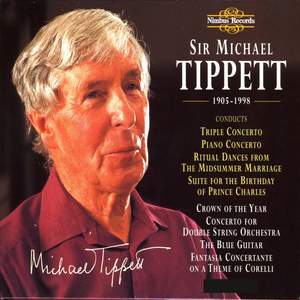
| |  | Sir Michael Tippett, 1905-1998: The Nimbus Recordings
Martino Tirimo (piano), Ernst Kovacic (violin), Gerard Caussé (viola), Alexander Baillie (cello), Craig Ogden (guitar) Chorus of Opera North, English Northern Philharmonia, BBC Philharmonic, Christ Church Cathedral Choir, Medici String Quartet, English String Orchestra, St. John's College Choir, Cambridge, Michael Tippett, William Boughton, George Guest “[Nimbus'] commitment to preserving the composer's own readings of his music during his lifetime was noble, assiduous and beyond reproach ... The achievement, as revealed on this four-CD collection, a panoramic view of his output lasting in all nearly four and a half hours, is such as to renew our sense of Tippett's greatness and his lasting historical presence, and the sheer glory of his music.” BBC Music Magazine | | | Usually despatched in 4 - 5 working days. |
|
|
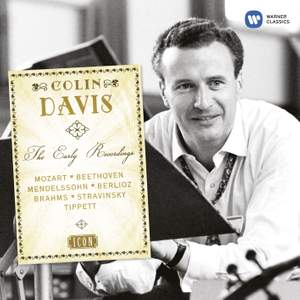
| |  | Sir Colin Davis: His Early Recordings1959-1963
Beethoven: | Symphony No. 7 in A major, Op. 92 Royal Philharmonic Orchestra Leonore Overture No. 3, Op. 72b Sinfonia of London | Berlioz: | Harold en Italie, Op. 16 Yehudi Menuhin (viola) Philharmonia Orchestra | Brahms: | Variations on a theme by Haydn for orchestra, Op. 56a 'St Anthony Variations' Sinfonia of London | Mendelssohn: | Hebrides Overture, Op. 26 Sinfonia of London | Mozart: | Symphony No. 29 in A major, K201 Sinfonia of London Symphony No. 34 in C major, K338 Sinfonia of London Symphony No. 39 in E flat major, K543 Sinfonia of London Oboe Concerto In C major, K314 Léon Goossens (oboe) Sinfonia of London Serenade No. 13 in G major, K525 'Eine kleine Nachtmusik' Philharmonia Orchestra German Dances (3), K605 Philharmonia Orchestra Serenade No. 6 in D major, K239 'Serenata Notturna' Philharmonia Orchestra La finta giardiniera, K196: Overture Royal Philharmonic Orchestra Idomeneo, K366: Overture Royal Philharmonic Orchestra Die Entführung aus dem Serail, K384: Overture Royal Philharmonic Orchestra Der Schauspieldirektor, K486: Overture Royal Philharmonic Orchestra Le nozze di Figaro, K492: Overture Royal Philharmonic Orchestra Don Giovanni, K527: Overture Royal Philharmonic Orchestra Così fan tutte, K588: Overture Royal Philharmonic Orchestra Die Zauberflöte, K620: Overture Royal Philharmonic Orchestra La clemenza di Tito, K621: Overture Royal Philharmonic Orchestra | Rossini: | Il Signor Bruschino Overture Royal Philharmonic Orchestra L'Italiana in Algeri Overture Royal Philharmonic Orchestra La gazza ladra Overture Royal Philharmonic Orchestra Semiramide Overture Royal Philharmonic Orchestra Guillaume Tell Overture Royal Philharmonic Orchestra | Stravinsky: | Oedipus Rex Sir Ralph Richardson (Speaker), Ronald Dowd (Oedipus), Raimund Herincx (Creon), Harold Blackburn (Tiresias), Patricia Johnson (Jocasta), Raimund Herincx (Messenger) & Alberto Remedios (Shepherd) Sadler’s Wells Opera Chorus (men’s voices) & Royal Philharmonic Orchestra | Tippett: | Piano Concerto John Ogdon (piano) Philharmonia Orchestra | Wagner: | Siegfried Idyll Sinfonia of London |
Sir Colin Davis was born on 25th September, 1927 in Weybridge and hence this year he celebrates his 85th birthday. His instrument was the Clarinet which he studied at the Royal College of Music and was a bandsman in the Household Cavalry. His inability to play the piano hindered his wish to be a conductor as he was refused entry into the RCM conducting class as well as an apprenticeship in opera houses. He gained experience informally with a group of RCM students and in his early 20’s his Mozart performances with the Chelsea Opera Group marked him out for potential greatness. At the age of 30 he was appointed assistant conductor of the BBC Scottish Orchestra and two years later an indisposed Otto Klemperer allowed him the opportunity to conduct Don Giovanni at the Festival Hall. This year, 1959 also marks his recording debut – appropriately in Mozart. In 1960 he replaced an ill Beecham at Glyndebourne in Die Zauberflöte and the following year he was appointed musical director of Sadler’s Wells Opera where he added success in Stravinsky, notably Oedipus Rex, to his Mozart and introduced the music of Weill and Janácek to British audiences. It was during this period that the solo orchestral recordings together with Oedipus Rex were made; the Berlioz and Tippett concerto recordings were made in 1962 and 1963 respectively. By 1964 he was in increasing demand for orchestral concerts and he left Sadler’s Wells. Two years later he made his Metropolitan Opera debut with Peter Grimes and in 1967 started his four year tenure as principal conductor of the BBC Symphony Orchestra where he became a hero to the younger members of the Prom audience for his adventurous programming. Following his successes at the Royal Opera, where he made in debut in 1965 (he had conducted the Royal Ballet five years previously), he succeeded Solti as musical director in 1971. He was knighted in 1980. | | | In stock - usually despatched within 1 working day. |
|
|
| |
|