All recordingsPrices shown exclude VAT. (UK tax is not payable for deliveries to United States.) See Terms & Conditions for p&p rates. | |  | Wilhelm Backhaus: The Virtuoso (1908-1940)
Albéniz: | Triana (from Iberia, book 2) | Brahms: | Variations on an Original Theme in D major, Op. 21, No. 1 Variations on a theme by Paganini in A minor, Op. 35 | Chopin: | Piano Concerto No. 1 in E minor Op. 11: Romance Impromptu No. 4 in C sharp minor, Op. 66 'Fantaisie-Impromptu' Berceuse in D flat major, Op. 57 Waltz No. 6 in D flat major, Op. 64 No. 1 'Minute Waltz' | Delibes: | Naila: Waltz | Kreisler: | Liebesleid | Liszt: | La leggierezza - Étude de concert No. 2, S144 A Midsummer Night’s Dream: Wedding March & Dance of the Fairies (after Mendelssohn), S410 Liebestraum, S541 No. 3 (Nocturne in A flat major) Hungarian Rhapsody, S244 No. 2 in C sharp minor Waldesrauschen, S145 No. 1 | Mendelssohn: | A Midsummer Night's Dream: Scherzo | Moszkowski: | Caprice espagnole, Op. 37 | Mozart: | Piano Concerto No. 26 in D major, K537 'Coronation' Deh! vieni alla finestra (from Don Giovanni) | Pick-Mangiagalli: | La Danza di Olaf | Rachmaninov: | Prelude Op. 3 No. 2 in C sharp minor | Schubert: | Marche Militaire, D733 No. 1 | Strauss, R: | Ständchen, Op. 17 No. 2 | Weber: | Piano Concerto No. 1 in C major, J. 98, Op. 11: Rondo - moto perpetuo |
Wilhelm Backhaus (piano, piano-roll) Berlin Municipal Orchestra, Berlin Stadtischen Opera Orchestra, Fritz Zaun This CD showcases Backhaus’s great virtuosity. “revelatory: instead of the stern Beethovenian we are used to, the young pianist who emerges courtesy of piano-roll recordings from the 1920s is full of fire and flamboyance.” BBC Music Magazine, February 2013 ***** | 
| | | (also available to download from $21.25) | In stock - usually despatched within 1 working day. |
|
|
| |  | A Liszt Recital
Vanessa Benelli Mosell (piano) The second album of Vanessa Benelli Mosell, one of the most exciting pianists of the younger generation, contains a selection of works which Liszt regularly performed himself during his piano recitals (the piano recital itself, being a showcase for one artist only, was invented by Liszt). The works share a quality to impress the audience, whether through hair-raising pyrotechnics (Hungarian Rhapsodies, Grand Galop Chromatique), or heartfelt sentiment (Liebestraum). Vanessa’s first album (Brilliant Classics 94209) was met with great enthusiasm from the international press.The Gramophone wrote: “Prodigious playing that combines the blazing virtuosic demand and her natural musical insight…great panache… sparkling technique in demanding music…she leaves no doubt of her enviable facility”. New recording, newly written liner notes. A second disc from the brilliant young Italian pianist brings a focus on the 19th century lion of piano music whose anniversary was celebrated last year. The first Brilliant Classics disc from Vanessa Benelli Mosell included music by Prokofiev and Scriabin: a test for even the most engulfing virtuoso. "Sparkling technique in demanding music", "She leaves no doubt of her enviable facility through out this, her ultra-demanding debut album", "Dextrous and cool-headed, she launches into Prokofiev's Seventh Sonata at a cracking pace...she is off like a rocket in the drum-beat 7/8 Precipitato finale, remarkably maintaining her impetus in the ever-widening leaps of the closing pages." Gramophone, November 2011 This new Liszt disc is structured after the fashion of a recital such as the composer himself might have given; with shorter and lighter items sprinkled among unabashed showpieces, and in the centre, an exploration of the composer’s complex relationship with his homeland expressed through native melodies and dances transmuted into new forms through the fantasymedium of the Hungarian Rhaposody. To finish, the fireworks of the Grand galop chromatique, beloved of Cziffra, Bolet and others in whose pianistic footsteps Vanessa Benelli Mosell dances with abandon. “While 'La leggierezza' is technically sound but musically square, the four Hungarian Rhapsodies stand out for Mosell's stylish bravura; she clearly enjoys showing off her supple octave technique in No. 6...Keep this one for the Rhapsodies.” Gramophone Magazine, February 2013 “Pianistically, this recording is every bit as thrilling as the first...dazzling with her technique and surprising with her emotional maturity...There is no call for much in the way of pathos in her programme...when it comes to virtuosity, sensibility, panache, however, she has what it takes. Her articulation in particular is outstanding, with every note - Liszt permitting! - clean and precise.” MusicWeb International, December 2012 | | | In stock - usually despatched within 1 working day. |
|
|
| |  | Liszt: Favourite Pieces
Liszt: | Grande Étude de Paganini, S. 141 No. 3 'La Campanella' Romance oubliée, for piano, S. 527 Gnomenreigen, S145 No. 2 Un Sospiro from 3 Concert Studies, S144 No. 3 Rhapsodie espagnole, S254 Liebestraum, S541 No. 3 (Nocturne in A flat major) Mephisto Waltz No. 1 Consolation, S. 172 No. 3 in D flat major Rakoczi March, S242a/1 (first version, 1839/40) Nuages gris, S199 Valse oubliée No. 1, S.215/1 La leggierezza - Étude de concert No. 2, S144 La Lugubre Gondola II, S200 No. 2 Étude d'exécution transcendante d'après Paganini, S. 140 No. 6 Les Préludes, symphonic poem No. 3, S97 Totentanz, S126 for piano & orchestra Orpheus, symphonic poem No. 4, S98 Mazeppa, symphonic poem No. 6, S100 Piano Concerto No. 1 in E flat major, S124 |
Emanuel Ax, Jorge Bolet, van Cliburn, Barry Douglas, Vladimir Horowitz, Stephen Hough, Byron Janis, Evgeny Kissin, Arcadi Volodos, Andre Watts Berliner Philharmoniker, Boston Pops Orchestra, Chicago Symphony Orchestra, New York Philharmonic Orchestra, Philharmonia Orchestra, Leonard Bernstein, Arthur Fiedler, Zubin Mehta, Fritz Reiner, Esa-Pekka Salonen | | | In stock - usually despatched within 1 working day. |
|
|
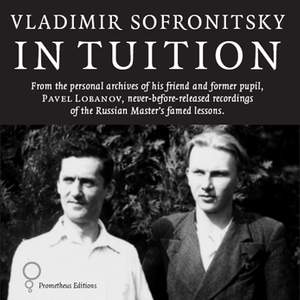
| |  | Vladimir Sofronitsky in TuitionFrom the personal archives of his friend and former pupil, Pavel Lobanov, never-before-released recordings of the Russian Master's famed lessons
Debussy: | Reflets dans l'eau (No. 1 from Images pour piano - Book 1) Recorded 1954 | Liszt: | La leggierezza - Étude de concert No. 2, S144 Recorded 1954 | Mendelssohn: | Etude in A Minor Op. 104b Recorded 1954 | Schumann: | Carnaval, Op. 9 Recorded 4th March 1947 | Scriabin: | Prelude, Op. 11 No. 4 in E minor Lesson: 2nd October 1954 Prelude, Op. 11 No. 5 in D major Lesson: 2nd October 1954 Poème in F sharp major, Op. 32 No. 1 Lesson: 2nd October 1954 Prelude, Op. 22 No. 1 in G sharp minor Recorded 21st September 1954 Prelude, Op. 11 No. 4 in E minor Recorded 21st September 1954 Mazurka in E minor, Op. 25 No. 3 Recorded 21st September 1954 Prelude, Op. 22 No. 3 in B minor Recorded 21st September 1954 (first few notes missing, with first bar of Op. 22 No. 4 following) Prelude, Op. 13 No. 6 in B minor Recorded 4th March 1947 Piano Sonata No. 9, Op. 68 'Black Mass' Recorded 1954 |
Vladimir Sofronitsky (piano/teacher), Pavel Lobanov (pupil) This CD brings over twenty-five minutes of Sofronitsky's teaching of three of Scriabin’s pieces as well as performances of four Scriabin pieces, all recorded privately at his Moscow apartment in 1954. The lessons are meticulously indexed with carefully labelled translations in the booklet. There's also a selection of private and live recordings from 1947 and 1954 of works by Scriabin, Schumann, Liszt, Debussy and Mendelssohn. WARNING: Although sonically challenged, these recordings have been available due to their profound historical significance. Also, the relatively extreme length [79.57] of this CD may cause reading problems in some early model players. “A fascinating glimpse into the teaching methods of a Russian master pianist...Sofronitsky’s charisma, the fascination he held for so many musicians...shine[s] through...Sofronitsky’s spontaneity and vitality can be enchanting; never more so than in the final section of ‘Promenade’ from Carnaval where Schumann leaves his dancing magic and glides into reverie.” Gramophone Magazine, October 2002 “The recording is primitive, but his points are all clearly caught, usually reinforced by demonstrations, and his unclichéing of his pupils' playing is meticulously indexed with carefully labelled translations in the booklet.” Irish Times, 29th August 2002 | | | In stock - usually despatched within 1 working day. |
|
|
| |  | Solomon plays Schumann and Brahms
“Solomon's 1952 recordings of Schumann's Carnaval and the Brahms Sonata in F minor are essential for the desert island, so this wellproduced compilation, generously filled out with Liszt, recommends itself. If you've heard tell of Solomon's reputation but don't know his work, or perhaps know only his Beethoven, snap it up. The sound has come up astonishingly well, also in the Liszt pieces which were made in 1930 and 1932. Solomon's performance of 'Au bord d'une source' is a match for Liszt's poetic inspiration, as few recordings of it are. Technical address and refinement on this level constitute a small miracle.” Gramophone Classical Music Guide, 2010 | | | In stock - usually despatched within 1 working day. |
|
|
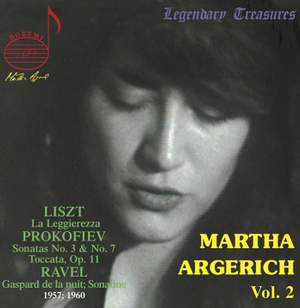
| |  | The Young Martha Argerich Vol. 2
The outstanding Argentinian pianist Martha Argerich recorded these concertos in Switzerland in 1959, when she was only 18 years old. This CD also includes a 1957 perfomance of Liszt’s Etude de concert No.2 “La leggierezza” | | | Usually despatched in 2 - 3 working days. |
|
|
| |  | Earl Wild plays Don Juan Fantasy, Mephisto Waltz & Polka & Etudes
Liszt: | La leggierezza - Étude de concert No. 2, S144 Un Sospiro from 3 Concert Studies, S144 No. 3 Funérailles (Harmonies poétiques et religieuses, S. 173 No. 7) Transcendental Study, S139 No. 9 'Ricordanza' Transcendental Study, S139 No. 3 'Paysage' Hungarian Rhapsody, S244 No. 4 in E flat major Sonetto 47 del Petrarca (Années de pèlerinage II, S. 161 No. 4) Sonetto 123 del Petrarca (Années de pèlerinage II, S. 161 No. 6) Mephisto Waltz No. 1 Valse oubliée No. 1, S.215/1 Grande Étude de Paganini, S. 141 No. 2 Grande Étude de Paganini, S. 141 No. 5 'La Chasse' Grande Étude de Paganini, S. 141 No. 3 'La Campanella' Réminiscences de ‘Robert le Diable’ de Meyerbeer: Valse infernale Gnomenreigen, S145 No. 2 Mephisto Polka, S217 Réminiscences de "Don Juan" (after Mozart), S. 418 Faust (Gounod)_Waltz |
Earl Wild’s death in 2010 was a farewell to one of the greatest pianists from the Golden Age of the Piano. His career spanned the biggest part of the 20th Century (more than 80 years), and he played with such legendary conductors as Toscanini, Reiner, Horenstein, Mitropoulos, Klemperer, Ormandy, Dorati and Solti. A dazzling virtuoso, he made the music of Liszt a central point in his repertoire. His performances of Gnomenreigen, La Leggierezza or the Mephisto Waltz were legendary. This 2-CD set offers some of the finest Liszt playing on disc. CD 1 was issued on Vanguard Classics as “The Demonic Liszt” and shows the devilish side of Liszt, the multifaceted genius. The second CD contains live recordings from different periods, red-hot performances of great brilliance and passion. | | | Usually despatched in 2 - 3 working days. |
|
|
| |  | Gülsin Onay plays Liszt, Haydn & Schubert
One of the greatest musical artists of modern Turkey, Gülsin Onay is an exceptional phenomenon, and Sono Luminus is excited to release her latest project, Liszt, Haydn, Schubert. Listeners will marvel at the kaleidoscopic range of colours she can produce from the instrument, with her unique touch in which even the least important, fleeting note has its own special meaning. Gülsin Onay excels both in recital and in concerto, playing alongside many leading orchestras - among them the Philharmonia, Vienna Radio Symphony Orchestra, Berlin Radio Symphony Orchestra, Staatskapelle Dresden, Royal Philharmonic Orchestra, Warsaw Philharmonic, Wiener Symphoniker, the Radio Symphony Orchestras of Copenhagen and Helsinki, Bavarian Radio Symphony Orchestra, Japan Philharmonic, Sinfonia Varsovia, and the St. Petersburg Philharmonic - and conductors such as Vladimir Ashkenzy, Erich Bergel, Michael Boder, Andrey Boreyko, Jörg Faerber, Edward Gardner, Emmanuel Krivine, Ingo Metzmacher, Esa-Pekka Salonen, Jose Serebrier, Vassily Sinaisky and Stanislaw Wislocki. Gülsin Onay also appears as a guest at major festivals around the world, including Berlin, Warsaw, Granada, Mozartfest Würzburg, Newport, Miami, Schleswig-Holstein and Istanbul. A natural soloist, Gülsin Onay is equally at home with music of all periods and styles: her repertoire ranges from Bach and Scarlatti to the contemporary, taking in the great classical and romantic works of the 19th and 20th centuries. She has championed the music of the contemporary Turkish composer A. Adnan Saygun, whose 2nd Piano Concerto was dedicated to her. Other contemporary composers who have dedicated works to Gülsin Onay are Hubert Stuppner, Denis Dufour, Jean-Louis Petit, Muhiddin Dürrüoglu-Demiriz and Marc-André Hamelin. Her recordings illustrate the breadth of her repertoire: concertos by Mozart, Chopin, Tchaikovsky, Rachmaninov, and Stuppner, and both concertos by Saygun; solo music by Haydn, Beethoven, Schubert, Mendelssohn, Schumann, Chopin, Debussy, Franck, Medtner, Ravel, Bartók, Busoni and Saygun; and two live concert DVDs, featuring a critically-acclaimed recital at the Miami festival, and concertos by Grieg and Saint-Saëns. Forthcoming releases include the concertos by Khachaturian and Ulvi Cemal Erkin, with Jose Serebrier and the Bilkent Symphony Orchestra. | | | (also available to download from $10.50) | Usually despatched in 2 - 3 working days. (Available now to download.) |
|
|
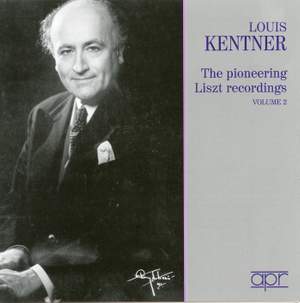
| |  | Louis Kentner - The Pioneering Liszt Recordings Volume 2
Liszt: | Soirées de Vienne: valse-caprice No. 6 (after Schubert), D427 No. 6 recorded on 17 July 1939 Grande Étude de Paganini, S. 141 No. 3 'La Campanella' recorded on 9 & 13 September 1946 Grande Étude de Paganini, S. 141 No. 2 recorded on 27 January 1942 Grande Étude de Paganini, S. 141 No. 5 'La Chasse' recorded on 9 & 13 September 1946 La leggierezza - Étude de concert No. 2, S144 recorded on 10 July 1939 Gnomenreigen, S145 No. 2 recorded on 3 September 1941 Liebestraum, S541 No. 3 (Nocturne in A flat major) recorded on 3 September 1941 Transcendental Study, S139 No. 5 'Feux Follets' recorded on 23 March 1937 Gondoliera, S. 162 No. 1 (from Venezia e Napoli) recorded on 30 March 1938 Tarantella, S. 162 No. 3 (from Venezia e Napoli) recorded on 30 March 1938 Richard Wagner - Venezia, S201 recorded on 10 November 1951 En rêve - Nocturne S207 recorded on 10 November 1951 Csárdás macabre, S. 224 recorded on 10 November 1951 Illustrations du Prophète: No. 2 Les Patineurs—scherzo (Meyerbeer) recorded on 7 March 1939 |
Though Hungarian by birth, and having studied at the Franz Liszt Academy in Budapest, Louis Kentner, like so many others of Jewish origin, immigrated to London in the mid 1930s, aware that central Europe was not the best place to be at that time for someone of his race. He was to remain in London for the rest of his life, becoming very much part of British musical life both as pianist and, later, as teacher. His somewhat sensational London debut took place in the Aeolian Hall in October 1936 where he gave an all Liszt recital. As a direct result he was signed up by HMV and over the next fifteen years, in addition to much other repertoire, he made a large number of Liszt recordings which featured not only the often recorded etudes and Hungarian Rhapsodies but also premiere recordings of many of Liszt's more important, but then less well known, larger works. Our first APR title (APR5514) featured such unusual works as the Scherzo & March, the Berceuse and the first Polonaise; on the current disc, in addition to a number of the well known aforementioned etudes, we find a group of late pieces, including the bizarre Czárdás Macabre, which was only published in the year of its recording, and the Meyerbeer/Liszt 'Les Patineurs' scherzo. This later piece is one of Liszt's most brilliant operatic transcriptions, but is strangely little known. It is perhaps Kentner's most stunning recording and a fitting way to end this fascinating recital. “Kentner, a 'great-grandpupil' of the composer, offers Liszt that is aristocratic and technically exquisite - La leggierezza and La campanella as light as sound itself. Colour and sonority are magically imagined.” BBC Music Magazine, August 2009 ***** “…throughout you will hear playing of a peerless scintillation, patrician command and a poetic engagement known to few pianists.” Gramophone Magazine, October 2009 | | | Usually despatched in 2 - 3 working days. |
|
|
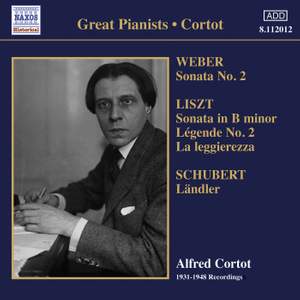
| |  | Alfred Cortot - HMV Recordings 1931-1948
Brahms: | Wiegenlied, Op. 49 No. 4 (Lullaby) (arr. Cortot) Recorded on 20th April 1948, EMI Studio No. 3, Abbey Road, London | Liszt: | Piano Sonata in B minor, S178 Recorded on 13th March 1939, Small Queen’s Hall, London Legende S.175 No. 2, St. Francis of Paola walking on the waves Recorded on 19th May 1937, EMI Studio No. 3, Abbey Road, London; La leggierezza - Étude de concert No. 2, S144 Recorded on 13th May 1931, Small Queen’s Hall, London | Schubert: | Ländler D790 No. 3 Recorded on 19th May 1937, EMI Studio No. 3, Abbey Road, London Litanei auf das Fest Allerseelen, D343 (arr. Cortot) Recorded on 19th May 1937, EMI Studio No. 3, Abbey Road, London | Weber: | Piano Sonata No. 2 in A flat major, Op. 39 Recorded on 10th March 1939 in EMI Studio No. 3, Abbey Road, London |
Alfred Cortot was one of the very greatest pianists of the 20th Century, renowned above all for his intuitive, highly personal interpretations of Romantic masterpieces. Drawn from sessions in London between 1931 and 1948, these recordings include a wonderfully poetic reading of Weber’s introspective and playful Second Piano Sonata, and intense yet subtly nuanced renditions of Liszt’s groundbreaking B minor Sonata, issued almost entirely from first takes, and Légende No. 2. Cortot’s own arrangements imbue Schubert’s Litanei and Brahms’s famous Lullaby with a heartfelt touch. A critic wrote after Cortot’s 5th January 1927 recital at New York’s Aeolian Hall: “He is one of those great musicians from whose readings of familiar works there is almost invariably something to learn and remember… it would be hard to surpass his sincerity, his feeling, his colouring, and declamation of the music. Nor are many as fortunate as he in striking the mean between what is nobly expressive and what is sentimental….” “Cortot's sweeping spontaneity is irresistible. The Weber is tremendous, and Liszt's Sonata (recorded in 1929, not 1939 as per the track-listing) has a hugely impressive albeit rather breathless drive.” BBC Music Magazine, June 2009 ***** | | | (also available to download from $9.00) | Usually despatched in 2 - 3 working days. (Available now to download.) |
|
|
| |
|