All recordingsPrices shown exclude VAT. (UK tax is not payable for deliveries to United States.) See Terms & Conditions for p&p rates. | |  | Liszt Lied Edition Volume 1 - Kling Leise Mein Leid
Liszt: | Kling Leise, mein Lied, S301 S'il est un charmant gazon, S284 Enfant, si j'étais roi (Hugo), S283 Comment, disaient-ils (Hugo), S276 Anfangs wollt ich fast verzagen, S311 Morgens steh ich auf und frage, S290 Im Rhein, im schönen Strome, S272 Ein Fichtenbaum steht einsam, S309 Sonetti di Petrarca (3) for voice & piano, S270 Drei Lieder aus Schillers Wilhelm Tell, S292 Angiolin dal biondo crin, S269 |
Adrian Eröd (baritone) & Charles Spencer (piano) The intention of the Liszt Lied Edition is to give these songs their due place in the repertoire of Liszt and to make previously unpublished works available, as well as to present recording premiers. Liszt’s Lieder contain the essence of his entire oeuvre. Adrian Eröd made his debut at the Vienna State Opera in 2001 and in 2003 at the Teatro Fenice in Venice. He has performed with Harnoncourt, Rilling and Rattle. | | | (also available to download from $10.50) | In stock - usually despatched within 1 working day. |
|
|
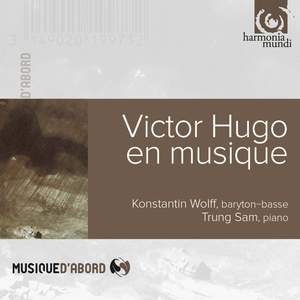
| |  | Victor Hugo in MusicMélodies on the poems of Victor Hugo
Konstantin Wolff (baritone) & Trung Sam (piano) Composers who dared to set the poetic works of Victor Hugo knew they had a challenge on their hands! Yet they managed to extract from this monument of literature the texts that would most benefit from their music, and between them created a multiple portrait: here is every facet of the poet, from the ethereal or sensual lover to the committed political figure, contemplating the world in verse of biting irony or Romantic lyricism.The young Konstantin Wolff has audibly taken great pleasure in tackling these subtly nuanced evocations. “…Vidal's setting of "Chant d'exil"… provides the emotional high-point of the recital. This beautiful song, in which the poet regrets his exile from his homeland, is given a heartfelt rendition by Wolff and his accompanist, Trung Sam, who provides sterling support throughout. This is a lovely disc in which Wolff proves himself worthy of comparison with the past great baritone interpreters of the mélodie.” Gramophone Magazine, February 2009 “Victor Hugo notoriously hated it when anyone tried to set his work to music. Opera composers, by and large, ignored his protestations, though others tended to be a bit more circumspect. This exceptional recital by bass-baritone Konstantin Wolff and pianist Trung Sam chronicles the attempts of francophone song composers to grapple with Hugo's poetry both during and after his lifetime. It's a disc of surprises and occasional failures. Hugo clearly inspired most composers to give of their best, as well as to stray, on occasion, into unfamiliar territory: Saint-Saëns is represented by a clutch of unknown songs that should be repertory pieces, and Fauré gets uncharacteristically angry over the political implications of L'Absent. Lalo, as one might expect, turns Hugo into an impishly blatant eroticist, while Reynaldo Hahn is altogether more fin de siècle and discreet. Only Paul Vidal's settings seem inappropriately delicate. The wide vocal range of Liszt's famous Oh! Quand Je Dors, lies a bit awkwardly for Wolff, who otherwise sings with a virile, articulate elegance that is absolutely right both for the music and for Hugo's poetry. As an accompanist, Sam is spectacular, but never intrusive.” The Guardian, 13th February 2009 | | | In stock - usually despatched within 1 working day. |
|
|
| |  | Liszt: Roots & Routes
Liszt: | Ich liebe dich, S542a Angiolin dal biondo crin, S269 Die drei Zigeuner, S.320 Es muss ein Wunderbares sein, S. 314 Comment, disaient-ils (Hugo), S276 Einst (Bodenstedt) Go not, happy day Enfant, si j'étais roi (Hugo), S283 Was Liebe sei? (Hagn) S'il est un charmant gazon, S284 Mignons Lied (Kennst du das Land), S275 Über allen Gipfeln ist Ruh (Wandrers Nachtlied II), S.306 La tombe et la rose, S285 Ein Fichtenbaum steht einsam, S309 Es war einmal ein König, S73 Tristesse, S327 Verlassen, S336 Jeanne d'Arc au bûcher, S293 Áldjon eg! Vergiftet sind meine Lieder, S.289 Ne brany menya, moy drug, S340a La perla, S326 O Meer im Abendstrahl, S344 |
Elisabeth Kulman (mezzo-soprano) & Eduard Kutrowatz (piano) This collection of songs by Liszt demonstrates how cosmopolitan he was. He wrote songs in German, French, Italian, English, Hungarian and Russian. Some are real discoveries, such as his only song in Russian and a duet. Ne brani menja, moj drug and O Meer im Abandstrahl are premiere recordings. “Liszt's songs are an often-forgotten part of his output. Here are 22 of them, in six languages charting his travels as an internationally renowned virtuoso. Beautifully performed.” BBC Music Magazine, March 2012 | | | Usually despatched in 2 - 3 working days. |
|
|
| |  | Sylvia Sass – The Decca Recitals
Bartók: | Five Songs, Op. 16 (Text: Endre Ady) | Bellini: | Sediziose voci (from Norma) with the Ambrosian Singers | Liszt: | Die Lorelei with András Schiff (piano) Ne brany menya, moy drug, S340a original version with András Schiff (piano) Enfant, si j'étais roi (Hugo), S283 with András Schiff (piano) Es muss ein Wunderbares sein, S. 314 with András Schiff (piano) Vergiftet sind meine Lieder, S.289 with András Schiff (piano) Kling Leise, mein Lied, S301 with András Schiff (piano) Der König von Thule with András Schiff (piano) Die drei Zigeuner, S.320 with András Schiff (piano) | Ponchielli: | Suicidio! (from La Gioconda) National Philharmonic Orchestra, Lamberto Gardelli | Puccini: | In questa reggia (from Turandot) London Symphony Orchestra, Lamberto Gardelli Vissi d'arte (from Tosca) London Symphony Orchestra, Lamberto Gardelli In quelle trine morbide (from Manon Lescaut) London Symphony Orchestra, Lamberto Gardelli Sola, perduta, abbandonata (from Manon Lescaut) London Symphony Orchestra, Lamberto Gardelli Un bel di vedremo (from Madama Butterfly) London Symphony Orchestra, Lamberto Gardelli | Verdi: | Ritorna vincitor! (from Aida) London Symphony Orchestra, Lamberto Gardelli Una macchia è qui tutt'ora (from Macbeth) London Symphony Orchestra, Lamberto Gardelli O madre, dal cielo …Se vano, se vano è il pregare (from I Lombardi) London Symphony Orchestra, Lamberto Gardelli È strano! è strano!...Ah! fors è lui (from La traviata) with Ian Caley (tenor) Vanne, lasciami (from Il Trovatore) La luce langue (from Macbeth) |
Sylvia Sass was born near Budapest, Hungary, in 1951 to a very musical family. Her mother was a coloratura soprano and her father a high school music teacher. She made her stage debut at age 14 in Adam’s operetta Die Nürnberger Puppe and then commenced study at the celebrated Franz Liszt Academy in Budapest, completing a five-year program in two. Her professional debut was as Frasquita in Carmen in 1971. Several awards followed – 1st prize at the Kodály Voice Competition in Budapest, 1972; winner at the International Opera Competition for Young Singers, of the Grand Prix as Violetta in La traviata, 1973, the Silver Medal at the International Tchaikovsky Competition in Moscow, 1974. She was also made an Honoured Artist of Hungary in 1977. While still in Budapest, she performed such dramatic roles as Freia in Das Rheingold, Violetta in La traviata and Mimi in La bohème. International stardom came with a composer with whom she is most associated and in a role represented on her Decca recitals – Giselda in Verdi’s I Lombardi at Covent Garden in London, 1976. The next year she made both, her Italian debut in Turin as Lady Macbeth, and her Metropolitan Opera debut as Tosca alongside José Carreras. La Scala followed the year after, in 1978, where she sang Puccini’s tragic heroine Manon Lescaut alongside Plácido Domingo. Soon, Sass was being heralded as ‘the new Callas’, and she did meet Callas in person, thanks to a meeting set up by Leonard Bernstein. True, the voice had a similar dramatic colour, but Sass quickly rebuffed the comparison, saying, ‘Callas was so great and so unique. I just don’t think it’s fair to compare somebody with such a great artist.’ Her three recital records for Decca include two discs of operatic arias, including all her most celebrated roles, both conducted by Lamberto Gardelli, and a disc of songs by Liszt and Bartók with her compatriot, pianist András Schiff. All of these are issued collectively as a 2CD set for the first time. In recent years, Sass has settled in France, where she keeps busy painting and giving masterclasses. “you could say that Sylvia Sass had taken the best from Callas's and Sutherland's Norma … ‘Sempre libera’, which sounds appropriately hectic, is fearlessly done (with a tender, ardent incursion from Ian Caley as Alfredo) … her vibrant ‘Suicidio’ is undeniably exciting … The Decca recording is faultless.” Gramophone Magazine “The very first phrases of the opening aria (Turandot’s ‘In questa reggia’, no less) command attention and let you know that something rather special has arrived on the scene. And as the Puccini arias follow one another it becomes quite clear that here is an exceptional singer, distinctive in timbre, distinguished in artistry. The voice glitters rather than soothes, shines rather than warms. It is powerful, has a wide range, and is firmly placed. The tone can be brilliantly luminous (as in the Turandot aria), or may acquire a deeper kind of radiance (as in the ‘Vissi d’arte’ that follows it).” Gramophone Magazine “Entering into every nuance of the songs’ moods, and employing a dynamic range from the merest whisper to a full-blooded climax, Sylvia Sass makes the utmost of their not very rewarding vocal line; but the success of this performance is assured by the subtle playing of András Schiff, who conjures up beautiful sounds from the swirling figurations [Bartók] … Die Loreley is an evocative scena, sung imaginatively (and with much flexibility of pace) by Sass, bringing into play a vocal quality as seductive as that of the siren herself; and her gentle singing of the serenade Kling leise, mein Lied would melt the most obdurate heart. … all the performances here are unusually illuminating and satisfying; and the recording is excellent.” Gramophone Magazine (Liszt, Bartók) | | | Usually despatched in 2 - 3 working days. |
|
|
| |  | Liszt Abroad
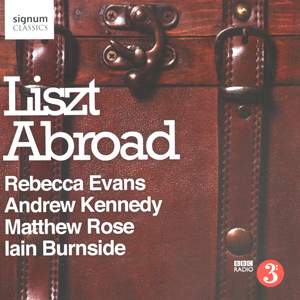
Liszt: | O quand je dors (Hugo), S282 Enfant, si j'étais roi (Hugo), S283 Gastibelza Comment, disaient-ils (Hugo), S276 Im Rhein, im schönen Strome, S272 Die Lorelei Die Vätergruft, S.281 Sonetti di Petrarca (3) for voice & piano, S270 Go not, happy day Gebet, S265 Morgens steh ich auf und frage, S290 Ein Fichtenbaum steht einsam, S309 Du bist wie eine Blume Wie singt die Lerche schon. S. 312 Blume und Duft Und wir dachten der Toten Über allen Gipfeln ist Ruh (Wandrers Nachtlied II), S.306 |
Perhaps stemming from his years touring Europe as a virtuoso pianist or from his later émigré life in Paris, Franz Liszt's choice of song texts reflect his 'polyglot' attraction to the 19th Century literature and culture of many different countries, shown in these settings of French, German, Italian, English, Russian and Hungarian words. “The 20 songs recorded here cover a vast range of language and expression… Burnside is a faultless guide along this journey, exhibiting power when required but never forcing either tone or pace; and his pianissimo playing reminds me of Gerald Moore's… The singing too is exemplary, with Rebecca Evans's floated high notes things of exquisite beauty.” BBC Music Magazine, Christmas 2009 ***** “The Three Sonnets are sung by Rebecca Evans - surprisingly, perhaps, but very beautifully. …her soft high tones, as in the last phrase of the first sonnet, are magically poised. Kennedy, too, is at his best, masterly indeed in "Die Loreley". Burnside himself, presiding spirit throughout, accompanies expertly.” Gramophone Magazine, October 2009 | | | Usually despatched in 3 - 4 working days. |
|
|
| |  | Liszt - Songs for Tenor
Liszt: | O Love Freudvoll und leidvoll, S.280 Es muss ein Wunderbares sein, S. 314 Sonetto 123 del Petrarca 'I' vidi in terra angelici costumi', S270 No. 3 Es rauschen die Winde, S294 Ich eiss nicht, was sol les bedeuten Vergiftet sind meine Lieder, S.289 Morgens steh ich auf und frage, S290 Es donnern die Hoh’n Es lachelt der See Wie singt die Lerche schon. S. 312 S'il est un charmant gazon, S284 Comment, disaient-ils (Hugo), S276 O quand je dors (Hugo), S282 Enfant, si j'étais roi (Hugo), S283 Die Macht der Musik, S.302 |
| | | Usually despatched in 2 - 3 working days. |
|
|
| |  | Song Recital
Chopin: | Piosnka litewska (Lithuanian Song), Op. 74 No. 16 Gdzie lubi (What She Likes), Op. 74 No. 5 Sliczny chlopiec (Handsome Lad), Op. 74 No. 8 Dumka (Reverie), KK.IVb/9 | Liszt: | O quand je dors (Hugo), S282 Enfant, si j'étais roi (Hugo), S283 | Mendelssohn: | Minnelied 'Wie der Quell so lieblich', Op. 47 No. 1 Frühlingslied 'Durch den Wald, den dunkeln', Op. 47 No. 3 Das erste Veilchen, Op. 19a No. 2 Auf Flügeln des Gesanges, Op. 34 No. 2 Neue Liebe, Op. 19a No. 4 Bei der Wiege, Op. 47 No. 6 | Schumann: | Frauenliebe und -leben, Op. 42 |
Bozena Harasimowicz (soprano), Olga Niecziporenko (piano) | | | Usually despatched in 4 - 5 working days. |
|
|
| |  | Franz Liszt Songs
Liszt: | Drei Lieder aus Schillers Wilhelm Tell, S292 Der du von dem Himmel bist (Goethe), S279 Über allen Gipfeln ist Ruh (Wandrers Nachtlied II), S.306 Im Rhein, im schönen Strome, S272 Vergiftet sind meine Lieder, S.289 Ihr Auge (Rellstab) Was Liebe sei? (Hagn) Kling Leise, mein Lied, S301 Einst (Bodenstedt) Sonetti di Petrarca (3) for voice & piano, S270 Enfant, si j'étais roi (Hugo), S283 S'il est un charmant gazon, S284 Comment, disaient-ils (Hugo), S276 O quand je dors (Hugo), S282 |
| |
|
| |  | Elisabeth Söderström
Grieg: | Med en Primula veris, Op. 26 No. 4 Med en vandlije, Op. 25 No. 4 Jeg Elsker Deg, Op. 41 No. 3 | Liszt: | S'il est un charmant gazon, S284 O quand je dors (Hugo), S282 Enfant, si j'étais roi (Hugo), S283 Comment, disaient-ils (Hugo), S276 Mignons Lied (Kennst du das Land), S275 | Nielsen: | Æbleblomst, Op. 10/1 | Rachmaninov: | Sing not, O lovely one (Ne poi, krasavitsa, pri mne), Op. 4 No. 4 Fragment from A. Musset, Op. 21 No. 6 The Rat-Catcher, Op. 38 No. 4 | Schubert: | Seligkeit D433 (Holty) Gretchen am Spinnrade, D118 Freudvoll und leidvoll Erlkönig, D328 | Sibelius: | Små flickorna (Text: Hjalmar Procopé) | Strauss, R: | Freundliche Vision, Op. 48 No. 1 Ein Obdach gegen Sturm und Regen, Op. 46 No. 1 | Tchaikovsky: | Otchevo? (Why?), Op. 6 No. 5 None but the lonely heart, Op. 6 No. 6 The Cuckoo, Op. 54 No. 8 | Wolf, H: | Mögen alle bösen Zungen (No. 13 from Spanisches Liederbuch: Weltliche Lieder) |
Recorded 1971/84 | | | (also available to download from $10.50) | Usually despatched in 2 - 3 working days. (Available now to download.) |
|
|
| |  | Victor Hugo, Poèmes en musique(poems in music)
Bizet: | Adieux de l'hotesse Arabe La chanson du fou La Coccinelle | Britten: | Enfance Nuits De Juin | Donizetti: | Le crépuscule | Fauré: | Le papillon et la fleur, Op. 1 No. 1 L'absent Op. 5 No. 3 | Franck, C: | Roses et papillons | Hahn, R: | Quand la nuit n'est pas étoilée Si mes vers avaient des ailes | Lalo: | Dieu qui sourit Guitarre, Op. 28 Puisqu'ici bas | Liszt: | S'il est un charmant gazon, S284 Comment, disaient-ils (Hugo), S276 Enfant, si j'étais roi (Hugo), S283 O quand je dors (Hugo), S282 | Saint-Saëns: | Si Vous N'avez Rien A Me Dire Soirée En Mer | Wagner: | L'attente, WWV 55 |
| | | Usually despatched in 3 - 4 working days. |
|
|
| |
|