All recordingsPrices shown exclude VAT. (UK tax is not payable for deliveries to United States.) See Terms & Conditions for p&p rates. | |  | Haydn: Concertos, German Dances & Overtures
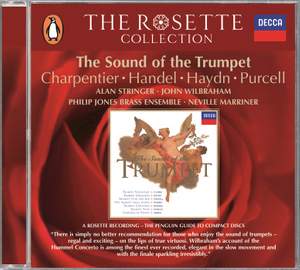
Haydn: | Cello Concerto No. 1 in C major, Hob. VIIb:1 Heinrich Schiff (cello) Cello Concerto No. 2 in D major, Hob. VIIb:2 (Op. 101) Heinrich Schiff (cello) Trumpet Concerto in E flat major, Hob. VIIe:1 Alan Stringer (trumpet) Keyboard Concerto No. 11 in D major, HobXVIII:11 George Malcolm (harpsichord) Overture in D major, Hob.Ia:7 Acide e Galatea: Sinfonia in D major, Hob.Ia:5 Six German Dances, Hob.IX:9 Six Allemandes, from Hob.IX Keyboard Concerto No. 1 in C major, Hob. XVIII:1 Simon Preston (organ) Horn Concerto No. 1 in D major, Hob.VIId:3 Barry Tuckwell (horn) Horn Concerto No. 2 in D major, Hob.VIId:4 Barry Tuckwell (horn) |
A generous collection of Haydn Concertos, Overtures and Dances, this 2CD set offers the Philips recordings of the Cello Concertos and the Argo recordings of the remaining works. Although issued in various reissues, the Marriner/Argo Haydn Concertos have never before been offered collectively, and this collection offers a great opportunity to explore these recordings from 1966–69. Familiar works such as the E flat major Trumpet Concerto and the two Cello Concertos appear together with the little-known Organ Concerto. Also on offer are two sets of German Dances/Allemandes (both making their first appearance on CD) and a pair of Overtures, of which that for Acide e Galatea is a first-on-CD release. “a delightfully crisp and vivacious performance here, at lively tempi and with neat, sharply defined phrasing” Gramophone Magazine (Organ Concerto) “Written while asleep", wrote Haydn on the score of the first of these concertos. Well, perhaps. And of course one has probably heard performances during which some of the players were undoubtedly asleep. But none of them, surely, could have dropped off on this occasion: both concertos are far too alive to conceive the possibility. Barry Tuckwell plays and phrases splendidly, not in the least intimidated by the range in both directions demanded of him by Haydn. And the orchestra are with him: stylish and alert.” Gramophone Magazine (Horn Concertos) “The harpsichord concerto is neatly played, tempi distinctly on the lively side, but with spruce rhythms from Neville Marriner’s orchestra and a crisp and brilliant account of the harpsichord part from George Malcolm.” Gramophone Magazine (Harpsichord Concerto) “…performances of such stimulating detail and so rich in individual character…” Gramophone Magazine (Cello Concertos) “Tuckwell plays the Horn Concerto No. 1 superbly … striking tone and finesse [from Alan Stringer in the Trumpet Concerto] … ‘the playing in the Dances and the Acide e Galatea Overture is a wonderful example of sheer style, yet readily conveys the players’ enjoyment of this innocent but rewarding music” Penguin Guide *** | | | In stock - usually despatched within 1 working day. |
|
|
| |  | Popular Trumpet Concertos
Maurice Murphy (trumpet) Consort of London, Robert Haydon Clark Maurice Murphy, Principal Trumpet of the London Symphony Orchestra, gives stylish performances of the popular trumpet concertos by Haydn and Hummel as well as Jeremiah Clarke’s Prince of Denmark’s March (Trumpet Voluntary) and Purcell’s Trumpet Tune and Air. Also included on this disc, is the concerto by Armenian composer Alexander Arutiunian - a richly romantic work which deserves to be more widely known. “Maurice Murphy is an excellent soloist. His timbre is bright and open, his style fluent and his bravura in the finales of the Haydn and Hummel works has plenty of sparkle” Gramophone Magazine | | | In stock - usually despatched within 1 working day. |
|
|
| |  | Six Trumpet Concertos
| | | In stock - usually despatched within 1 working day. |
|
|
| |  |
| | | In stock - usually despatched within 1 working day. |
|
|
| |  | Haydn & Hummel - Trumpet Concertos
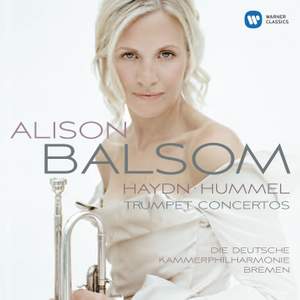
Alison Balsom’s fourth CD for EMI Classics features Franz Joseph Haydn and Johann Nepomuk Hummel’s evergreen trumpet concertos, coupled with concertos by Johann Baptist Georg Neruda and Giuseppe Torelli. Balsom also directs Die Deutsche Kammerphilharmonie Bremen. The Haydn Trumpet Concerto is arguably the most popular work for the instrument as well as one of the composer’s best known compositions, a favourite of performers and audiences alike for its wonderful melodic invention and challenging virtuosity. Reviewing Alison’s performance with the Milwaukee Symphony in March of this year, the Journal Sentinel wrote, “Alison Balsom's details of attack, release, dynamics and timbre polished Haydn's … Trumpet Concerto into an exquisite little gem. …This concerto … has its moments of brilliant bugling. More often, though, it [shows the short-lived keyed trumpet] capable of a refined sort of expression …. Balsom excelled at both facets of the concerto. She snapped off staccato 16ths with ease and signal calls with clarion purity and power. And she shaped and colored Haydn's gentle, lyrical lines with the grace and warmth of a really good Mozartean mezzo.” Jonathan Freeman-Attwood’s CD booklet note describes the notoriously-difficult-to-play ‘natural’ trumpet of the Renaissance and Baroque periods and the development of the ‘keyed’ trumpet by the Viennese court trumpeter Anton Weidinger in the 1790s, which inspired the concerto masterpieces by Haydn and Hummel performed on this disc. The enticing melodic possibilities of Weidinger’s “keyed” trumpet, and indeed the artistry of Weidinger himself, moved Franz Joseph Haydn (1732-1809), then at the height of his powers, to compose his concerto in E-flat for trumpet & orchestra. His last purely orchestral work, the concerto is a “gloriously ebullient and concise masterpiece in which the composer […] conceives a highly distinctive palette to thrust the trumpet into a brave new world.” Interestingly, it was not premiered until 1800, four years after its completion, possibly because Weidinger needed time to master its technical challenges. Also composed for Weidinger was the Concerto in E Major (often performed, as here, in E-flat) by Johann Nepomuk Hummel (1778-1837), prodigy, student of Mozart and, later, of Haydn. Hummel composed his trumpet concerto in 1803 and Weidinger premiered it the following year for members of the Esterházy court. The composer was subsequently appointed music director there, on Haydn’s recommendation and likely helped by the success of his trumpet concerto. The concerto, “a more expansive work [than Haydn’s, takes the modified trumpet] a stage further in variety of idiomatic figuration and harmonic adventure.” The Concerto in D by Giuseppe Torelli (1658-1709) was composed for the “natural” trumpet and likely performed on feast days in the San Petronio Basilica. The concerto for hunting horn and strings in E-flat by the Czech composer Johann Baptist Neruda (c1707-c1780) was probably written in the 1760s and is an example of a charming, traditional work of its era. “Balsom plays them all with great virtuosity, varied toned and good style. The German Chamber Philharmonic provides spirited, carefully detailed support.” BBC Music Magazine, October 2008 ***** “Occasionally a player comes along who turns all the preconceived ideas about their instrument on their head, and reinvents the repertoire. … Alison Balsom is a virtuoso player and a natural, gifted communicator, but what really comes across is her sheer exuberance and joy in making music.” Classic FM Magazine “The first movement of the Haydn is a model of concision which Balsom plays gloriously” Classic FM Magazine, December 2010 *** “Haydn and Hummel composed their concertos for Anton Weidinger's newfangled keyed trumpet, whose timbre was appreciably softer than the natural trumpet (contemporaries likened it to an oboe or clarinet). More than any performance, Alison Balsom brings out the mellow, even veiled, colouring of so much of the writing. Where clarion brilliance is in order she can peal out with the best of them. But what lingers in the memory is the lyrical grace of her phrasing, and her delicacy of shading. In the entertaining Hummel Concerto, with its palpable Mozart cribs, she mingles tonal subtlety and swagger in the opening movement, spins a refined, beautifully modulated line in the slow movement, and makes the finale's pyrotechnics properly dazzling. The spruce Deutsche Kammerphilharmonie match her all the way in sensitivity and rhythmic verve. Moving back in time, Balsom savours the bold, bugling fanfares of Torelli's miniature concerto and makes a persuasive case for a pleasant, if hardly distinctive, mid-18th-century concerto by the Czech Johann Baptist Neruda, written for the corno da caccia but forgivably pilfered by trumpeters hard-up for solo concertos. In sum, a stunning recital from a poet of this traditionally martial instrument.” Gramophone Classical Music Guide, 2010 “…a stunning recital from a poet of this traditionally martial instrument.” Gramophone Magazine, Awards Issue 2008 | | | In stock - usually despatched within 1 working day. |
|
|
| |  | Maurice André - Music for Trumpet
Albinoni: | Adagio for Strings and Organ in G minor (arr. Jean-Michel Defaye) Concerto Op. 7 No. 3 for oboe & strings in B flat major Concerto Op. 7 No. 6 for oboe & strings in D major Trumpet Concerto in D minor (from Violin Sonata Op. 6 No. 4) | Bach, J S: | Gavotte (Rondeau) from Partita No. 3 in E major BWV1006 Cantata BWV68 'Also hat Gott die Welt geliebt: Mein glaubiges Herze Orchestral Suite No. 3 in D major, BWV1068: Air ('Air on a G String') Cello Suite No. 4 in E flat major, BWV1010: Bouree Cantata BWV147 'Herz und Mund und Tat und Leben': Jesu, bleibet meine Freude | Charpentier, M-A: | Te Deum, H146: Prélude | Clarke, Jeremiah: | Trumpet Voluntary 'Prince of Denmark's March' | Gounod: | Ave Maria | Handel: | Largo from Xerxes (instrumental arrangement) Gloria in Excelsis Deo Concerto in D minor for Trumpet & Organ | Haydn: | Trumpet Concerto in E flat major, Hob. VIIe:1 | Hertel, J W: | Trumpet Concerto in E flat | Marcello, A: | Trumpet Concerto in C minor | Mozart: | Exsultate, jubilate, K165 - Alleluia | Purcell: | Queen's Dolour in A minor, Z670 | Schubert: | Ave Maria, D839 | Senaillé: | Allegro spiritoso | Stanley, J: | Trumpet Voluntary in D major | Telemann: | Concerto TWV 51:D7 in D major for trumpet, strings & b.c. Trumpet Concerto in F minor |
| | | In stock - usually despatched within 1 working day. |
|
|
| |  | Famous Classical Trumpet Concertos
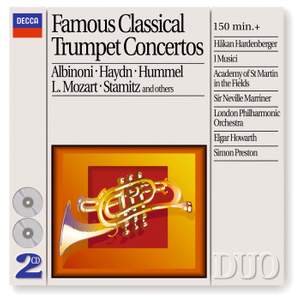
Albinoni: | Concerto Op. 7 No. 3 for oboe & strings in B flat major Adagio for Strings and Organ in G minor (transcribed for trumpet by Giovanni Orsomando) | Bach, J S: | Chorale Prelude BWV721 'Erbarm' dich mein, o Herre Gott' Chorale Prelude BWV639 'Ich ruf' zu dir, Herr Jesu Christ' Chorale Prelude BWV727 'Herzlich tut mich verlangen' | Clarke, Jeremiah: | Trumpet Tune | Corelli: | Sonata a quattro in D for Trumpet, Strings and Continuo, WoO 4 | Gounod: | Ave Maria | Haydn: | Trumpet Concerto in E flat major, Hob. VIIe:1 | Haydn, M: | Trumpet Concerto in C major, MH 60, P. 34 | Hertel, J W: | Trumpet Concerto in D Trumpet Concerto in E flat | Hummel, J: | Trumpet Concerto in E (or E flat) major, WoO/S49 | Molter: | Trumpet Concerto No. 1 in D, MWV 6/32 | Mozart, L: | Trumpet Concerto in D major | Richter, F X: | Trumpet Concerto in D | Stamitz, J: | Trumpet Concerto in D |
“This is probably the finest single collection of trumpet concertos in the catalogue. When it first appeared in 1987 (the Hummel and Haydn have since been recoupled with a later set as listed here) it created overnight a new star in the firmament of trumpeters. The two finest concertos for the trumpet are undoubtedly those of Haydn and Hummel, and Hardenberger plays them here with a combination of sparkling bravura and stylish elegance that are altogether irresistible. Hardenberger opens with the famous Hummel Concerto, played in E major rather than the usual E flat, which makes the work sound bolder and brighter than usual. The finale with its crisp articulation, fantastic tonguing and tight trills, displays a genial easy bravura, yet overflows with energy and high spirits. Marriner and his Academy accompany with characteristic finesse and warmth, with the lilting dotted rhythms of the first movement of the Hummel, seductively jaunty. The lovely Andante of the Haydn is no less beguiling, and both finales display a highspirited exuberance and an easy bravura which make the listener smile with pleasure. The recording gives him the most vivid realism and presence, but it's a pity that the orchestral backcloth is so reverberant; otherwise the sound is very natural. A superb disc.” Gramophone Classical Music Guide, 2010 | | | In stock - usually despatched within 1 working day. |
|
|
| |  | Concertos In Contrast
“exactly the right balance of virtuosity and taste... smouldering intensity, darkly brooding and intense... quite possibly the best performance available [of Schelomo]” Classics Today | | | In stock - usually despatched within 1 working day. |
|
|
| |  | Trumpet Concertos
Edward H. Tarr (trumpet) Franz Liszt Chamber Orchestra, János Rolla (direction) The period after 1750 meant a crisis for the high brass instruments, trumpet and horn. To be sure, the art of playing higher and higher on a simple or 'natural' brass instrument had reached its apogee, but the compositional style had changed. Owing to a new bourgeois idea of society, the trumpet fell out of favour, since it represented the old courtly culture. Felix Weingartner wrote of an anticipatory longing for reform which was in the air at that time. The final reform was brought about by full chromatifica-tion of trumpets and horns resulting from the invention of the valve (just before 1815). On the pathway to this final reform, however, the most intellectual brows were furrowed over the most efficient means of making brass instruments chromatic. The works on this disc represent three steps on this pathway: the explosive expansion of the frontiers of high-register playing by employing the 5th octave of the harmonic series, which had remained more or less unused, from high C upwards, around 1770 (Neruda); the Viennese court trumpeter Anton Weidinger's successful introduction of the keyed trumpet around 1800 (Haydn, Hummel); and finally the establishment of the 'Romantic' trumpet in low F or G with valves after c. 1828 (Kreutzer, Millares). On this disc, the works by Neruda, Haydn and Hummel are performed on modern instruments (although the horn employed in the Neruda concerto was built over 100 years ago). The 'Romantic' trumpet used in the works by Kreutzer and Millares is pitched in low D and E flat, respectively. | | | Usually despatched in 3 - 4 working days. |
|
|
| |  | Karlheinz Stockhausen conducts
| | | (also available to download from $10.50) | Usually despatched in 4 - 5 working days. (Available now to download.) |
|
|
| |
|