All recordingsPrices shown exclude VAT. (UK tax is not payable for deliveries to United States.) See Terms & Conditions for p&p rates. | |  |
| | | In stock - usually despatched within 1 working day. |
|
|
| |  |
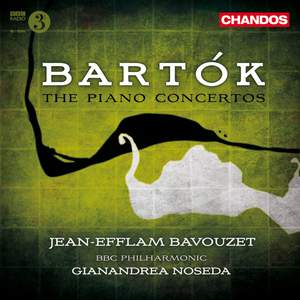
This is the first concerto recording by Jean-Efflam Bavouzet for Chandos. Following the tremendous success of his complete Debussy piano music edition (‘This could well be the finest and most challenging of all Debussy piano cycles’ – Bryce Morrison, Gramophone) – which scooped awards from both Gramophone and BBC Music – and the launch of his ambitious Haydn Piano Sonatas series, the pianist now turns his attention to some of the mightiest concertos of the twentieth century. The three Bartók Piano Concertos on a single CD represents superb value for money. Bartók wrote his First Concerto, one of his most challenging works, in 1926. The percussive piano writing ads much bite to the textures. The first movement is striking in its rhythmic vigour and dramatic character. The central Andante is essentially a dialogue between the soloist and four percussion players and features much atmospheric ‘Night Music’. In the finale, following without a break, the brilliant motoric rhythms of the first movement return, as does the dramatic use of percussion in a thrilling mêlée of sound. The Second Concerto was first performed in 1933. The music is more melodically appealing and in the first movement, which is notably contrapuntal, the strings are silent throughout. The hushed slow movement on strings is interrupted half way through by a brilliant and startling scherzo, with a striking sequence of tremolos and note-clusters, before the haunting quiet mood of the opening returns. The finale, again with brilliant use of percussion (as well as brass), ends the work in virtuoso fashion. The Third Concerto was written at the end of the composer’s life, in 1945, and is much more restrained than the previous piano concertos. The work is lighter, airy, and almost neo-classical compared to much of his earlier music. Unlike much of Bartók’s output, the piece was not composed on commission, but was rather created as a surprise birthday gift for Bartók’s second wife, Ditta Pásztory, who was, like Bartók, a skilled concert pianist. The two lively outer movements, full of the composer’s distinctive rhythmic drive, are separated by a slow movement of great beauty and serenity, with, again, a striking, contrasting middle section. The final seventeen bars were orchestrated by the composer’s pupil, Tibor Serly, after the composer’s death, based on Bartók’s notes. “Both Bavouzet and the BBC Philharmonic with Gianandrea Noseda are outstanding in the First Concerto, capturing its epic scale and mixture of formality and barbarism...[These performances] generally have all the sweep, intensity and precision that these works demand.” The Guardian, 26th August 2010 **** “In league with the finely honed BBC Philharmonic, these are performances vibrant in colour, vital in rhythm and detail and viscerally exciting in impact.” The Telegraph, 2nd September 2010 ***** “Bavouzet relishes the high-octane energy of the outer movements of the first two concertos but through his imaginatively varied use of colour manages to avoid the trap of making Bartók's percussive writing seem too relentless.” BBC Music Magazine, October 2010 ***** “Bavouzet's own energy and lightness make the most of the jubilant, rhythmic writing.. It's a beautifully nuanced performance, brimming over with variety of touch and dynamic...The orchestra match him in their deft lightness, brightness and virtuosity.” Charlotte Gardner, bbc.co.uk, 16/09/2010 “Bavouzet's interpretations are masculine, intelligent and direct. In most of the nine movements, he opts for unusually brisk tempos, though quick as they are, the music never sounds rushed or precipitous. Clarity invariably prevails and Noseda and the orchestra are equal partners at every turn...the overall effect is viscerally exhilarating.” International Record Review, October 2010 “If you're after a disc of Bartok's piano concertos that maximises on the music's drive, elegance and sparring potential, then you could hardly to better than his ear-catching new production...Bavouzet doesn't play down the music's earth-derived grandeur...or its drama.” Gramophone Magazine, Awards Issue 2010 “From the paranoid wranglings of the First Concerto to the helter-skelter glamour of the Second and the burlesque of the Third, the playing is first rate. Pianist Jean-Efflam Bavouzet delivers coruscating cadenza and locates an almost Beethovenian limpidity for the Adagio Religioso.” The Independent on Sunday, 17th October 2010 BBC Music Magazine
Orchestral Choice - October 2010 |
| | | In stock - usually despatched within 1 working day. |
|
|
| |  | Bartók - The Piano & Violin Concertos
This well-filled 2CD set – nearly 2 hours and 40 minutes long – presents Bartók’s major concertos (the Viola Concerto appears on another Eloquence CD released this month). The three Piano Concertos appear in muscular and sumptuously recorded performances (one of the finest examples of Decca’s 1970s engineering at the venerated Kingsway Hall) by Pascal Rogé and Walter Weller. Likewise, the Second Violin Concerto resurrects a long-buried 1980 Argo recording by the late Iona Brown, with none other than Sir Simon Rattle conducting. The First Violin Concerto, the result of an ultimately called-off love affair with Stefi Geyer, found its music rechannelled into the Two Portraits and in Kyung Wha Chung and Chantal Juillet, respectively, find two of the composer’s most persuasive advocates. “Iona Brown gives a clean-cut and stylish performance, superbly recorded” Penguin Guide | | | In stock - usually despatched within 1 working day. |
|
|
| |  | Bartók & Ravel - Piano Concertos
Recording made in 2008. Booklet notes. Klára Würtz studied with Zoltan Kocsis and Gyorgy Kurtag, and received a scholarship from András Schiff for his masterclasses at Prussia Cove, Cornwall, UK. She has since performed widely in the North America and Europe When Bartók started work on his Third and last piano concerto in 1944, he was already ill, and in exile in the United States. The following year he died, leaving the concerto almost complete. His pupil Tibor Serly completed the final bars using Bartók’s instructions. The concerto was premiered in 1946 and was an immediate success. Unlike much of his earlier work, the Third concerto like the Concerto for Orchestra shows a more approachable and less modernistic character. The public had balked at Bartók’s spiky and percussive music, and the comparatively warm, almost wistful romanticism of the Third concerto provides an ideal introduction to the composer. The work is the summation of his close relationship with the concertos of the classical and romantic period composers he admired – Mozart, Beethoven, Liszt and Richard Strauss. Ravel was determined to write just one work in each genre, and if he ever deviated from his rule, the resulting work in the same genre contrasted greatly with its companion. His two piano concertos were composed around 1930. The Concerto for the Left Hand is a very challenging work for the performer, and the mood is predominantly dark and brooding. In contrast the Concerto in G was described by Ravel as a divertissement, and he said that Mozart and Saint-Saëns provided the inspiration. Allied to these influences is Ravel’s love of jazz which can be detected in the first movement and the finale which frame a serene and beautiful slow movement. | | | In stock - usually despatched within 1 working day. |
|
|
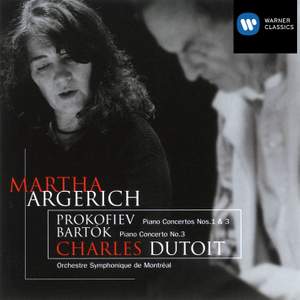
| |  | Prokofiev & Bartók - Piano Concertos
| | | In stock - usually despatched within 1 working day. |
|
|
| |  | Bartók: Piano & Violin Concertos
| | | In stock - usually despatched within 1 working day. |
|
|
| |  |
“Boulez is arguably the most influential figure in the world of music today” The Guardian | | | In stock - usually despatched within 1 working day. |
|
|
| |  |
Recorded 1967-8 | | | In stock - usually despatched within 1 working day. |
|
|
| |  | Bartok: Music for Piano & Orchestra
Russell Sherman (piano) SWF Symphony Orchestra | | | In stock - usually despatched within 1 working day. |
|
|
| |  | Bartók: The Piano Concertos and Violin Concertos
“the hushed intensity of the writing, as well as the biting Hungarian flavour, is caught superbly, thanks to Solti as well as to the soloist, and there is no sentimental lingering. In the Piano Concerto, the partnership between Ashkenazy and Solti works equally well.” Penguin Guide, 2011 edition | | | In stock - usually despatched within 1 working day. |
|
|
| |
|