All recordingsPrices shown exclude VAT. (UK tax is not payable for deliveries to United States.) See Terms & Conditions for p&p rates. | |  |
| | | In stock - usually despatched within 1 working day. |
|
|
| |  | Bartók - The Piano & Violin Concertos
This well-filled 2CD set – nearly 2 hours and 40 minutes long – presents Bartók’s major concertos (the Viola Concerto appears on another Eloquence CD released this month). The three Piano Concertos appear in muscular and sumptuously recorded performances (one of the finest examples of Decca’s 1970s engineering at the venerated Kingsway Hall) by Pascal Rogé and Walter Weller. Likewise, the Second Violin Concerto resurrects a long-buried 1980 Argo recording by the late Iona Brown, with none other than Sir Simon Rattle conducting. The First Violin Concerto, the result of an ultimately called-off love affair with Stefi Geyer, found its music rechannelled into the Two Portraits and in Kyung Wha Chung and Chantal Juillet, respectively, find two of the composer’s most persuasive advocates. “Iona Brown gives a clean-cut and stylish performance, superbly recorded” Penguin Guide | | | In stock - usually despatched within 1 working day. |
|
|
| |  | Bartók & Ravel - Piano Concertos
Recording made in 2008. Booklet notes. Klára Würtz studied with Zoltan Kocsis and Gyorgy Kurtag, and received a scholarship from András Schiff for his masterclasses at Prussia Cove, Cornwall, UK. She has since performed widely in the North America and Europe When Bartók started work on his Third and last piano concerto in 1944, he was already ill, and in exile in the United States. The following year he died, leaving the concerto almost complete. His pupil Tibor Serly completed the final bars using Bartók’s instructions. The concerto was premiered in 1946 and was an immediate success. Unlike much of his earlier work, the Third concerto like the Concerto for Orchestra shows a more approachable and less modernistic character. The public had balked at Bartók’s spiky and percussive music, and the comparatively warm, almost wistful romanticism of the Third concerto provides an ideal introduction to the composer. The work is the summation of his close relationship with the concertos of the classical and romantic period composers he admired – Mozart, Beethoven, Liszt and Richard Strauss. Ravel was determined to write just one work in each genre, and if he ever deviated from his rule, the resulting work in the same genre contrasted greatly with its companion. His two piano concertos were composed around 1930. The Concerto for the Left Hand is a very challenging work for the performer, and the mood is predominantly dark and brooding. In contrast the Concerto in G was described by Ravel as a divertissement, and he said that Mozart and Saint-Saëns provided the inspiration. Allied to these influences is Ravel’s love of jazz which can be detected in the first movement and the finale which frame a serene and beautiful slow movement. | | | In stock - usually despatched within 1 working day. |
|
|
| |  | Prokofiev & Bartók - Piano Concertos
| | | In stock - usually despatched within 1 working day. |
|
|
| |  | Bartók: Piano & Violin Concertos
| | | In stock - usually despatched within 1 working day. |
|
|
| |  |
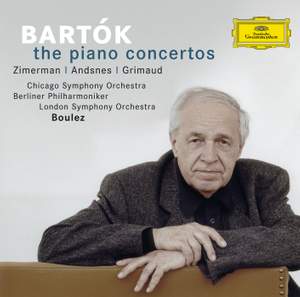
“Boulez is arguably the most influential figure in the world of music today” The Guardian | | | In stock - usually despatched within 1 working day. |
|
|
| |  | Bartok: Music for Piano & Orchestra
Russell Sherman (piano) SWF Symphony Orchestra | | | In stock - usually despatched within 1 working day. |
|
|
| |  | Bartók: The Piano Concertos and Violin Concertos
“the hushed intensity of the writing, as well as the biting Hungarian flavour, is caught superbly, thanks to Solti as well as to the soloist, and there is no sentimental lingering. In the Piano Concerto, the partnership between Ashkenazy and Solti works equally well.” Penguin Guide, 2011 edition | | | In stock - usually despatched within 1 working day. |
|
|
| |  |
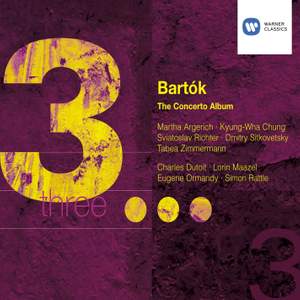
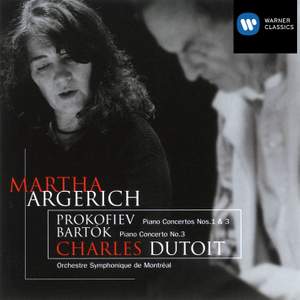
“As always with this most mercurial of virtuosos, Martha Argerich's playing is generated by the mood of the moment and many listeners may well be surprised at her relative geniality with Dutoit. Personal and vivacious throughout, she always allows the composer his own voice. This is particularly true in Bartók's Third Concerto where her rich experience in chamber music makes her often primus inter pares, a virtuoso who listens to her partners with the greatest care. In the Adagio religioso she achieves a poise that has sometimes eluded her in the past and her finale is specially characterful, her stealthy start to the concluding Presto allowing the final pages their full glory. Dutoit and the Montreal Symphony achieve a fine unity throughout, a sense of like-minded musicians at work. All true musicians will recognise performances of a special magic and integrity. In the Prokofiev First Concerto, her opening is arguably more authentically brioso than ferocious, her overall view a refreshingly fanciful view of Prokofiev's youthful iconoclasm. The central Andante assai is inflected with an improvisatory freedom she probably wouldn't have risked earlier in her career and in the Allegro scherzando she trips the light fantastic, reserving a suitably tigerish attack for the final octave bravura display. Her performance of the Third Concerto is less fleet or nimble-fingered than in her early days but is more delectably alive to passing caprice. The recordings are clear and naturally balanced. ....................................................................... Martha Argerich's return to the studios in two concertos she has not previously recorded is an uplifting moment. As always with this most mercurial of virtuosos, her playing is generated very much by the mood of the moment, but you may well be surprised at her relative geniality with Dutoit here. Her entire reading is less hard-driven, her opening arguably more authentically brioso than ferocious, her overall view a refreshingly fanciful view of Prokofiev's youthful iconoclasm. The central Andante assai is inflected with an improvisatory freedom she would probably not have risked earlier in her career and in the Allegro scherzando she trips the light fantastic, reserving a suitably tigerish attack for the final octave bravura display. Again, while her performance of the Third Concerto is less fleet or nimble-fingered than in her early legendary disc for DG with Abbado; it's more delectably alive to passing caprice. Part-writing and expressive detail interest her more than in the past and there's no lack of virtuoso frisson in the first movement's concluding quasi-fugal più mosso chase. Once more Argerich is unusually sensitive in the central Andantino, to the fourth variation's plunge into Slavic melancholy and introspection. Personal and vivacious throughout, she always allows the composer his own voice. This is true to an even greater extent in Bartók's Third Concerto where her rich experience in chamber music makes her often primus interpares, a virtuoso who listens to her partners with the greatest care. Dutoit and his orchestra achieve a fine unity throughout. The recordings are clear and naturally balanced and only those in search of metallic thrills and rushes of blood to the head will feel disappointed.” Gramophone Classical Music Guide, 2010 | | | In stock - usually despatched within 1 working day. |
|
|
| |  | Bartók: | Concerto for Orchestra, BB 123, Sz.116 Dance Suite, BB 86, Sz. 77 Portrait No. 5 for Violin & Orchestra Sz37 Romanian Folk Dances for orchestra, Sz. 68, BB 76 Music for Strings, Percussion & Celesta, BB 114, Sz. 106 Piano Concerto No. 3, BB 127, Sz. 119 |
Ernest Ansermet's view of Bartok was a lyrical one and his incredible ear brought out lines, sonorities and shape in this music that have rarely been equalled. Here, collected together on CD for the first time, are his complete Bartok recordings for Decca as part of the ongoing 'Decca Ansermet Legacy' and they include some of his most famous orchestral works, with a first release on CD of the Music for Strings, Percussion and Celesta, and a first international release of the other orchestral works. The Piano Concerto No. 3, released as part of the Ansermet volume in Decca's 'Original Masters', features Julius Katchen as soloist. | | | In stock - usually despatched within 1 working day. |
|
|
| |
|