All recordingsPrices shown exclude VAT. (UK tax is not payable for deliveries to United States.) See Terms & Conditions for p&p rates. | |  | Liederabend: Frederica von Stade
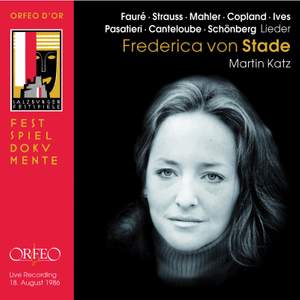
Another favourite of the Salzburg public was the mezzo-soprano Frederica von Stade, who besides her Cherubino in Mozart’s Marriage of Figaro also enjoyed repeated successes in Salzburg with her song recitals. In 1986, accompanied by Martin Katz, she offered a programme that knew no boundaries – ranging from the florid poesy of settings by Fauré and Strauss to Mahler’s Songs of a Wayfarer, the moderate American Modernism of Charles Ives, Copland and Pasatieri, then to Canteloube’s French folk song adaptations. Schoenberg’s early cabaret songs served to round off the evening in ebullient fashion. “the mezzo-soprano on excellent form in a fascinating programme … Katz is a consistently birlliant accompanist and the programme is as absorbing as it is enterprising. Nobody who admires this singer should hesitate for a moment.” International Record Review, December 2012 | | | In stock - usually despatched within 1 working day. |
|
|
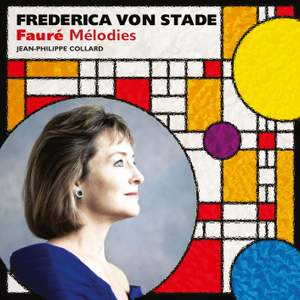
| |  | Frederica von Stade sings Fauré Melodies
Fauré: | Les berceaux, Op. 23 No. 1 Le papillon et la fleur, Op. 1 No. 1 Lydia, Op. 4 No. 2 Rêve d'amour, Op. 5 No. 2 La fée aux chansons Op. 27 No. 2 Au bord de l'eau, Op. 8 No. 1 (Prudhomme) Notre amour Op. 23 No. 2 Les roses d'Ispahan Op. 39 No. 4 Dans les ruines d'une abbaye Op. 2 No. 1 Après un rêve, Op. 7 No. 1 Clair de Lune, Op. 46 No. 2 Mandoline, Op. 58 No. 1 (Verlaine) En sourdine, Op. 58 No. 2 (Verlaine) L'aurore Arpège, Op. 76 No. 2 (Samain) Prison, Op. 83 No. 1 Dans la forêt de septembre Op. 85 No. 1 Au cimetière, Op. 51 No. 2 Mélisande's song from Op. 80 |
Described by the New York Times as “one of America’s finest artists and singers,” Frederica von Stade continues to be extolled as one of the music world’s most beloved figures. Known to family, friends, and fans by her nickname “Flicka,” the mezzo-soprano has enriched the world of classical music for three decades. This release highlights the iconic recordings of Faure Melodies with Jean-Philippe Collard and Melisande's Song from Faure's Pelleas et Melisande with Orchestre du Capitole de Toulouse under Michel Plasson. | | | In stock - usually despatched within 1 working day. |
|
|
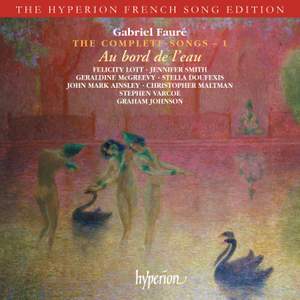
| |  | Fauré - The Complete Songs - 1
“Few singers would give over a whole evening to Fauré's songs on the concert platform, and choosing a way of presenting them on disc obviously poses problems. Previous sets had all the songs in chronological order; others chose poets or moods: Graham Johnson and company have begun with songs about water. This means a lot of dreaming and melancholy, whether in Gautier's Chanson du pêcheur ('Ma belle amie est morte', also set by Berlioz), or Richepin's Aucimitière. The latter is given a most beautiful rendition by John Mark Ainsley, who otherwise only sings on two tracks, with Jennifer Smith in the sentimental Pleurs d'or, and the homage to Venice and its lovers in Marc Monnier's Barcarolle. Three cycles are the main items here. Felicity Lott sings the Cinq Mélodies de Venise, which includes some of Fauré's best-known songs, 'Mandoline', 'En sourdine' and 'Green'. She brings to bear on them a lifetime's devotion to French song. Her other contribution is Au bordde l'eau, to a poem by Sully-Prudhomme. This is made to sound very sad; taken faster it can be quite merry; it's a celebration of love, as well as a meditation on the passing of time. Stephen Varcoe sings Mirages, Fauré's penultimate cycle (1919). As Graham Johnson writes in his fascinating notes, these poems by Brimont permitted Fauré 'uneventful passion'. Christopher Maltman is the other featured singer, in five separate songs and L'horizon chimérique. All the performances are elegant and well-balanced, but one misses the extra slight note of acid that native French singers bring to Fauré's songs. Hyperion's sound is impeccable and in both his playing and accompanying essay, Graham Johnson penetrates to the heart of one of music's most subtle and enigmatic geniuses.” Gramophone Classical Music Guide, 2010 | | | In stock - usually despatched within 1 working day. |
|
|
| |  | Faure: Complete Songs, Vol. 2
Pierre Mollet (baritone), Simone Gouat (piano), Berthe Monmart (soprano), Renee Doria (soprano), Jacques Dutey (baritone), Tasso Janopoulo (piano) | |
|
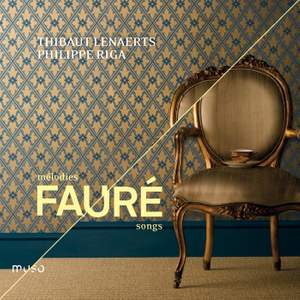
| |  | Fauré: Mélodies
Fauré: | Nell, Op. 18 No. 1 Le voyageur Op. 18 No. 2 Automne, Op. 18 No. 3 Chant d'automne Op. 5 No. 1 La fée aux chansons Op. 27 No. 2 Les présents Op. 46 No. 1 Clair de Lune, Op. 46 No. 2 Larmes Op. 51 No. 1 Au cimetière, Op. 51 No. 2 Spleen, Op. 51 No. 3 (Verlaine) La rose Op. 51 No. 4 Cinq Melodies 'de Venise', Op. 58 La Bonne Chanson, Op. 61 Le parfum impérissable Op. 76 No. 1 Arpège, Op. 76 No. 2 (Samain) Prison, Op. 83 No. 1 Soir Op. 83 No. 2 Dans la forêt de septembre Op. 85 No. 1 La fleur qui va sur l'eau Op. 85 No. 2 Accompagnement Op. 85 No. 3 Mirages, Op. 113 L'horizon chimérique, Op. 118 |
Noel Lee (piano), Bernard Kruysen (baritone) | |
|
| |  |
Jan Van der Crabben (baritone), Inge Spinette (piano) | | | Usually despatched in 4 - 5 working days. |
|
|
| |  | Fauré - Chansons Vol. 2
| | | (also available to download from $10.50) | Usually despatched in 8 - 10 working days. (Available now to download.) |
|
|
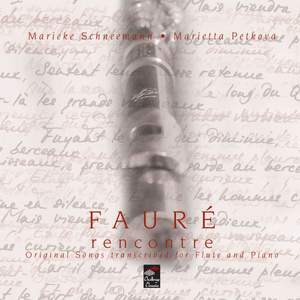
| |  | Fauré: Romance Sans Paroles
Fauré: | Les berceaux, Op. 23 No. 1 Après un rêve, Op. 7 No. 1 Romance sans paroles, Op. 17 No. 3 Sicilienne, Op. 78 Le secret Op. 23 No. 3 Ici-bas ! Op. 8 No. 3 Élégie in C minor, Op. 24 Nell, Op. 18 No. 1 Aurore, Op. 39 No. 1 Au bord de l'eau, Op. 8 No. 1 (Prudhomme) Poème d'un jour Op. 21 Chanson du pêcheur Op. 4 No. 1 En sourdine, Op. 58 No. 2 (Verlaine) Clair de Lune, Op. 46 No. 2 Au cimetière, Op. 51 No. 2 En Priere Chant d'automne Op. 5 No. 1 Nocturne, Op. 43 No. 2 |
Thérèse Ryan (cello), Francine Chabot (piano) | | | (also available to download from $10.50) | Usually despatched in 2 - 3 working days. (Available now to download.) |
|
|
| |  | Naturally Fauré
Fauré: | Les berceaux, Op. 23 No. 1 Après un rêve, Op. 7 No. 1 Romance sans paroles, Op. 17 No. 3 Le secret Op. 23 No. 3 Sicilienne, Op. 78 Ici-bas ! Op. 8 No. 3 Élégie in C minor, Op. 24 Nell, Op. 18 No. 1 Aurore, Op. 39 No. 1 Au bord de l'eau, Op. 8 No. 1 (Prudhomme) Poème d'un jour Op. 21 Chanson du pêcheur Op. 4 No. 1 En sourdine, Op. 58 No. 2 (Verlaine) Clair de Lune, Op. 46 No. 2 Au cimetière, Op. 51 No. 2 En Priere Chant d'automne Op. 5 No. 1 Nocturne, Op. 43 No. 2 Andantino for Piano Trio Sicilienne, Op. 78 |
Francine Chabot (piano), Stéphane Lemelin (piano), Benoît Loiselle (cello), Yannick Nézet-Séguin (piano), Anne Robert (violin), Thérèse Ryan (cello), Alain Trudel (trombone), Stéphane Lemelin (piano), Benoît Loiselle (cello), Yannick Nézet-Séguin (piano), Anne Robert (violin), Thérèse Ryan (cello), Alain Trudel (trombone) Gabriel Fauré composed over 100 songs which, among all his works, best capture the spirit of his time. Naturally Fauré features a number of these songs transcribed for cello and piano, including the well-known Après un rêve , Les berceaux, Clair de lune, and En prière. Also featured on this recording are Romance sans paroles Op. 17, No. 3, Sicilienne, Op. 78, and Élégie , Op. 24. Bonus material includes a transcription for trombone and piano of the Sicilienne , and the Andantino from the Piano Trio , Op. 120 - a profound work composed at the end of Fauré’s life. | |
|
| |
|