Schubert: Schwanengesang, D957

This page lists all recordings of Schwanengesang, D957, by Franz Peter Schubert (1797-1828) on CD, SACD, DVD & download (MP3 & FLAC). Generally, more recent releases are listed first, but with priority given to those that are in stock.

Recommendations

Choral & Song Choice
July 2012
Disc of the Month
July 2005
Editor's Choice
Awards Issue 2011
Editor's Choice
April 2009
4 star4 star

All recordings

Prices shown exclude VAT. (UK tax is not payable for deliveries to United States.)
See Terms & Conditions for p&p rates.

Schubert: Schwanengesang

Schubert: Schwanengesang


Schubert:

Schwanengesang, D957

Auf dem Strom, D943, Op. post. 119

Previously unpublished

Radovan Vlatković (horn)


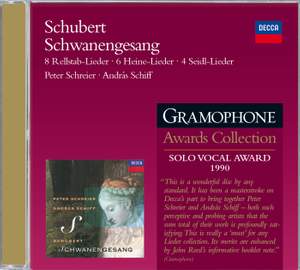
The eighteen songs included in this recording of Schwanengesang all belong to the last three years of Schubert’s life. The earliest of them, Am Fenster, was written in March 1826, while the last, Die Taubenpost, was finished only a few weeks before his death on 19 November 1828. Fourteen of them, seven by Ludwig Rellstab, six by Heinrich Heine and one by the Vienna government official and journalist J.G. Seidl, were published by Tobias Haslinger in May 1829 under the umbrella title Schwanengesang (‘Swan Song’) and are often performed as a complete cycle. Of these, Am Fenster, Der Wanderer an den Mond (both Seidl) and Herbst (Rellstab), were not included in the original publication of Schwanengesang.

Auf dem Strom, with obbligato horn, dates from the previous year, 1827, but was first performed on 26 March 1828, marking the first anniversary of Beethoven’s death. The horn plays a significant melodic role in the setting, opening the piece, providing interludes between the verses, and duetting with the solo tenor voice. It was recorded in 1991 by Peter Schreier and András Schiff, with Radovan Vlatković, at the Decca Winterreise sessions, but owing to the playing time of the CD, Auf dem Strom did not appear. This is the recording’s first release.

“One of the greats. The most of all Schreier's Schwanengesang recordings, and with a previously unpublished performance of 'Auf der Strom' as a bonus.” BBC Music Magazine, March 2013 *****

“This is a wonderful disc by any standard. Indeed, the partnership of Schreier and Schiff [is] a masterstroke of Decca … [Schreier’s] performances of the Heine settings … have become so anguished as to expose every nerve end in their depiction of lost love, and Schiff's realization of the piano's role seconds the singer's probings perfectly. […] This is really a 'must' for any Lieder collection.” Gramophone Magazine, February 2013

“One of the most compelling recordings ever of Schwanengesang … The recording is vividly real.” Penguin Guide ***

Australian Eloquence - 4804923

(CD)

$10.25

(Sorry, download not available in your country)

In stock - usually despatched within 1 working day.

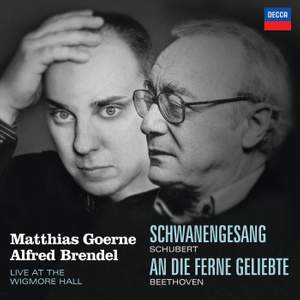
Schubert Lieder Volume 6: Schwanengesang & Sonata D960

Schubert Lieder Volume 6: Schwanengesang & Sonata D960


Schubert:

Schwanengesang, D957

with Matthias Goerne (baritone)

Piano Sonata No. 21 in B flat major, D960


Matthias Goerne continues his Schubert survey that has already established him as one of the most gifted exponents of the song repertoire. Goerne does not merely ‘interpret' Schubert, he 'lives' each song and invites the listener to share this poetry and musical intimacy.

This sixth volume also features an unforgettable performance of Schubert's last piano sonata by one of the baritone's favourite partners, Christoph Eschenbach. Offered on a free bonus CD, this ‘second swansong' reveals hitherto unexplored resonances under his expert fingers.

“Some of those songs – Der Atlas, Der Doppelgänger – become exercises in gothic horror, others are slowed down to the point of inertia, though the group of Rellstab settings is generally buoyant and beautifully nuanced.” The Guardian, 5th April 2012 ***

“This new Schwanengesang is characteristically thoughtful and probing: we hear Schubert’s lyrical heartbeat at its most artless and unaffected, outstandingly so in the ghostly stillnesses of “Die Stadt” and “Der Doppelgänger”… The second CD is devoted to one of Schubert’s last piano sonatas, to which Eschenbach brings classical grace and refinement, never seeking to milk the Romantic doom and gloom.” Financial Times, 21st April 2012

“Their phrasing is exquisite throughout, with 'Die Taubenpost' sounding particularly pliant...Yet some of the Heine settings lack requisite weirdness...But for the sheer beauty and suppleness of voice, Goerne remains unbeatable.” Entartetemusik, May 2012

“The distinctive mellow roundness of Goerne's timbre, at once deep and soft-grained, and his care for a true, 'bound' legato are pleasures in themselves. He and the ever-fastidious Eschenbach invariably allow you to savour the sheer beauty of Schubert's melodic lines.” Gramophone Magazine, July 2012

“Goerne is showing an increasing tendency to capitalise on what he does best, exploiting his superb breath control in singing of hushed and seamless legato...[He] has both the breath control and the will to give full time and space to the long, long last lines of 'In die Ferne', and to bring to them a sense of dark despair as well as longing. He is also able and willing to dare extremes of pacing and dynamics in a spectral 'Ihr Bild'.” BBC Music Magazine *****

“sung with unfailing beauty and sensitivity, at speeds that are on the slow side and in a manner that’s more than usually veiled with reserve and regret. The air of contemplation also pervades Eschenbach’s tonally gorgeous performance of the late, great Sonata in B flat” Irish Times, 13th July 2012

“Goerne has his own ideas about the music and puts them forth with confidence and persuasion. That, in the end, is what sells this recording…A fine disc.” Audiophile Audition, 5th September 2012

BBC Music Magazine

Choral & Song Choice - July 2012

Harmonia Mundi Matthias Goerne Schubert Edition - HMC902139/40

(CD - 2 discs)

$17.50

In stock - usually despatched within 1 working day.

Schubert: Schwanengesang

Schubert: Schwanengesang


Schubert:

Schwanengesang, D957

Herbst, D945

encore

Der Winterabend (Es ist so still), D938

encore


Christopher Maltman (baritone) & Graham Johnson (piano)

Concluding a highly acclaimed series of Schubert song cycles, Wigmore Hall Live now release the much-anticipated Schwanengesang. Recorded live on the Wigmore stage by Christopher Maltman and Graham Johnson in April 2010, the song cycle was collated after Schubert’s death by the publisher Haslinger and, through the works of three poets, depicts a despairing man tormented by his lost love. Often sorrowful, sometimes enraged, this performance never fails to search deep within the emotive poetry, truly exploring the drama that unfolds through the fourteen poems. Famed for his superlative Schubertian pianism, Johnson features here not as an accompanist but as an equal, as Maltman’s stunningly colourful voice displays an infinite palette of timbres, carefully and subtly nuanced throughout.

“Maltman brings a light touch to 'Liebesbotschaft', beautifully complemented by the filigree of Johnson's accompaniment...The second encore, 'Der Winterabend', culminates in Johnson's right hand doubling and counterpointing the vocal line - magical.” Gramophone Magazine, March 2012

“Both singer and accompanist are on far better form, for me, than they were in Winterreise...These are direct, uncluttered accounts of songs of varying quality, and the deepest - 'Am Meer', 'Der Doppelganger' - get appropriately weighty treatment, while others, such as the last, are delightfully light.” BBC Music Magazine, March 2012 ****

“Maltman has a very beautiful light baritone voice and sings Schubert with undemonstrative perceptiveness and much musical intelligence...This is fine recording of Schwanengesang, the accompaniment occasionally somewhat insensitive but Maltman's singing hard to fault.” International Record Review, February 2012

“There's an uncompromising emotional rawness in Maltman's singing in Der Atlas, Die Stadt and Der Doppelgänger that make for very disquieting listening. But it's not all angst: he's sexy in Ständchen and humorous in Die Taubenpost. Johnson, meanwhile, is exemplary, reminding us throughout of the genius of Schubert's piano writing.” The Guardian, 8th March 2012 ****

“Maltman confirms that he is one of the most impressive baritone exponents of art songs currently before the public and, of course, he is partnered by one of the finest accompanists of our day, one who is steeped in Schubert’s lieder. Though there are many excellent CD versions of Schwanengesang in the catalogue this one joins the ranks of the very best.” MusicWeb International, June 2012

Wigmore Hall Live - WHLIVE0049

(CD)

$11.50

In stock - usually despatched within 1 working day.

Schubert: Schwanengesang

Schubert: Schwanengesang


Schubert:

Schwanengesang, D957

Auf dem Strom, D943, Op. post. 119

with Richard Watkins (horn)

Die Sterne, D939 (Leitner)


Mark Padmore (tenor) & Paul Lewis (piano)

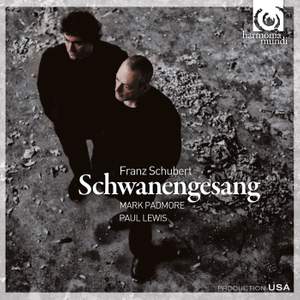
Tenor Mark Padmore and pianist Paul Lewis conclude their acclaimed Schubert triptych with this revelatory account of Schwanengesang, the third and last of the great Schubert cycles, collected and published after the composer’s death.

Auf dem Strom for tenor, horn & piano, and the gently hopeful song Die Sterne complete the programme.

“Tempos are generally slow and the emotional atmosphere introspective, imbuing even something as superficially cheerful as Ständchen with melancholy. Occasionally, as in Der Atlas, one longs for more power and colour than Padmore’s light bright tenor can authentically provide, but this is a performance of undeniable musical integrity.” The Telegraph, 2nd September 2011 ****

“Padmore’s very English tenor voice, so clean in articulation, so carefully coloured, penetrates these songs of love’s despair with memorable clarity. Subtlety, too...More than before, singer and pianist seem joined at the hip in thought and deed...Lewis spins his own poetry, whispering with the breezes, trotting his hoofs, whatever words and music indicate.” The Times, 22nd September 2011 ****

“This is a wonderful recording, two supreme Schubertians working in perfect harmony. Odd as it might sound, I think that this disc is valuable above all for Paul Lewis's stupendous playing. Not only has he the technique - no mean feat, with some of Schubert's accompaniments - but he is also, with Mitsuko Uchida, one of the greatest Schubertians of our time. He has clearly immersed himself in these songs to an impressive degree” BBC Music Magazine, November 2011 ****

“Padmore's silvery, keen-edged tenor, grace of phrase and sensitivity to mood and verbal nuance are ideal [in Liebesbotschaft]; and how affectionately Lewis's left hand sings in gentle colloquy with the voice...In its fine balance of subtlety and devastating emotional directness, this is certainly a Schwanengesang in the Schreier-Schiff class, its attractions enhanced by the "bonus" items.” Gramophone Magazine, Awards Issue 2011

“His feeling for words, their meaning and expression form the bedrock of this performance, as Schubert himself would have wanted. The intensity of communication here flows from the ideal marriage of verbal and musical articulation, complex and rich in their relationship, with singer and pianist united as selfless matchmakers between poetry and music” Classic FM Magazine, November 2011 *****

GGramophone Magazine

Editor's Choice - Awards Issue 2011

Harmonia Mundi - HMU907520

(CD)

$17.50

In stock - usually despatched within 1 working day.

Werner Güra: The Art of Lied

Werner Güra: The Art of Lied


Schubert:

Schwanengesang, D957

Im Gegenwärtigen Vergangenes, D710

with the RIAS Kammerchor, Marcus Creed

Nachthelle, D892 (Seidl)

with the RIAS Kammerchor, Marcus Creed

Schumann:

Dichterliebe, Op. 48 (extracts)

Wolf, H:

Mörike-Lieder: excerpts


Werner Güra (tenor) & Christoph Berner (fortepiano)

Harmonia Mundi Initiales - HMX2908460/61

(CD - 2 discs)

$14.25

In stock - usually despatched within 1 working day.

Schubert - Schwanengesang & Lieder

Schubert - Schwanengesang & Lieder


Schubert:

Prometheus, D674 (Goethe)

Ganymed, D544 (Goethe)

Freiwilliges Versinken D700 (Mayrhofer)

Gruppe aus dem Tartarus, second version, D583 (Schiller)

Elysium D584 (Schiller)

Schwanengesang, D957


Dietrich Henschel (baritone) & Fritz Schwinghammer (piano)

Dietrich Henschel, acknowledged as one of today’s foremost interpreters of the lied, records a stunning programme of Schubert lieder, including his posthumously issued collection of lieder known as ‘Schwanengesang’, accompanied by award-winning pianist, Fritz Schwinghammer. The recital touches on the very essence of the Romantic soul, somewhere between bitter dreams and heartrending sorrows.

Schwanengesang, a collection of 14 songs published shortly after his death, are considered some of Schubert’s most tragic songs, offering the listener an arresting concentration of the composer’s imaginative universe and his obsessions: departure, the death of the beloved, amorous reveries. The set of songs accompanying this great cycle, sees Schubert explore one of the prevailing features of early German Romanticism: a longing for a better world, one that is lost forever. In doing so, he draws on the mythological poems of Goethe, Schiller and Mayrhofer.

German baritone Dietrich Henschel is acknowledged as one of today’s foremost interpreters of the lied, and is invited all over the world with the pianists Fritz Schwinghammer, Helmut Deutsch and Michael Schäfer. His substantial discography features lieder and song cycles by Mahler, Wolf, Schubert, Korngold, and Beethoven, as well as Busoni’s Doktor Faust which won a Grammy Award.

“In this studio account of Schubert's final song collection...there is still an enormous amount to admire - in the way that Henschel colours every line individually and, unlike some celebrated lieder baritones of today, never applies a uniform expressivity to everything he sings, and in the fine-grained expressive nuances with which he weights the meaning and significance of every word.” The Guardian, 31st July 2009 ***

“[Henschel's] voice is as flexible as ever, rich and commanding one moment and drained of all colour the next. Henschel and Schwinghammer convince us that this is no mere random selection of songs gathered after Schubert's death, as some believe, but a dramatic narrative that demands our attention.” The Observer, 26th July 2009

“Dietrich Henschel studied with Dietrich Fischer-Dieskau and the latter’s stamp is clearly imprinted on his singing of Schubert’s last song-cycle. Henschel is never less than elegant, virile and intelligent.” The Telegraph, 11th August 2009 ***

“You couldn’t call Henschel’s bass-baritone voice suave, but his reedy tone can be very expressive when applied to songs of anguish. There are plenty of those in Schubert’s posthumous lieder collection.” The Times, 1st August 2009 ***

Ambroisie - AM138

(CD)

$16.75

(also available to download from $10.50)

In stock - usually despatched within 1 working day.

Schubert - Schwanengesang

Schubert - Schwanengesang


Schubert:

Geheimnis, D491 (Mayrhofer)

An Schwager Kronos, D369

Widerschein, D949

Schwanengesang, D957

Die Taubenpost, D965A (D957 No. 14)

Abschied D475 (Mayrhofer)


Ian Bostridge (tenor) & Antonio Pappano (piano)

Following their highly acclaimed Hugo Wolf lieder album, Ian Bostridge and Antonio Pappano have renewed their musical partnership with a recording of Franz Schubert’s Schwanengesang, the third and last of the composer’s song cycles, and literally his swan song, as he succumbed to illness shortly after its completion in 1828.

In addition to Schwanengesang, the CD also includes Schubert songs Abschied (D475); Geheimnis (D250); An Schwager Kronos (D369) and Widerschein (D639).

Bostridge and Pappano performed Schwanengesang in recital at the Schwarzenberg (Austria) Schubertiade, at the Edinburgh and Aldeburgh festivals and in Glasgow before committing it to disc: “[a recital] characterised by unaffected intimacy and reverence to the music … The two gave a performance as intense and intriguing as it was timeless.” (The Scotsman); “Each song is a mini-drama … [Bostridge] is a performer of extremes who, at the moment of delivery, convinces you that this is how it must be.” (Evening Standard)

Schwanengesang ("Swan Song”) was published posthumously. This title is attributed to Schubert’s publisher, Haslinger, who, in his attempt to maximize profits after the composer’s death, presented the work as the composer’s final musical testament. In contrast with Schubert’s previous song cycles, Die schöne Müllerin and Winterreise, each composed to verses by a single poet, Schwanengesang draws on the work of two poets, Ludwig Rellstab (1799-1860) and Heinrich Heine (1797-1856). In the original manuscript, all 13 songs (seven by Rellstab, six by Heine) were copied in Schubert's handwriting on consecutive manuscript pages and appear in the standard performance order. There are thematic connections between the Rellstab and Heine verses in terms of subject matter and musical motifs.

Taubenpost, to a text by Johann Gabriel Seidl (1804-1875), is often performed as a finale to Schwanengesang. However, research indicates that, rather than being intended as such by Schubert, this tradition was initiated by the publisher, who appended the song to the first edition. While the song is not technically part of Schwanengesang, it is considered to be Schubert's last lied.

Ian Bostridge is firmly established in the opera house, concert hall and recital room, and much sought after internationally as one of the finest of his generation of tenors. He is one of today’s leading interpreters of Schubert lieder, repertoire that he names as his first love. Bostridge’s Schubert cycles and song explorations on EMI Classics began in 1998 with the release of a lieder disc with Julius Drake. Subsequent Schubert lieder albums, most recently The Wanderer, a collection of Schubert lieder and fragments released in summer 2008, and cycles of Der Winterreise and Die schöne Müllerin have seen Bostridge in partnership with Leif Ove Andsnes and Mitsuko Uchida.

“Ian Bostridge continues to be the most striking Schubert tenor of the day. When he is joined by Antonio Pappano as accompanist, the effect is intensified.” The Herald

“Ian Bostridge and Antonio Pappano bring out the best in each other.” BBC Music Magazine

“ Schwanengesang is really no such thing, and there is nothing to prevent a singer omitting the song or changing the order. Bostridge follows the publisher's order and does not flinch before 'Aufenthalt'; and if momentarily he goes under, perhaps it is part of the musical-verbal picture that he should. In any case, all of this is a diversion, almost a frivolity. At the heart of the matter are 'Der Doppelgänger', 'Die Stadt', 'Ihr Bild', 'Am Meer' and, from the Rellstab settings, 'In der Ferne'. Bostridge has, in the pallor of voice and expression, the haunting that pervades these songs. In the first mentioned (the last sung) he is one of the few who can create unease without anticipating the horror, still making those openmouthed vowels ('starret', 'Schmerzensgewalt', 'so manche Nacht') call out into the night like a wounded animal.
Such rare moments are the singer's own; elsewhere the performance is equally the pianist's.
Pappano plays with imagination as verbally attuned as Bostridge's. The rightness of touch is evident in the first additional song, 'Geheimnis', and in the last, the very simple and aptly chosen 'Abschied'. He is also graceful and interesting in the happier songs. There's one misgiving – Bostridge makes so much of the German words, rather as though anxious to communicate with the back rows of a concert-hall full of non-German speakers. Whatever the justification in situ, it nags a little on records.”
Gramophone Classical Music Guide, 2010

“At the heart of the matter are "Der Doppelgänger", "Die Stadt", "Ihr Bild", "Am Meer" and, from the Rellstab settings, "In der Ferne". Bostridge has, in the pallor of voice and expression, the haunting that pervades these songs. In the first mentioned (the last sung) he is one of the few who can create unease without anticipating the horror.” Gramophone Magazine, June 2009

“[Bostridge's] somewhat detached, hard vocal quality suits the introspective longing of many of these settings.” The Times, 21st February 2009 ***

EMI - 2426392

(CD)

$14.25

In stock - usually despatched within 1 working day.

Schubert - Schwanengesang

Schubert - Schwanengesang


Schubert:

Schwanengesang, D957

Herbst, D945

Der Winterabend (Es ist so still), D938


Robert Holl (bass-baritone) & Roger Vignoles (piano)

The Dutch bass-baritone Robert Holl is one of the great Lieder singers of our time. A recent review of a recital from The Times illustrates his extroardinary technique and mesmerising power: ’Dutch baritone Robert Holl delivered a Schubert programme with such natural force and passion that resistance was impossible … Holl’s huge presence, and huge, dark voice can transform itself at will into the lightest breath of spring, rising into a hushed head-voice with total ease, or fining itself down to recreate the vision of a wakeful gondolier and a sleeping Serenissima.’

In Holl’s first recording for Hyperion, he brings his tremendous artistry to Schubert’s last song-cycle.

The songs in Schwanengesang were described by Schubert’s publisher Haslinger as ‘the final blooms of Schubert’s creative muse’. Schwanengesang contains some of Schubert’s greatest works. It tells no particular story, but the two sets of songs are linked by their poetic themes—nature, love and separation in the case of the settings of Rellstab, bitterness, loss and despair in the case of Heine.

This recording includes two further songs. The first, Herbst, though also to a text by by Rellstab, did not appear in Schwanengesang, and the manuscript was not discovered until the 1890s. A highly atmospheric nature-piece, its texture anticipates Mendelssohn’s songs on a similar theme, with its tremolando right hand and sinuous, fateful left-hand melody. The other extra is Der Winterabend from 1828. The poem by Leitner creates the image of a contented man, contemplating not just the winter evening, but by implication also his approaching death (the silvery moonlight is a symbolic pall cast over the objects of his life). In his extensive booklet notes, Roger Vignoles writes that ‘If one wants to know how Schubert felt about his own mortality, it is worth noting the loving care he bestowed on this song. Every turn of phrase, every modulation is perfectly judged, as in the hushed sidestep (through a major third, his favourite interval) that announces the entry of the moonlight into the poet’s chamber’.

“…Holl's interpretation really does stand alone in its musical truthfulness and depth of insight.” BBC Music Magazine, October 2008 ****

“Part of what makes Holl such a wonderful artist is the obvious relish he has for the simple act of singing. The words emerge with a wonderful fruity weight, the tone burgeoning through the note's length.Being so firmly rooted in the body, the singing carries an immense natural conviction.” The Telegraph, 26th October 2006 (on the Wigmore Hall performance of Schwanengesang))

Hyperion - CDA67657

(CD)

$16.75

In stock - usually despatched within 1 working day.

Schubert: Schwanengesang

Schubert: Schwanengesang


Schubert:

Schwangesang D318 (Kosegarten)

Schwanengesang, D957

Herbst, D945

Schwanengesang D744 (Senn)

Sehnsucht, D636 (Schiller)


Christoph Hammer (fortepiano), Dominik Worner (bass-baritone)

ARS Produktion - ARS38494

(CD)

$18.50

(also available to download from $10.50)

Usually despatched in 4 - 5 working days. (Available now to download.)

Schubert: Schwanengesang

Schubert: Schwanengesang


Schubert:

Liebesbotschaft, D957 No.1

Kriegers Ahnung D 957, No. 2

Frühlingssehnsucht, D 957 No. 3

Ständchen 'Leise flehen meine Lieder', D957 No. 4

Im Walde D834

Im Frühling, D882

Über Wildemann D884 (Ernst Schulze)

Schwanengesang, D957


Thomas Oliemans (baritone), Malcolm Martineau (piano)

The highly regarded baritone Thomas Oliemans has been acclaimed for his performances of the works of Schubert; “Oliemans gives an astonishing Schubert-recital. Opera Magazine. ”In a recent interview he said “I’ve never been afraid of the great compositions, because they are the reasons for keeping music alive”. He will be making his Royal Opera House debut in 2011.

“[Oliemans is] an exceptionally fine singer. Some of the performances - "In der Ferne", "Im Frühling" and "Am Meer", for example - rank with the best. Malcolm Martineau's contribution is beyond estimate, so strong and yet sensitive, always a special creation of his own while never losing its true Schubertian identity.” Gramophone Magazine, March 2011

Etcetera - KTC1420

(CD)

$17.25

Usually despatched in 2 - 3 working days.

Page: 

 1   2   3   4 

 Next >>

Copyright © 2002-13 Presto Classical Limited, all rights reserved.