All recordingsPrices shown exclude VAT. (UK tax is not payable for deliveries to United States.) See Terms & Conditions for p&p rates. | |  |
| | | In stock - usually despatched within 1 working day. |
|
|
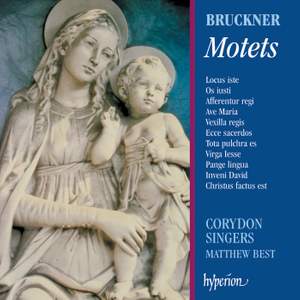
| |  | Bruckner - Motets
Philip Salmon (tenor), Graham Chambers, Jeremy Gough, Martin Kelly, Christopher Stearn (trombones), Thomas Trotter (organ) Corydon Singers, Matthew Best | | | In stock - usually despatched within 1 working day. |
|
|
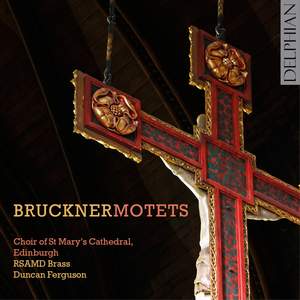
| |  | Bruckner: Motets
Bruckner: | Tota pulchra es, antiphon, WAB 46 Aequalis No. 1 for three trombones Zwei Totenlieder I: O ihr, die ihr heut mit mir zum Grabe geht Ave Maria (1861), WAB 6 Offertorium: Afferentur regi Christus factus est Ecce sacerdos magnus Virga Jesse floruit Locus iste, WAB 23 Pange lingua Iam lucis orto sidere Aequalis No. 2 for three trombones Libera me, for choir & organ, WAB 21 Zwei Totenlieder II: O ihr, die ihr heut mit mir zum Grabe geht Vexilla regis Os justi meditabitur sapientiam Inveni David, offertorium for male chorus & 4 trombones,WAB 19 |
Following their highly acclaimed recording of the 16th-century John Taverner, Duncan Ferguson and his Edinburgh choir turn their attention to one of the 19th -century's compositional giants. This sequence of motets among them several little-known gems are a testament to Bruckner's profound Catholic faith and these performances blaze with fire and fervour in the vast cathedral's icy acoustic. “within seconds you are hooked...you are listening to a choir of humans who sing like angels...pitching in with total commitment at every possible dynamic level from fortissimo to the whisper of dulcet prayer...[the tenors] are remarkably healthy; while the basses have the kind of deep vigour mostly associated with Russian voices. What’s in Scotland’s water, vodka?” The Times, 25th March 2011 “These motet performances...are thrillingly homogenous, conveying well the unifying purpose of the works, but also the ecstatic quality that pervades the mighty Ecce sacerdos and the quiet affirmation of Locus iste.” The Scotsman, 5th April 2011 “Ferguson’s singers are beyond reproach; intonation is never less than perfect and the sound made at full stretch is glorious – higher lines piercingly clear thanks to the cathedral’s choristers singing the soprano parts. We also get the two Aequale for three trombones, played here with sombre magnificence. Brilliant.” The Arts Desk, 16th April 2011 “This performance is just superb. It's the kind of disc you want to turn up to full volume and lose yourself in, whether you're of a religious bent or not. Through their crisp, measured phrases, limpid textures, and their reverent but never syrupy tone, they've captured the simplicity and humility of both texts and music...This is a disc to be revisited and savoured again and again.” bbc.co.uk, 8th April 2011 “There's plenty of drive and commitment to this performance, which adds a sense of spiritual relevance beyond the solely musical...the overall effect is surprisingly uplifting thanks to the clarity and directness of the performance, helped by the cathedral's wonderful acoustic.” Classic FM Magazine, June 2011 **** “this is Bruckner performed with no holds barred, but instead sung with passionate conviction and raw energy - there is nothing remotely polite about MacBruckner...you cannot but be aware of Bruckner's originality, and command of texture and sonority: can the art of modulation ever have been bettered? To hear this marvellous music given with such urgency and all-out commitment is a remarkable experience.” International Record Review, May 2011 “The Edinburgh singers perform with a robust though polished fervour. Alto, tenor and bass lines are beyond reproach, while the mixed-sex treble line copes admirably with exposed writing. The recorded sound is first-class, capturing both voices and instruments (including some excellent organ-playing) with an engaging immediacy.” Gramophone Magazine, July 2011 “The Edinburgh choristers (a mix of boy trebles and girls) are fearless in confronting Bruckner’s demands...This is an excellent disc. The performances are thrilling and intense and they are captured in an excellent recording that mixes spaciousness and clarity. The contributions of the uncredited organist (Nicholas Wearne?) and the RSAMD trombonists add a splendid sonority to some of the items.” MusicWeb International, 11th July 2011 “There’s not a dud moment here...Ferguson’s singers are beyond reproach; intonation is never less than perfect and the sound made at full stretch is glorious – higher lines piercingly clear thanks to the cathedral’s choristers singing the soprano parts” The Arts Desk, 15th April 2011 | | | Usually despatched in 3 - 4 working days. |
|
|
| |  | Bruckner: Motets
Bruckner: | Os justi meditabitur sapientiam Christus factus est, WAB 11 Ave Maria (1861), WAB 6 Offertorium: Afferentur regi Tantum ergo, 4 motets, WAB 41 Tantum ergo in D major, WAB 42 Vexilla regis Virga Jesse floruit Locus iste, WAB 23 Ave Maria (1856), WAB 5 Pange lingua Tota pulchra es, antiphon, WAB 46 Ecce sacerdos magnus Libera me, for choir, three trombones & organ, WAB 22 |
Eva Danhelová (soprano), Pavla Zborilová (alto), Petr Julícek (tenor), Jirí Vydra (trombone), Jaroslav Zouhar (trombone), Pavel Vydra (trombone), Martin Jakubícek (organ) Czech Philharmonic Choir Brno, Petr Fiala “The least often performed of Bruckner’s mature works are his short choral pieces. Most of these 17 pieces are unaccompanied and purely choral, but three are accompanied by three trombones, a striking effect…Few would guess that they were Bruckner, though occasionally the harmonies are so daring that few composers would have dared to use them. The performances here are given by a Czech Choir with a characteristic, central European sound, rougher, more throaty than one would expect from a British choir, and in that way welcome… they are impressive and I suggest going to the last three to find that out.” Michael Tanner, BBC Music Magazine | | | Usually despatched in 2 - 3 working days. |
|
|
| |  | Bruckner: Latin Motets
Oly Pfaff (tenor), Manfred Hug (organ), Wolfgang Czelusta, Klaus Bäuerle, Peter Redwig & Fritz Zanotelli Philharmonia Vocalensemble Stuttgart, Hans Zanotelli The motets on this recording range from a cappella style to works for four to eight voices accompanied by three or four trombones and organ. They include continuously set motets and motets in ‘strophe’ form. Since a difference of almost forty years separates the first and the last compositions, stylistic differences are to be expected. The harmonies also provides for variety. | | | (also available to download from $10.50) | Usually despatched in 2 - 3 working days. (Available now to download.) |
|
|
| |  | Bruckner: Choral Music
Erin Stedman (soprano), Jill Richardson (mezzo-soprano), Thaddeus James Stuart (organ), Jack Richardson (tenor), Brian Clickner (tenor), Jeffrey Stell (baritone), Allan Mosher (bass), Christopher Jones (tenor), Allan Mosher (baritone) Roberts Wesleyan College Chorale, Roberts Wesleyan College Brass Ensemble, Robert Shewan, Paul Shewan Anton Bruckner (1824-1896) is today recognized as a leading symphonic composer of the Viennese school in the direct lineage of Haydn, Beethoven and Schubert. Nine of his 11 symphonies are central to the late Romantic orchestral repertory, with the three mature masses and Te Deum representing the final flowering of the Austro-German symphonic choral tradition as exemplified by the festive mass-oratorios of Haydn and Schubert. A less familiar side of Bruckner's work is found in his many smaller occasional pieces for choir, some with instrumental accompaniment, all of which, in contrast to the symphonies, take only a few minutes in performance. These short choral works, both sacred and secular, date from all periods of Bruckner's creative life, which is to say from his first known work as a child of 11, to the last completed opus in 1893. In many cases, the motets and choruses show a development of Bruckner's skill and imagination paralleling that seen in his better-known symphonies. “The choral works, in particular, were written more often than not for local church choirs or amateur choral societies - often of professional caliber, of course, but groups who were there not so much to make a beautiful sound as to cherish the meaning of the words through the music. This is precisely the quality that Robert Shewan and his singers have captured in this exceptionally generous program of sacred and secular choral works. Some of the tempos are quite slow, but so rich are the sounds, and so telling the choir's seeming joy in the words, that time seems suspended....This is a deeply moving release, and the sonic are really gorgeous” Fanfare | |
|
| |  | Bruckner: Symphony No. 0 & Motets
| |
|
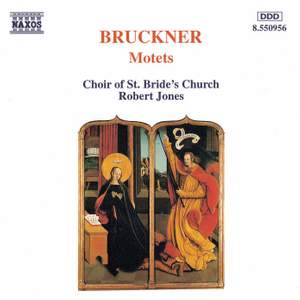
| |  | Bruckner: Motets
Bruckner: | Os justi meditabitur sapientiam Locus iste, WAB 23 Libera me, for choir & organ, WAB 21 Ave Maria (1861), WAB 6 Ecce sacerdos magnus Vexilla regis Salvum fac populum tuum Offertorium: Afferentur regi Pange lingua Tota pulchra es, antiphon, WAB 46 Virga Jesse floruit Inveni David, Gregorian chorale for chorus & organ, WAB 20 Iam lucis orto sidere Tantum ergo in A major, WAB 43 Christus factus est, WAB 10 |
Matthew Morley (organ) St. Bride's Church Choir, Fleet Street, Robert Jones “I can offer nothing but praise to Naxos who, by releasing such exemplary recrodings at super budget price (not to mention the oft-overlooked advantage of this label's wide availability) will hopefully have encourage a larger audience to experience the very real beauty of Bruckner's most intimate creations.” Gramophone Magazine | | | (also available to download from $6.00) | Usually despatched in 2 - 3 working days. (Available now to download.) |
|
|
| |  | Bruckner: Motets
Bruckner: | Os justi meditabitur sapientiam Christus factus est, WAB 11 Ave Maria (1861), WAB 6 Offertorium: Afferentur regi Tantum ergo in D major, WAB 42 Vexilla regis Virga Jesse floruit Locus iste, WAB 23 Ave Maria (1856), WAB 5 Pange lingua Tota pulchra es, antiphon, WAB 46 Ecce sacerdos magnus Libera me, for choir, three trombones & organ, WAB 22 Tantum ergo, 4 motets, WAB 41 |
Eva Danhelová (soprano), Pavla Zborilová (alto), Petr Julícek (tenor), Jirí Vydra (trombone), Jaroslav Zouhar (trombone), Pavel Vydra (trombone), Martin Jakubícek (organ) Czech Philharmonic Choir Brno, Petr Fiala | | | Usually despatched in 2 - 3 working days. |
|
|
| |  |
| | | Usually despatched in 2 - 3 working days. |
|
|
| |
|