Prices shown exclude VAT. (UK tax is not payable for deliveries to United States.) See Terms & Conditions for p&p rates. | |  | Liederabend: Frederica von Stade
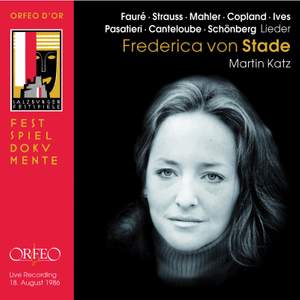
Another favourite of the Salzburg public was the mezzo-soprano Frederica von Stade, who besides her Cherubino in Mozart’s Marriage of Figaro also enjoyed repeated successes in Salzburg with her song recitals. In 1986, accompanied by Martin Katz, she offered a programme that knew no boundaries – ranging from the florid poesy of settings by Fauré and Strauss to Mahler’s Songs of a Wayfarer, the moderate American Modernism of Charles Ives, Copland and Pasatieri, then to Canteloube’s French folk song adaptations. Schoenberg’s early cabaret songs served to round off the evening in ebullient fashion. “the mezzo-soprano on excellent form in a fascinating programme … Katz is a consistently birlliant accompanist and the programme is as absorbing as it is enterprising. Nobody who admires this singer should hesitate for a moment.” International Record Review, December 2012 | | | In stock - usually despatched within 1 working day. |
|
|
| |  | Gerald Finley & Julius Drake
Gerald Finley writes: “It is with great sense of pride that this disc becomes the 25th release of the Wigmore Live series, in a musical partnership I have enjoyed for many years with Julius Drake. Performing at the Wigmore is always a highlight of any career. The others in the series are distinguished performers I have admired for years and the performances are wonderful. The audiences at the Wigmore are always welcoming and knowledgeable, and this atmosphere is captured perfectly. Already a fine catalogue, I hope the Wigmore Live series continues its honour roll” Critically praised for his performances both on stage and in concert, this recital of American and Russian song by Gerald Finley offers listeners the rare opportunity to hear one of today’s most in-demand baritones within the beautiful, intimate setting of the Wigmore Hall. After a recital at Carnegie Hall in March, 2007, Finley was praised by New York Times critic Bernard Holland as having a "bass-baritone of easy luxury" and that his "sensibilities begin with the pre-eminence of words." His recording of Stanford's Songs of the Sea and Songs of the Fleet with Richard Hickox and the BBC NOW for Chandos received the Editor's Choice Award at the 2006 Classic FM Gramophone Awards. Press acclaim for Gerald Finley & Julius Drake at Wigmore Hall “Gerald Finley is one of the few baritones before the public today with whom it's virtually impossible to find fault” Music OMH “No other baritone can touch him for declamatory expressiveness” The Independent “Finley and Drake paced them all tactfully, precisely mediating between relaxed storytelling and rapt introspection. Here was very fine singing of truly great songs” The Guardian “For my money this inspired pianist is now the best in the business” New York Magazine “…a really superb recital by this accomplished Canadian bass-baritone and his celebrated accompanist, Julius Drake. In recent years Gerald Finley's voice has developed more character and cutting power, and a fine dramatic edge which suits this emphatic, sometimes shocking programme very well indeed.” BBC Music Magazine, December 2008 ***** “Gerald Finley can do no wrong at present, and this Wigmore Hall Live offering makes a cherishable keepsake of what was evidently a memorable event. …Finley lavishes wonderfully rounded treatment upon the sequence of seven Tchaikovsky songs… Not only do his top notes ring out with thrilling projection... he exhibits grace, sensitivity and intelligence that ensure that the music never topples into rampant self-pity.” Gramophone Magazine, February 2009 “Aided by scrupulous support from Julius Drake, Gerald Finley lavishes wonderfully rounded treatment upon the sequence of seven Tchaikovsky songs that open proceedings. Be it in the ardent swagger of 'Don Juan's Serenade', wistful glow of 'At the ball' or meltingly lovely 'The mild stars shone for us', Finley is not found wanting. Not only do his top notes ring out with thrilling projection (yet without a hint of hardness), he exhibits a grace, sensitivity and intelligence that ensure that the music never topples into rampant self-pity. There's a comparable authority and integrity about these artists' interpretation of Mussorgsky's Songs and Dances of Death. Finley is in complete command of his very considerable resources, distilling every ounce of pathos from the mother's desperate pleadings in the opening 'Lullaby' and conveying in full the grim implacability of 'The Field-Marshal' . Ned Rorem's similarly declamatory War Scenes is also performed with total understanding, while the last of the three encores, Wolseley Charles's wickedly amusing TheGreen-Eyed Dragon (written in 1926 for Stanley Holloway), predictably brings the house down. A genuine treat, this, and not to be missed.” Gramophone Classical Music Guide, 2010 | | | In stock - usually despatched within 1 working day. |
|
|
| |  | Voices of our Time - Dawn UpshawA Contemporary Songs Selection
| | | In stock - usually despatched within 1 working day. |
|
|
| |  | Charles Ives: A Songbook
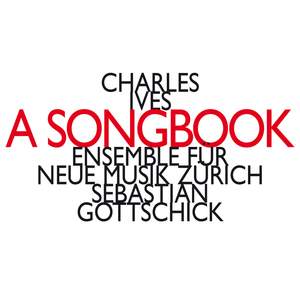
Jeannine Herzel (mezzo) & Omar Ebrahim (baritone) Ensemble für Neue Musik Zürich, Sebastian Gottschick "Sebastian Gottschick’s adaptations of Ives’ songs and short instrumental pieces in this sense not only pay homage to the composer but develop his work further. The multifaceted ensemble and the instrumentation Gottschick chose allow him to be highly differentiated in his approach to the specific Ives sound that oscillates between crude realism and symbolist fragmentation: he either deliberately avoids this sound (for instance by using a vibraphone in Grantchester) or he pushes it to the point of prismatic refraction. Apart from this, Gottschick’s selection proceeds in a continuous, multi-perspective order that can be interpreted as a drama en miniature, a model of an ordinary day from the snatches of dreams in the morning to the falling night, and finally also as the epitome of the diversity of life itself. Behind all that the power and intangible nature of memories, Ives’ lifelong theme, becomes visible and audible." Wolfgang Rathert “Creative decisions have been taken about where to place Ives's songs in relation to each other, this new concept designed to illuminate our understanding of the time and place that begat them...both singers are...sympathetic and technically bulletproof” Gramophone Magazine, May 2013 | 
| | | Usually despatched in 3 - 4 working days. |
|
|
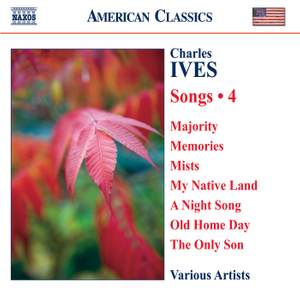
| |  | Ives - Songs Volume 4
Lielle Berman, Patrick Carfizzi, Jennifer Casey Cabot, Michael Cavalieri, Robert Gardner, Ian Howell, Sara Jakubiak, Sumi Kittelberger, Ryan MacPherson, Tamara Mumford, Mary Phillips, David Pittsinger, Matthew Plenk, Kenneth Tarver, Leah Wool, Enrico Sartori, Douglas Dickson, Laura Garritson, J.J. Penna & Eric Trudel Charles Ives wrote almost two hundred songs. Although his reputation rests on orchestral, chamber and piano music, it is Ives's songs that represent the heart of his creative thinking. The expressive variety encountered is accordingly vast: indeed, the gradual evolution of Ives’s songwriting is analogous to the wider evolution of American music during the late nineteenth and early twentieth centuries. This new edition includes all the songs that Ives completed. The alphabetic approach ensures that each volume (of which this disc is the fourth of six) contains a representative cross-section. “These songs, with all their quirks and flights of fantasy, [are] among the most important of the 20th century in any language.” The Guardian | | | (also available to download from $6.00) | Usually despatched in 2 - 3 working days. (Available now to download.) |
|
|
| |  | A Song For AnythingSongs by Charles Ives
“The Canadian baritone Gerald Finley has a voice of great beauty, but it's always under the control of his penetrating intelligence: he risks bending pitches for expressive effect, and he adapts his golden timbre and almost English diction to the childlike tones of The Greatest Man and the cowboy drawl of Charlie Rutlage. Julius Drake is an equally versatile pianist, adept alike in simplicity and complexity.” BBC Music Magazine, September 2005 ***** “These songs, drawn from Ives's 200, can encourage at one extreme a rough declamatory style and at the other an almost voiceless intimacy. Without in any way underplaying, Finlay is always essentially a singer – his tone and command of the singing line are a pleasure in themselves. But he also has the absolute mastery of the composer's idioms and, with Julius Drake, his fearless and totally committed pianist, the technical, virtuosic skills to realise his intentions with (amid all the quirks) complete conviction of naturalness. This is a selection that very satisfactorily balances early and late, rumbustious and contemplative. Several of the early German settings are included, always beautiful and always develop- ing with some touch that is entirely personal. Of a quite distinctive beauty are those like Remembrance, Berceuse, and The Housatonic at Stockbridge where voice and piano work a dreamy, misty spell. And still more characteristic are the settings of his own verses evoking memories of childhood. The 'character' songs (such as Charlie Rutlage) and the 'big' numbers (GeneralWilliam Booth Enters into Heaven) become less prominent than they commonly seem in a recital group where they are programmed as an effective tour de force. The total impression is of an astonishing individuality and, more importantly, of a completely honest, dauntless and increasingly to be valued musical identity.” Gramophone Classical Music Guide, 2010 | | | Usually despatched in 2 - 3 working days. |
|
|
| |  | The Art of Susan Graham
Berg: | Sieben frühe Lieder | Berlioz: | La Damnation de Faust, Op. 24: Chanson gothique 'Autrefois un roi de Thulé' Dieu! Que viens-je d'entendre?…Il m'en souvient ... Je l'aime donc? (from Béatrice et Bénédict) | Brahms: | He, Zigeuner, greife in die Saiten ein! (No. 1 from Zigeunerlieder, Op.103) Hochgetürmte Rimaflut, wie bist du trüb (No. 2 from Zigeunerlieder, Op.103) Wißt ihr, wann mein Kindchen am allerschönsten ist? (No. 3 from Zigeunerlieder, Op.103) Lieber Gott, du weißt, wie oft bereut ich hab' (No. 4 from Zigeunerlieder, Op.103) Brauner Bursche führt zum Tanze (No. 5 from Zigeunerlieder, Op.103) Röslein dreie in der Reihe blühn so rot (No. 6 from Zigeunerlieder, Op.103) Kommt dir manchmal in den Sinn (No. 7 from Zigeunerlieder, Op.103) Rote Abendwolken ziehn am Firmament (No. 8 from Zigeunerlieder, Op.103) | Chausson: | Poème de l'amour et de la mer, Op. 19 | Debussy: | Proses Lyriques Fantoches Songs from Le livre de Baudelaire | Gluck: | O del mio dolce ardor (from Paride ed Elena) Non, je n'espere plus... O toi qui prolongeas mes jours (from Iphigénie en Tauride) O malheureuse Iphigenie! (from Iphigénie en Tauride) Non, cet affreux devoir... Je t'implore et je tremble (from Iphigénie en Tauride) Qu'entends-je? Qu'a-t-il dit?... Amour, viens rendre a mon ame (from Orphée et Eurydice) J'ai perdu mon Eurydice (from Orphée et Eurydice) | Hahn, R: | A Chloris O mon bel inconnu: 'O mon bel inconnu' Brummell: 'Air de la Lettre' Mozart: 'Etre adore' O mon bel inconnu: 'C'est tres vilain d'etre infidele' Ciboulette: 'C'est pas Paris, c'est sa banlieue' | Handel: | Di te mi rido (from Alcina) Mi lusinga il dolce affetto (from Alcina) | Heggie: | Who will walk with me? (from Dead Man Walking) He will gather us around (from Dead Man Walking) | Honegger: | Les Aventures du roi Pausole: 'Si vous saviez' | Ives, C: | The Things our Fathers Loved The Housatonic at Stockbridge Swimmers Memories: (A) Very Pleasant; (B) Rather Sad Ann Street Serenity ‘1, 2, 3' Songs My Mother Taught Me The Circus Band The Cage The Indians Like a Sick Eagle September Soliloquy, or a Study in 7ths and Other Things Farewell to Land Thoreau | Mahler: | Liebst Du um Schönheit (Rückert-Lieder) | Messager: | L'Amour masque: 'J'ai deux amants' Fortunio: 'Je ne vois rien..Lorsque je n'etais qu'une enfant' Coups de roulis: 'Les hommes sont biens tous les memes' Passionnement: 'L'amour est un oiseau rebelle' Les P'tites Michu: 'Vois-tu, je m'en veux' La Petite Fonctionnaire: 'Je regrette mon Pressigny' Les Dragons de l"Imperatrice: 'Amour, amour, quel est donc ton pouvoir' L'Amour masque: 'Mon reve' | Moore, B: | Sexy Lady | Mozart: | Non so più cosa son, cosa faccio (from Le nozze di Figaro) Parto, parto, ma tu ben mio (from La Clemenza di Tito) Voi che sapete (from Le nozze di Figaro) Deh, per questo istante solo (from La Clemenza di Tito) Non ho colpa (from Idomeneo) Dunque Sperar Poss'io...Il Tenero Momento (from Lucio Silla) | Poulenc: | Quatre poemes de Guillaume Apollinaire | Ravel: | Shéhérazade | Rorem: | Sonnet (Santa Fe Songs) Clouds Early in the morning The Serpent Now Sleeps the Crimson Petal Opus 101 (Santa Fe Songs) I Strolled Across an Open Field To a Young Girl Jeanie with the Light Brown Hair Ode For Poulenc Little Elegy Alleluia Look down fair moon O you to whom I often and silently come I will always love you The Tulip Tree The Wintry Mind (Santa Fe Songs) I am Rose The Lordly Hudson O Do Not Love Too Long Far-Far-Away For Susan A Journey Sometimes with one I love Love Orchids Stopping by Woods on a Snowy Evening Do I love you more than a day? Ferry Me Across the Water The Sowers (Santa Fe Songs) That shadow, my likeness | Simons, Moises: | Toi c'est moi: 'C'est ca la vie, c'est ca l'amour' Toi c'est moi: 'Vagabonde' | Yvain: | Yes: 'Yes' |
| | | Usually despatched in 4 - 5 working days. |
|
|
| |
|