All recordingsPrices shown exclude VAT. (UK tax is not payable for deliveries to United States.) See Terms & Conditions for p&p rates. | |  | Der heitere LoeweThe Lighter Side of Loewe
Loewe, C: | Der Spaziergang, Op. 9 No. 4 Der Apotheker als Nebenbuhler, Op. 9 No. 6 Die Verliebte Schaeferin, Op. 9 No. 3 Süßes Begräbnis, Op. 62 No. 4 Hinkende Jamben, Op. 62 No. 5 Der Zahn Die Heinzelmännchen, Op. 83 Der Papagei, Op. 111 Wer ist Baer?, Op. 64 No. 4 Rüberettich Findlay Beim Maitrank Der junge Herr und das Mädchen, Op. 50 No. 2 Frau Twardowska, Op. 51 Der verliebte Maikäfer, Op. 64 No. 1 Der Kuckuck, Op. 64, No. 2 Vogelsang, Op. 9 No. 3 Die Katzenkönigin, Op. 64 No. 3 Zeislein, Op. 62 No. 1 Der Gesang, Op. 56 No. 2 Kleiner Haushalt, Op. 71 O süße Mutter, Op. 62 No. 3 Schwalbenmärchen, Op. 68 No. 1 Die Zugvögel, Op. 74 Der heilige Franziskus, Op. 75 No. 3 Der Feind (Der Marsch), Op. 145 No. 2 An die Grille St. Johannes und das Wuermlein, Op. 35 No. 1 Trommelständchen, Op. 132 No. 2 Prinz Eugen, der edle Ritter, Op. 92 Abendlied, Op. 62 No. 1 |
Wolfgang Anheisser (baritone) & Gunther Weissenborn (piano) On this CD reissue, five songs are added to the original collection that were omitted from the LP owing to the limited playing time. They appear for the first time. "Musicality, creativity, sensitivity and emotional involvement" – these were the qualities attributed to the Baritone Wolfgang Anheisser even at the outset of his tragically brief career, and they made him one of the most interesting Loewe interpreters. | | | In stock - usually despatched within 1 working day. |
|
|
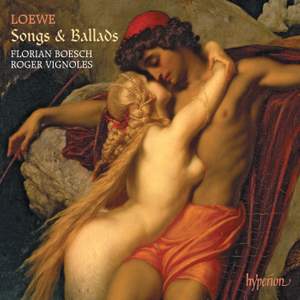
| |  | Carl Loewe: Songs & Ballads
Loewe, C: | Edward, Op. 1 No. 1 (Herder) Tom der Reimer "Der Reimer Thomas lag am Bach", Op. 135a Der Erlkönig, Op. 1 No. 3 (Goethe) Herr Oluf "Herr Oluf reitet spät und weit", Op. 2/2 Wandrers Nachlied, Op. 9 No. 3a Wandrers Nachlied, Op. 9 No. 3b Graf Eberstein Lynceus der Turmer, auf Fausts Sternwarte singend, Op. 9, H.VIII, 3 Süßes Begräbnis, Op. 62 No. 4 Hinkende Jamben, Op. 62 No. 5 Die wandelnde Glocke, Op. 20 No..3 Im Vorübergehen, Op. 81, No. 1 arr. Fritz Der Pilgrim vor St Just, Op. 99, No. 3 Odins Meeresritt "Meister Oluf, der Schmied auf Helgoland", Op. 118 Die Uhr, Op. 123 No. 3 Der Wirthin Töchterlein, Op. 1, No. 2 Meeresleuchten, Op. 145 No. 1 Im Sturme, Op. 145, No. 3 Heimlichkeit, Op. 145, No. 4 Reiterlied, Op. 145, No. 5 |
In his lifetime the German composer Carl Loewe was often referred to as the ‘Schubert of North Germany’. He is frequently credited with the development of the romantic ballad into a powerful art form, and his prolific output of ballads and songs amounts to some four hundred works. Loewe’s treatment of long narrative poems in a clever and powerful mixture of dramatic and lyrical styles, has been a template for many subsequent composers. Many of the ballads on this disc are masterpieces of their genre and they are performed here in a magisterial Hyperion debut by Austrian baritone Florian Boesch. In these refined performances it is clear why Boesch has been labelled as ‘one of the finest interpreters of Lieder of his generation’. His ability to create characters and enact stories brings the dramatic texts vividly to life, while he maintains musical coherence with astonishing lyricism. Loewe’s daring and imaginative accompaniments are played here by the incomparable Roger Vignoles, in another addition to his acclaimed discography of Hyperion recordings. His eloquent pianism and penetrating musicianship match Boesch’s artistry to perfection. “Boesch is arguably [Loewe's] finest interpreter today, and this disc is mesmerising. An expressionistic vocal actor, Boesch has the ability to change the sound of his voice to fit the character he is portraying; when he gets to the big dialogues like Erlkönig, Edward or Herr Oluf, it's hard to believe that only one person is singing...A benchmark recording, and essential listening.” The Guardian, 12th May 2011 ***** “Loewe is at his best when the drama of a ballad unfolds through the characters' words, and his 'Erlkönig', though less terrifying than Schubert's, is more chilling: the child's death is a greater musical shock....Boesch sings these ballads with strong dramatic sympathy...Vignoles's accompaniment is always confident, very musical and perceptive.” International Record Review, May 2011 “Boesch's performance...demonstrates huge imaginative variety in characterisation (offering two different voices when necessary, or even three in Loewe's setting of Erlkonig), and moving convincingly to the lower register...Vignoles matches him in playing of perception in what is pretty well an ideal introduction to a fascinating figure.” BBC Music Magazine, July 2011 ***** “Loewe's writing is perhaps less sophisticated than Schubert's but, like him, he had a supremely appealing melodic gift...As for the singing, I cannot praise it too highly. Florian Boesch has a warmly attractive baritone voice and his diction is first class, as is his response to the word meanings. Roger Vignoles's accompaniments, too, give great pleasure in themselves, especially in the pictorial devices which Loewe so relishes.” Gramophone Magazine, August 2011 | | | In stock - usually despatched within 1 working day. |
|
|
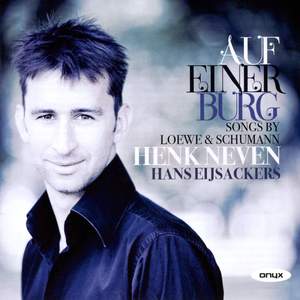
| |  | Auf Einer Burg
Loewe, C: | Wandrers Nachlied, Op. 9 No. 3b Hinkende Jamben, Op. 62 No. 5 Odins Meeresritt "Meister Oluf, der Schmied auf Helgoland", Op. 118 Süßes Begräbnis, Op. 62 No. 4 Herr Oluf "Herr Oluf reitet spät und weit", Op. 2/2 Der selt'ne Beter op. 141 Tom der Reimer "Der Reimer Thomas lag am Bach", Op. 135a Edward, Op. 1 No. 1 (Herder) Der Pilgrim vor St Just, Op. 99, No. 3 Die Uhr, Op. 123 No. 3 | Schumann: | Liederkreis, Op. 39 |
Henk Neven (baritone) & Hans Eijsackers (piano) Henk Neven studied with Maarten Koningsberger and Margreet Honig at the Conservatory of Amsterdam where he graduated cum laude in 2003. In 2002 he received a diploma cum laude from the New Opera Academy. He followed masterclasses with Graham Johnson, Graham Clark, Rudolf Jansen, Hartmut Höll, Jard van Nes and Robert Holl. He was awarded a Borletti-Buitoni Fellowship in 2009, and is a BBC New Generation Artist 2009-2011. Henk Neven has performed at the BBC Proms and at the Wigmore Hall. He also has a busy career in the opera houses of Europe, including Leporello in Don Giovanni in De Doelen Rotterdam, Patrocle in Iphigénie en Tauride by Gluck at La Monnaie in Brussels, Ottokar in Der Freischütz in Theater an der Wien, Mercutio in Roméo et Juliette at De Nederlandse Opera and Gralritter in Parsifal in Het Concertgebouw Amsterdam. As a recitalist he will appear with Hans Eijsackers in de ‘Vocale Serie’ of Het Concertgebouw, La Monnaie Brussels and de Beurs van Berlage Amsterdam. This is his debut recording, and he has selected Lieder by Carl Loewe to programme with Schumann’s Liederkreis op22, repertoire he loves performing. Neven is a major new vocal talent. “Neven’s highly individual timbre is unlike any other lieder interpreter’s; he sings with astonishing technical finesse, verbal acuity and a youthful sense of wonder in these pieces from Schumann’s annus mirabilis of song, 1840...Eijsackers’s virtuoso piano-playing only enhances this remarkable young singer’s outstanding debut.” Sunday Times, 17th April 2011 **** “His gift of bringing out word-meaning is enhanced by the clearest possible diction and by the beautifully balanced recording. His shading of dynamics and phrasing then crowns each interpretation. It is a consistent joy to hear a Lieder singer whose tone is pure over the widest range without a trace of roughness...It is a long time since I enjoyed a disc of Lieder from a young singer quite as much as this, and I long to hear more from him.” Gramophone Magazine, July 2011 “[Neven] has a beautiful voice, flexible, rounded and warm, and sings, always in the middle of the note, with much intelligence and no affectation...both Neven and his excellent accompanist Hans Eijsackers manage almost to avoid sentimentality” International Record Review, July 2011 “Neven possess a lightly textured, attractive voice, and his diction is focused and expressive” BBC Music Magazine, July 2011 *** | | | In stock - usually despatched within 1 working day. |
|
|
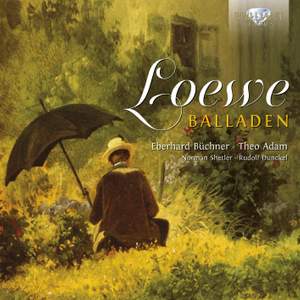
| |  | Loewe: Balladen
Loewe, C: | Des Goldschmieds Tochterlein Der Wirthin Töchterlein, Op. 1, No. 2 Der Erlkönig, Op. 1 No. 3 (Goethe) Der Nöck, Op. 129 No. 2 Heinrich der Vogler, Op. 56 No. 1 Die Heinzelmännchen, Op. 83 Der verliebte Maikäfer, Op. 64 No. 1 Die Uhr, Op. 123 No. 3 Prinz Eugen, der edle Ritter, Op. 92 Süßes Begräbnis, Op. 62 No. 4 Tom der Reimer "Der Reimer Thomas lag am Bach", Op. 135a |
Theo Adam (bass), Eberhart Buchner (tenor), Rudolf Dunckel (piano), Norman Shetler (piano) Carl Loewe was born in Löbejün, studied in Halle, toured through Germany in his mid-20s and then secured an appointment as professor and Kantor at the Gymnasium and seminary in Stettin (formerly in Prussia, now in Poland), where he remained for the rest of his life. A contemporary of Schubert, he was a central figure in Stettin's musical life, and was a prolific composer of songs and oratorio to cater for the increasing musical appetite of the late-19th-century German bourgeoisie. Loewe is today remembered for his treatment of the ballad, a relatively new genre at that time which took the form of a lengthy story comprising many verses, characters and dramatic events. Country life, olden or idealised times, love and the passing of time are often the subject matter for his works, which are set to a variety of then-contemporary poets ranging from classical masters Rückert and Schiller to more forward-looking ones such as Chamisso - while Prinz Eugen (1844) recounts the victory of Prince Eugen of Savoy during the Austro-Turkish War of 1716-18, for instance, Süßes Begräbnis describes the final resting place of a shepherdess (1837). Also included on the release is Loewe's intimate setting of Goethe's Erlkönig, a direct contrast to Schubert's infamous and much more extrovert rendition of the text, composed just one year earlier. Performing these often over-looked works are the tenor and bass singers Eberhard Büchner and Theo Adam, accompanied by Norman Shetler and Rudolf Dunckel respectively. The two duos cover all manner of moods in what are highly atmospheric pieces, and in doing so offer a strong case for why Loewe - nicknamed the 'Schubert of North Germany' in his day - deserves to be better known. | 
| | | Scheduled for release on 24 June 2013. Order it now and we will deliver it as soon as it is available. |
|
|
| |
|